2,281 posters, 63 videos, 56 audios, 43 topics, 18 sessions, 6,174 authors, 2,323 institutions
ePostersLive by SciGen Technologies S.A. All rights reserved.
RCOG World Congress 2025
June 23 - 25, 2025 | ExCeL London, UK
EP.0253
Suspected ovarian ectopic in IUCD user – a case report and literature review.
Poster Presenter
Part of Topic
Early pregnancy complications/early pregnancy and acute gynaecology
Suspected ovarian ectopic in IUCD user – a case report and literature review.
Objective:
This case report looks to explore the risk factors, diagnosis and management of ovarian ectopic.
Case report:
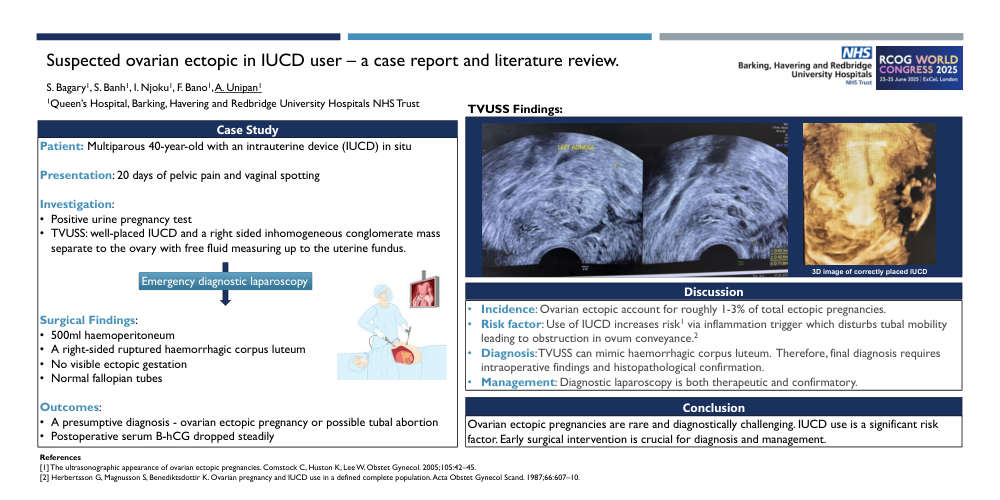
We report the case of a multiparous 40-year-old female with an intrauterine device presenting with significant pelvic pain and presence of vaginal blood spotting over 20 days. She tested positive on urine pregnancy test at our gynaecology emergency department. Transvaginal ultrasound showed a well-placed IUCD and a right sided inhomogeneous conglomerate mass separate to the ovary with free fluid measuring up to the uterine fundus. An emergency diagnostic laparoscopy was performed which revealed 500ml haemoperitoneum and a right-sided ruptured haemorrhagic corpus luteum. No overt ectopic pregnancy was identified and both fallopian tubes appeared normal. A presumptive diagnosis of ovarian ectopic pregnancy was made or possible tubal pregnancy abortion. The patient was followed up for serial serum bHCG, which began to drop following surgery.
Discussion:
Ovarian ectopic accounts for roughly 1 –3% of total ectopic pregnancies [1] and is highly associated with the use of IUCD. Mild inflammation triggered by IUCD disturbs tubal motility leading to obstruction in ovum conveyance [2]. Their presentation can be delayed due to the increased accommodating capacity of the ovary for a pregnancy in comparison to the fallopian tubes. The primary diagnostic tool is transvaginal sonography; however, exact diagnosis is challenging as ultrasonic appearances mimic the appearances of a physiological corpus luteum or haemorrhagic ovarian cyst. Therefore, final diagnosis requires intraoperative findings and histopathological confirmation.
Conclusions:
Preoperative diagnosis of ovarian ectopic is very challenging, with the most important risk factor being the use of IUCD as shown in this study. Surgical intervention is the recommended first-line option, having both diagnostic and therapeutic values.
References:
[1] The ultrasonographic appearance of ovarian ectopic pregnancies. Comstock C, Huston K, Lee W. Obstet Gynecol. 2005;105:42–45.
[2] Herbertsson G, Magnusson S, Benediktsdottir K. Ovarian pregnancy and IUCD use in a defined complete population. Acta Obstet Gynecol Scand. 1987;66:607–10.