2,281 posters, 63 videos, 56 audios, 43 topics, 18 sessions, 6,174 authors, 2,323 institutions
ePostersLive by SciGen Technologies S.A. All rights reserved.
RCOG World Congress 2025
June 23 - 25, 2025 | ExCeL London, UK
EP.0247
Haemophilus Influenzae Causing a Tubo-Ovarian Abscess: a Case Report
Poster Presenter
Authors
Affiliations
Part of Topic
Early pregnancy complications/early pregnancy and acute gynaecology
Haemophilus Influenzae Causing a Tubo-Ovarian Abscess: a Case Report
Objective: We describe a rare case of Haemophilus influenzae causing a Tubo-ovarian Abscess (TOA).
Case Report:
A 47-year-old female presented with a 2-week history of sharp lower abdominal pain. She denied any fevers or abnormal vaginal discharge. She had no other past medical or surgical history. She was sexually active with one stable male partner who had had a vasectomy.
On examination: She was hemodynamically stable (BP 157/87 mmHg, HR 101 bpm) and afebrile (36.2°C). Her abdomen was soft with minimal lower quadrant tenderness.
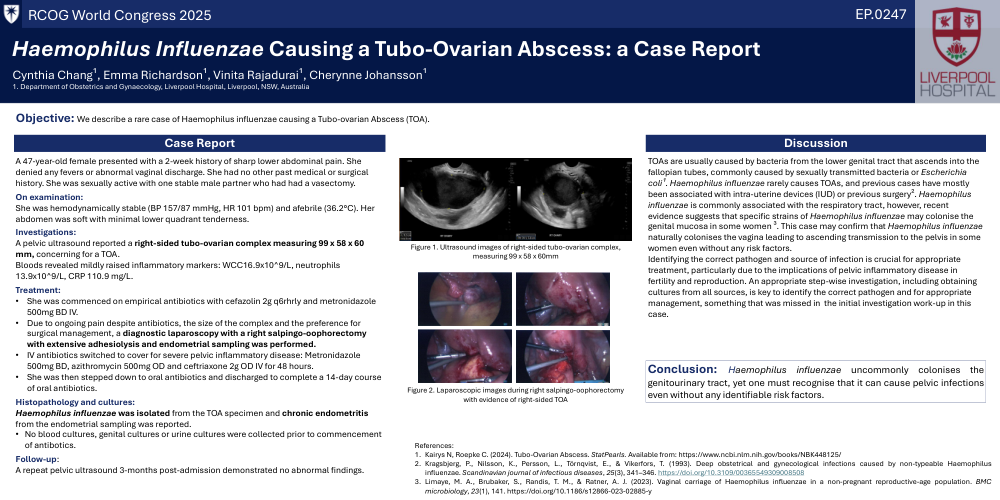
Investigations: A pelvic ultrasound reported a right-sided tubo-ovarian complex measuring 99 x 58 x 60 mm, concerning for a TOA. Bloods revealed mildly raised inflammatory markers: WCC16.9x10^9/L, neutrophils 13.9x10^9/L, CRP 110.9 mg/L.
Treatment: She was commenced on empirical antibiotics with cefazolin 2g q6rhrly and metronidazole 500mg BD IV. Due to ongoing pain despite antibiotics, the size of the complex and the preference for surgical management, a diagnostic laparoscopy with a right salpingo-oophorectomy with extensive adhesiolysis and endometrial sampling was performed. IV antibiotics switched to cover for severe pelvic inflammatory disease: Metronidazole 500mg BD, azithromycin 500mg OD and ceftriaxone 2g OD IV for 48 hours. She was then stepped down to oral antibiotics and discharged to complete a 14-day course of oral antibiotics.
Histopathology and cultures: Haemophilus influenzae was isolated from the TOA specimen and chronic endometritis from the endometrial sampling was reported. No blood cultures, genital cultures or urine cultures were collected prior to commencement of antibotics.
Follow-up: A repeat pelvic ultrasound 3-months post-admission demonstrated no abnormal findings.
Discussion: TOAs are usually caused by bacteria from the lower genital tract that ascends into the fallopian tubes, commonly caused by sexually transmitted bacteria or Escherichia coli¹. Haemophilus influenzae rarely causes TOAs, and previous cases have mostly been associated with intra-uterine devices (IUD) or previous surgery². Haemophilus influenzae is commonly associated with the respiratory tract, however, recent evidence suggests that specific strains of Haemophilus influenzae may colonise the genital mucosa in some women ³. This case may confirm that Haemophilus influenzae naturally colonises the vagina leading to ascending transmission to the pelvis in some women even without any risk factors. Identifying the correct pathogen and source of infection is crucial for appropriate treatment, particularly due to the implications of pelvic inflammatory disease in fertility and reproduction. An appropriate step-wise investigation, including obtaining cultures from all sources, is key to identify the correct pathogen and for appropriate management, something that was missed in the initial investigation work-up in this case.
Conclusion: Haemophilus influenzae uncommonly colonises the genitourinary tract, yet one must recognise that it can cause pelvic infections even without any identifiable risk factors