2,281 posters, 63 videos, 56 audios, 43 topics, 18 sessions, 6,174 authors, 2,323 institutions
ePostersLive by SciGen Technologies S.A. All rights reserved.
RCOG World Congress 2025
June 23 - 25, 2025 | ExCeL London, UK
EP.0246
Mirror Syndrome and Pre-Eclampsia, Similarities and their Co-Existence
Poster Presenter
Authors
Affiliations
Part of Topic
Early pregnancy complications/early pregnancy and acute gynaecology
Mirror Syndrome and Pre-Eclampsia, Similarities and their Co-Existence
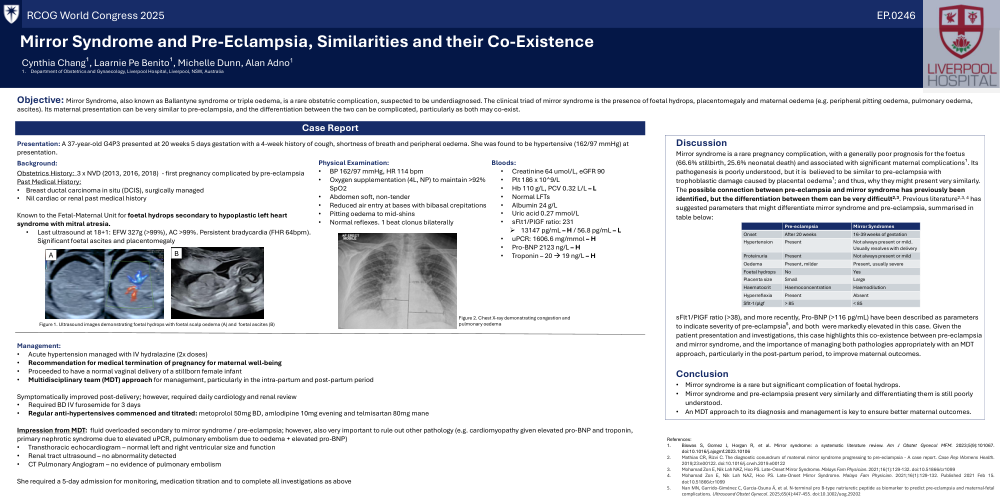
Objective: Mirror Syndrome, also known as Ballantyne syndrome or triple oedema, is a rare obstetric complication, suspected to be underdiagnosed. The clinical triad of mirror syndrome is the presence of foetal hydrops, placentomegaly and maternal oedema (e.g. peripheral pitting oedema, pulmonary oedema, ascites). Its maternal presentation can be very similar to pre-eclampsia, and the differentiation between the two can be complicated, particularly as both may co-exist.
Discussion: Mirror syndrome is a rare pregnancy complication, with a generally poor prognosis for the foetus (66.6% stillbirth, 25.6% neonatal death) and associated with significant maternal complications¹. Its pathogenesis is poorly understood, but it is believed to be similar to pre-eclampsia with trophoblastic damage caused by placental oedema¹; and thus, why they might present very similarly. The possible connection between pre-eclampsia and mirror syndrome has previously been identified, but the differentiation between them can be very difficult2,3. Previous literature2,3, 4 has suggested parameters that might differentiate mirror syndrome and pre-eclampsia.
sFlt1/PlGF ratio (>38), and more recently, Pro-BNP (>116 pg/mL) have been described as parameters to indicate severity of pre-eclampsia⁵, and both were markedly elevated in this case. Given the patient presentation and investigations, this case highlights this co-existence between pre-eclampsia and mirror syndrome, and the importance of managing both pathologies appropriately with an MDT approach, particularly in the post-partum period, to improve maternal outcomes.
Conclusion: Mirror syndrome is a rare but significant complication of foetal hydrops. Mirror syndrome and pre-eclampsia present very similarly and differentiating them is still poorly understood. An MDT approach to its diagnosis and management is key to ensure better maternal outcomes.