2,281 posters, 63 videos, 56 audios, 43 topics, 18 sessions, 6,174 authors, 2,323 institutions
ePostersLive by SciGen Technologies S.A. All rights reserved.
RCOG World Congress 2025
June 23 - 25, 2025 | ExCeL London, UK
PP.0123
Duration of cryo-storage and survival rates, implantation potential of vitrified human embryos
Poster Presenter
Authors
Neeta Singh, Neena Malhotra, Reeta Mahey, Monika Saini, Supriya Kumari
Affiliations
Part of Topic
Reproductive medicine/assisted reproduction
Title:Duration of cryo-storage andsurvival rates, implantation potential of vitrified human embryos-10-year single Centre study
Objective: To evaluate the effect of long- term cryopreservation of embryos on the survival rate, implantation rate and neonatal outcomes of FET cycles
Rationale: Does prolong cryo-storage of Embryos have any impact on the live-births & neonatal outcomes following transfer of these embryos?
Design: After obtaining institutional ethics committee approval, a single center retrospective cohort study was conducted at a tertiary care hospital.
Materials &methods: Women who underwent frozen embryo transfers between January 2014 -December 2023 were included. The data was extracted from hospital medical records i.e., baseline characteristics, cycle details, embryological details and cycle outcomes. Frozen Embryo Cycles (FET) were divided into four groups based on the duration of embryo cryopreservation as <3 months, 3 months to 6 months, 6 months to 1 year, 1 to 3 years and > 3 years. Primary outcome was Live birth rate (LBR), defined as the proportion of cycles leading to at least one live-born child at >24 weeks gestation. Secondary outcomes included clinical pregnancy rate (CPR) and neonatal outcomes. Statistical analysis was performed using SPSS software.
Results
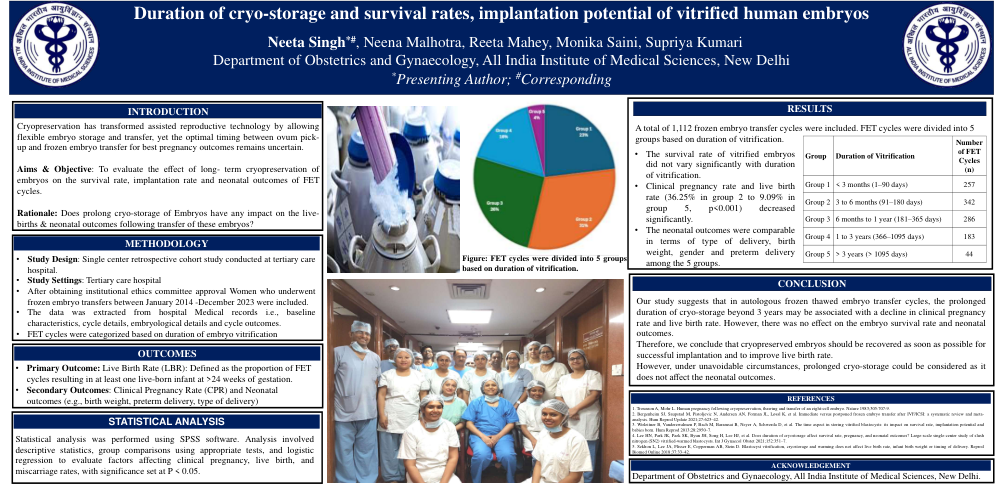
A total of 1,112 frozen embryo transfer cycles were included. FET cycles were divided into 5 groups based on duration of vitrification. Group 1 (n = 257), 1–90 days; Group 2 (n = 342), 91–180 days; Group 3 (n = 286), 181–365 days; Group 4 (n = 183), 366–1095 days; and Group 5 (n = 44), > 1095 days. The survival rate of the vitrified embryos did not vary significantly with the duration of vitrification. However, the clinical pregnancy rate and live birth rate (36.25% in group 2 to 9.09% in group 5, p<0.001) decreased significantly. The neonatal outcomes were comparable in terms of type of delivery, birth weight, gender and preterm delivery among the 5 groups. A multivariate logistic regression analysis was performed to eliminate the potential effects of confounders and the final results were consistent with the previous results.
Conclusion
Our study suggests that in autologous frozen thawed embryo transfer cycles, the prolonged duration of cryo-storage beyond 3 years may be associated with a decline in clinical pregnancy rate and live birth rate. However, there was no effect on the embryo survival rate and neonatal outcomes. Therefore, we conclude that cryopreserved embryos should be recovered as soon as
possible for successful implantation and to improve live birth rate. However, under unavoidable circumstances, prolonged cryo-storage could be considered as it does not affect the neonatal outcomes.