2,281 posters, 63 videos, 56 audios, 43 topics, 18 sessions, 6,174 authors, 2,323 institutions
ePostersLive by SciGen Technologies S.A. All rights reserved.
RCOG World Congress 2025
June 23 - 25, 2025 | ExCeL London, UK
PP.0122
Reproductive Carrier Screening: Benefits for Reproduction and for Maternal Health
Poster Presenter
Part of Topic
Reproductive medicine/assisted reproduction
Reproductive Carrier Screening: Benefits for Reproduction and for Maternal Health
Vivienne Souter (1), Eugenia Martinez Jaime (1), Samantha Leonard (1), Asma Khalil (2), Elizabeth Repass (1), Yang Wang (1), Erin M Armenti (1), Victoria Blank (1), Jessica L Saben (1), Ashley Cantu-Weinstein (1), Peter Benn (3)
1. Natera, Inc., Austin, TX, USA 2. St George’s Hospital, City St George’s University of London, London, UK 3. UCONN Health, Farmington, CT, USA
Introduction
The American College of Medical Genetics and Genomics (ACMG) recommends offering all pregnant individuals and those planning pregnancy a pan-ethnic, 113-gene (‘Tier 3’) carrier screening panel.
We reviewed our experience with this panel.
Methods
Retrospective study
Cohort: women aged 18–55 with samples submitted to a commercial lab (01/2023– 08/2024) for carrier screening including ACMG-Tier 3 genes
The Tier 3 panel comprises 113 genes (97 autosomal recessive, 16 X-linked conditions).
Pathogenic or likely pathogenic (P/LP) variants were identified primarily via next-generation sequencing.
We calculated carrier frequencies, and estimated at-risk and affected pregnancy rates.
Carrier frequencies for genes relevant to maternal health and reproductive risk were also analyzed.
Results
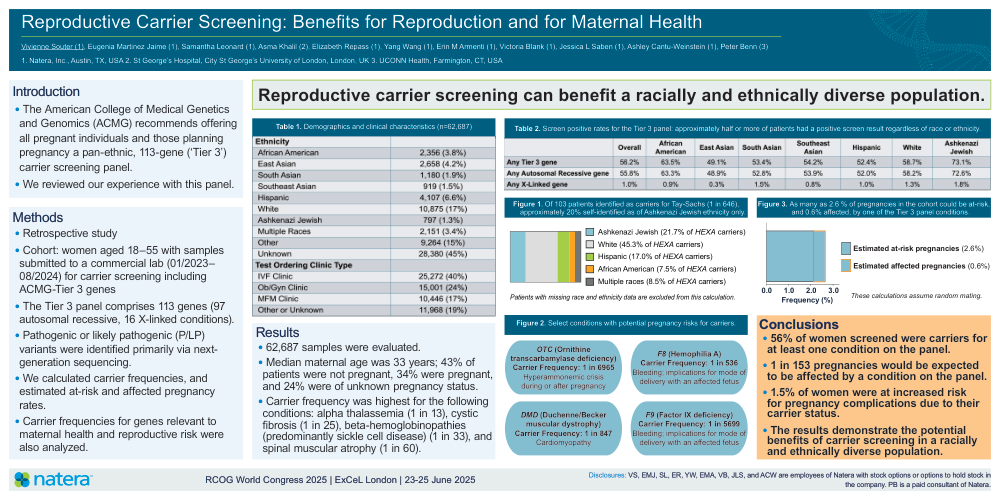
62,687 samples were evaluated.
Median maternal age was 33 years; 43% of patients were not pregnant, 34% were pregnant, and 24% were of unknown pregnancy status.
Carrier frequency was highest for the following conditions: alpha thalassemia (1 in 13), cystic fibrosis (1 in 25), beta-hemoglobinopathies (predominantly sickle cell disease) (1 in 33), and spinal muscular atrophy (1 in 60).
Conclusions
56% of women screened were carriers for at least one condition on the panel.
1 in 153 pregnancies would be expected to be affected by a condition on the panel.
1.5% of women were at increased risk for pregnancy complications due to their carrier status.
The results demonstrate the potential benefits of carrier screening in a racially and ethnically diverse population.