2,281 posters, 63 videos, 56 audios, 43 topics, 18 sessions, 6,174 authors, 2,323 institutions
ePostersLive by SciGen Technologies S.A. All rights reserved.
RCOG World Congress 2025
June 23 - 25, 2025 | ExCeL London, UK
PP.0117
The potential to weaponise accusations of female genital cutting/mutilation in children
Poster Presenter
Authors
Affiliations
Part of Topic
Adolescent gynaecology
The potential to weaponise an accusation of female genital cutting/mutilation in children
Objective
Female Genital Cutting/Mutilation (FGCM) is defined as any procedure whereby there is partial or total removal, or other injury to the external female genitalia, which is not medically necessary. It is widely considered an international human rights violation and is performed in some communities for a variety of socio-cultural reasons.
FGCM was criminalised in the UK in 1985, and since then several policies and legislation have been introduced with the intention to protect children from FGCM. In England and Wales, these include mandatory reporting duty of under 18year olds where there is disclosure, or physical signs indicate FGCM; mandatory recording any cases of FGCM to a national database, and the potential of prosecution of those who perform, assist FGCM, including prosecution of parents who fail to protect their child from undergoing FGCM.
With these measures, there is the potential for accusations to be weaponised, both from within families, or from external sources.
Methods
This was a retrospective review of children and young people (C/YP) under 18 years of age referred to a specialist children and young people’s FCG/M clinic over a ten year period. Data on demographics, referral concerns and social history was extracted from their medical records. The data was collected and analysed in Excel
Results
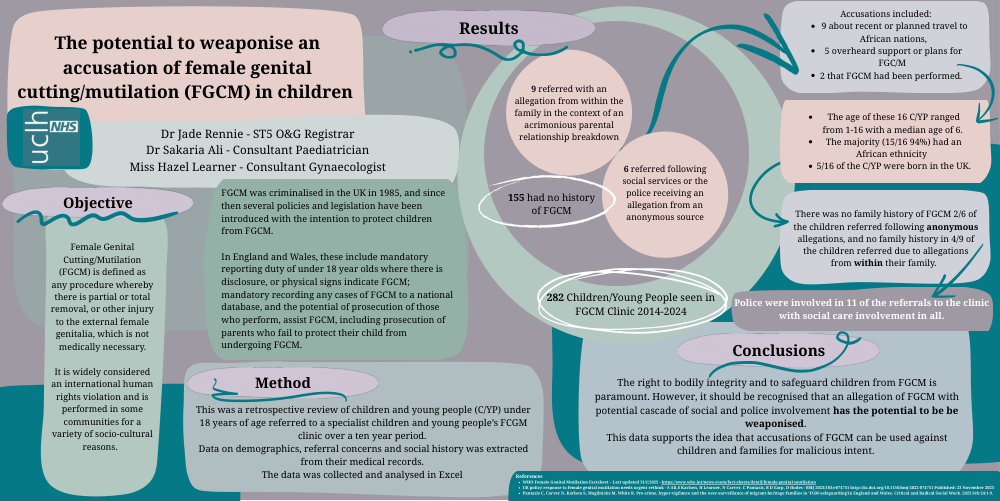
There were 282 C/YP seen in the clinic between 2014-2024. 155/282 (55%) C/YP had no previous history of FGCM.
Of the 155 C/YP not known to have a history of FGCM 9/155 were referred with an allegation from within the family in the context of an acrimonious parental relationship breakdown and 6/16 referred following social services or the police receiving an allegation from an anonymous source.
The accusations included 9/16 allegations about recent or planned travel to African nations, 5/16 allegations of overheard support or plans for FGC/M and 2/16 allegations that FGCM had been performed.
The age of these 16 C/YP ranged from 1-16 with a median age of 6. The majority (15/16 94%) of these C/YP had an African ethnicity and 5/16 of the C/YP were born in the UK.
There was no family history of FGCM 2/6 of the children referred following anonymous allegations, and no family history in 4/9 of the children referred due to allegations from within their family.
Police were involved in 11/16 of the referrals to the clinic with social care involvement in all.
Conclusions
The right to bodily integrity and to safeguard children from FGCM is paramount. However, it should be recognised that an allegation of FGCM with potential cascade of social and police involvement has the potential to be be weaponised. This data supports the idea that accusations of FGCM can be used against children and families for malicious intent.