2,281 posters, 63 videos, 56 audios, 43 topics, 18 sessions, 6,174 authors, 2,323 institutions
ePostersLive by SciGen Technologies S.A. All rights reserved.
RCOG World Congress 2025
June 23 - 25, 2025 | ExCeL London, UK
PP.0114
Clinical experience of p16/ki67 dual-staining cytology (DS) in managing HPV positive women
Poster Presenter
Authors
Affiliations
Part of Topic
Colposcopy & cervical pathology
Clinical experience of p16/ki67 dual-staining cytology (DS) in managing HPV positive women
Tay SK, Ang J, Lee WY Department of Obstetrics and Gynecology, Singapore General Hospital, Outram Road, Singapore.
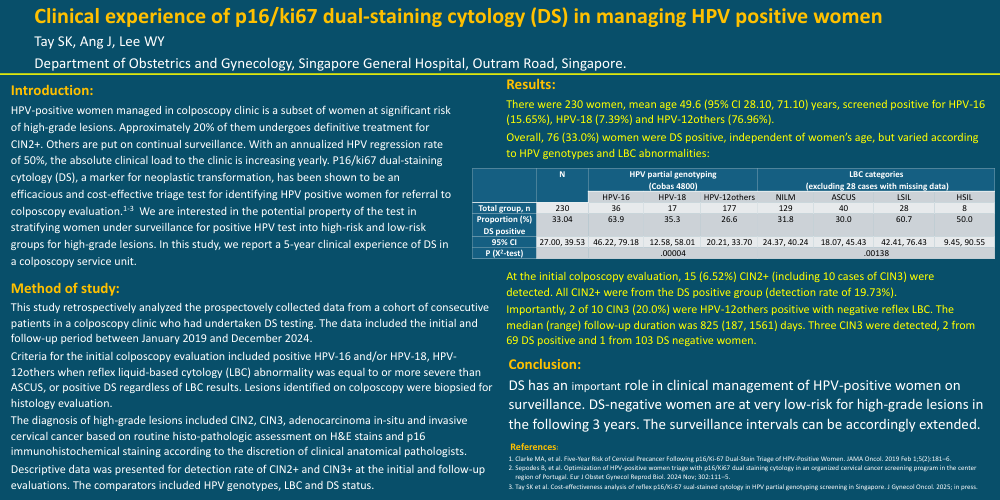
Introduction: HPV-positive women managed in colposcopy clinic is a subset of women at significant risk of high-grade lesions. Approximately 20% of them undergoes definitive treatment for CIN2+. Others are put on continual surveillance. With an annualized HPV regression rate of 50%, the absolute clinical load to the clinic is increasing yearly. P16/ki67 dual-staining cytology (DS), a marker for neoplastic transformation, has been shown to be an efficacious and cost-effective triage test for identifying HPV positive women for referral to colposcopy evaluation.1-3 We are interested in the potential property of the test in stratifying women under surveillance for positive HPV test into high-risk and low-risk groups for high-grade lesions. In this study, we report a 5-year clinical experience of DS in a colposcopy service unit. Method of study: This study retrospectively analyzed the prospectovely collected data from a cohort of consecutive patients in a colposcopy clinic who had undertaken DS testing. The data included the initial and follow-up period between January 2019 and December 2024. Criteria for the initial colposcopy evaluation included positive HPV-16 and/or HPV-18, HPV 12others when reflex liquid-based cytology (LBC) abnormality was equal to or more severe than ASCUS, or positive DS regardless of LBC results. Lesions identified on colposcopy were biopsied for histology evaluation. The diagnosis of high-grade lesions included CIN2, CIN3, adenocarcinoma in-situ and invasive cervical cancer based on routine histo-pathologic assessment on H&E stains and p16 immunohistochemical staining according to the discretion of clinical anatomical pathologists. Descriptive data was presented for detection rate of CIN2+ and CIN3+ at the initial and follow-up evaluations. The comparators included HPV genotypes, LBC and DS status.
Results: There were 230 women, mean age 49.6 (95% CI 28.10, 71.10) years, screened positive for HPV-16 (15.65%), HPV-18 (7.39%) and HPV-12others (76.96%). Overall, 76 (33.0%) women were DS positive, independent of women’s age, but varied according to HPV genotypes and LBC abnormalities.
At the initial colposcopy evaluation, 15 (6.52%) CIN2+ (including 10 cases of CIN3) were detected. All CIN2+ were from the DS positive group (detection rate of 19.73%). Importantly, 2 of 10 CIN3 (20.0%) were HPV-12others positive with negative reflex LBC. The median (range) follow-up duration was 825 (187, 1561) days. Three CIN3 were detected, 2 from 69 DS positive and 1 from 103 DS negative women. Conclusion: DS has an important role in clinical management of HPV-positive women on surveillance. DS-negative women are at very low-risk for high-grade lesions in the following 3 years. The surveillance intervals can be accordingly extended.
References: 1. Clarke MA, et al. Five-Year Risk of Cervical Precancer Following p16/Ki-67 Dual-Stain Triage of HPV-Positive Women. JAMA Oncol. 2019 Feb 1;5(2):181–6. 2. Sepodes B, et al. Optimization of HPV-positive women triage with p16/Ki67 dual staining cytology in an organized cervical cancer screening program in the center region of Portugal. Eur J Obstet Gynecol Reprod Biol. 2024 Nov; 302:111–5. 3. Tay SK et al. Cost-effectiveness analysis of reflex p16/Ki-67 sual-stained cytology in HPV partial genotyping screening in Singapore. J Gynecol Oncol. 2025; in press.