2,281 posters, 63 videos, 56 audios, 43 topics, 18 sessions, 6,174 authors, 2,323 institutions
ePostersLive by SciGen Technologies S.A. All rights reserved.
RCOG World Congress 2025
June 23 - 25, 2025 | ExCeL London, UK
PP.0087
THE OBSTETRIC PANNICULUS STAGING SYSTEM
Poster Presenter
Part of Topic
High risk pregnancy
The Obstetric Panniculus Staging System
1Shirley, R; 1Binsadiqalbakri, M; 1Cohen, L; 2Nabipoor, M; 1Maxwell, C
1Dept of Obstetrics & Gynecology, Mount Sinai Hospital, Toronto, Canada
2Dept of Biostatistics, University Health Network, Toronto, Canada
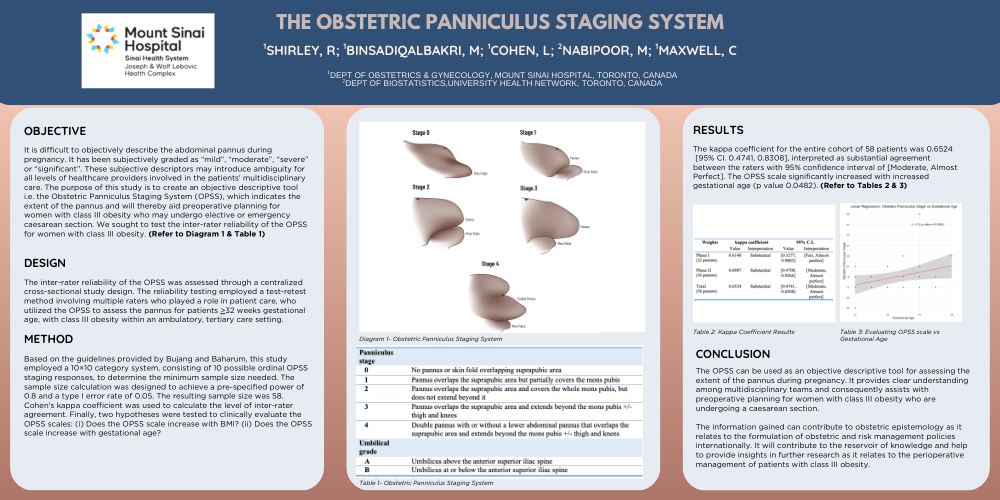
Objective: It is difficult to objectively describe the abdominal pannus during pregnancy. It has been subjectively graded as “mild”, “moderate”, “severe” or “significant”. These subjective descriptors may introduce ambiguity for all levels of healthcare providers involved in the patients' multidisciplinary care. The purpose of this study is to create an objective descriptive tool i.e. the Obstetric Panniculus Staging System (OPSS), which indicates the extent of the pannus and will thereby aid preoperative planning for women with class III obesity who may undergo elective or emergency caesarean section. We sought to test the inter-rater reliability of the OPSS for women with class III obesity.
Design: The inter-rater reliability of the OPSS was assessed through a centralized cross-sectional study design. The reliability testing employed a test-retest method involving multiple raters who played a role in patient care, who utilized the OPSS to assess the pannus for patients ≥32 weeks gestational age, with class III obesity within an ambulatory, tertiary care setting.
Method: Based on the guidelines provided by Bujang and Baharum, this study employed a 10×10 category system, consisting of 10 possible ordinal OPSS staging responses, to determine the minimum sample size needed. The sample size calculation was designed to achieve a pre-specified power of 0.8 and a type I error rate of 0.05. The resulting sample size was 58.
Cohen's kappa coefficient was used to calculate the level of inter-rater agreement. Finally, two hypotheses were tested to clinically evaluate the OPSS scales: (i) Does the OPSS scale increase with BMI? (ii) Does the OPSS scale increase with gestational age?
Result: The kappa coefficient for the entire cohort of 58 patients was 0.6524 [ 95% CI. 0.4741, 0.8308], interpreted as substantial agreement between the raters with 95% confidence interval of [Moderate, Almost Perfect].
The OPSS scale significantly increased with increased gestational age (p value 0.0482).
Conclusion: The OPSS can be used as an objective descriptive tool for assessing the extent of the pannus during pregnancy. It provides clear understanding among multidisciplinary teams and consequently assists with preoperative planning for women with class III obesity who are undergoing a caesarean section.
The information gained can contribute to obstetric epistemology as it relates to the formulation of obstetric and risk management policies internationally. It will contribute to the reservoir of knowledge and help to provide insights in further research as it relates to the perioperative management of patients with class III obesity.