2,281 posters, 63 videos, 56 audios, 43 topics, 18 sessions, 6,174 authors, 2,323 institutions
ePostersLive by SciGen Technologies S.A. All rights reserved.
RCOG World Congress 2025
June 23 - 25, 2025 | ExCeL London, UK
PP.0078
Advancing Gender Equity in Women's Health: Thoughts from Canadian Healthcare Providers
Poster Presenter
Part of Topic
Women's health & policies
Advancing Gender Equity in Women’s Health : Thoughts from Canadian Healthcare Providers
Introduction
•There are unique challenges and escalating complexities in the field of obstetrics, gynaecology and sexual and reproductive health and gender equity remains a persistent challenge in the field.
•Evidence clearly illustrates that health needs and experiences of different populations are not uniform; populations differ in risk and resilience factors, and genetics, culture and social constructs interact in complex ways.
•This study was designed to explore gender equity in sexual and reproductive health care by gathering insights from health care providers in order to identify barriers, perceptions and solutions to promote equitable practices.
•Findings will guide policy, training and practice improvements.
Methods
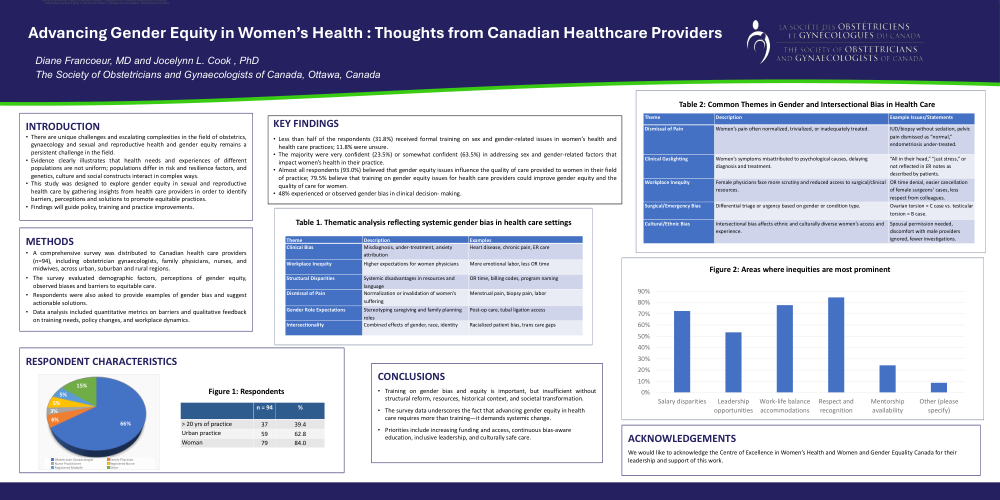
•A comprehensive survey was distributed to Canadian health care providers (n=94), including obstetrician gynaecologists, family physicians, nurses, and midwives, across urban, suburban and rural regions.
•The survey evaluated demographic factors, perceptions of gender equity, observed biases and barriers to equitable care.
•Respondents were also asked to provide examples of gender bias and suggest actionable solutions.
•Data analysis included quantitative metrics on barriers and qualitative feedback on training needs, policy changes, and workplace dynamics.
KEY FINDINGS
•Less than half of the respondents (31.8%) received formal training on sex and gender-related issues in women’s health and health care practices; 11.8% were unsure.
•The majority were very confident (23.5%) or somewhat confident (63.5%) in addressing sex and gender-related factors that impact women’s health in their practice.
•Almost all respondents (93.0%) believed that gender equity issues influence the quality of care provided to women in their field of practice; 79.5% believe that training on gender equity issues for health care providers could improve gender equity and the quality of care for women.
•48% experienced or observed gender bias in clinical decision- making.
Conclusions
•Training on gender bias and equity is important, but insufficient without structural reform, resources, historical context, and societal transformation.
•The survey data underscores the fact that advancing gender equity in health care requires more than training—it demands systemic change.
•Priorities include increasing funding and access, continuous bias-aware education, inclusive leadership, and culturally safe care.