2,281 posters, 63 videos, 56 audios, 43 topics, 18 sessions, 6,174 authors, 2,323 institutions
ePostersLive by SciGen Technologies S.A. All rights reserved.
RCOG World Congress 2025
June 23 - 25, 2025 | ExCeL London, UK
EP.2232
Slipping through the net: Women’s experiences of maternity during the COVID-19 pandemic.
Poster Presenter
Part of Topic
Women's health & policies
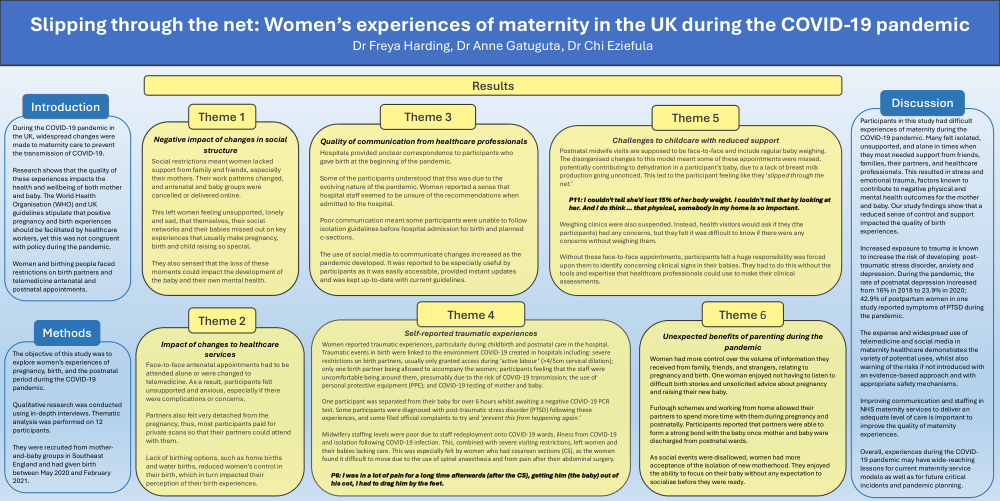
Slipping through the net: Women’s experiences of maternity in the UK during the COVID-19 pandemic
Authors: Dr Freya Harding, Dr Anne Gatuguta, Dr Chi Eziefula
Introduction
During the COVID-19 pandemic in the UK, widespread changes were made to maternity care to prevent the transmission of COVID-19.
Research shows that the quality of these experiences impacts the health and wellbeing of both mother and baby. The World Health Organisation (WHO) and UK guidelines stipulate that positive pregnancy and birth experiences should be facilitated by healthcare workers, yet this was not congruent with policy during the pandemic.
Women and birthing people faced restrictions on birth partners and telemedicine antenatal and postnatal appointments.
Methods
The objective of this study was to explore women’s experiences of pregnancy, birth, and the postnatal period during the COVID-19 pandemic.
Qualitative research was conducted using in-depth interviews. Thematic analysis was performed on 12 participants.
They were recruited from mother-and-baby groups in Southeast England and had given birth between May 2020 and February 2021.
Results
Theme 1
Negative impact of changes in social structure
Social restrictions meant women lacked support from family and friends, especially their mothers. Their work patterns changed, and antenatal and baby groups were cancelled or delivered online.
This left women feeling unsupported, lonely and sad, that themselves, their social networks and their babies missed out on key experiences that usually make pregnancy, birth and child raising so special.
They also sensed that the loss of these moments could impact the development of the baby and their own mental health.
Theme 2
Impact of changes to healthcare services
Face-to-face antenatal appointments had to be attended alone or were changed to telemedicine. As a result, participants felt unsupported and anxious, especially if there were complications or concerns.
Partners also felt very detached from the pregnancy, thus, most participants paid for private scans so that their partners could attend with them.
Lack of birthing options, such as home births and water births, reduced women's control in their birth, which in turn impacted their perception of their birth experiences.
Theme 3
Quality of communication from healthcare professionals
Hospitals provided unclear correspondence to participants who gave birth at the beginning of the pandemic.
Some of the participants understood that this was due to the evolving nature of the pandemic. Women reported a sense that hospital staff seemed to be unsure of the recommendations when admitted to the hospital.
Poor communication meant some participants were unable to follow isolation guidelines before hospital admission for birth and planned c-sections.
The use of social media to communicate changes increased as the pandemic developed. It was reported to be especially useful by participants as it was easily accessible, provided instant updates and was kept up-to-date with current guidelines.
Theme 4
Self-reported traumatic experiences
Women reported traumatic experiences, particularly during childbirth and postnatal care in the hospital.
Traumatic events in birth were linked to the environment COVID-19 created in hospitals including: severe restrictions on birth partners, usually only granted access during ‘active labour’ (>4/5cm cervical dilation); only one birth partner being allowed to accompany the women; participants feeling that the staff were uncomfortable being around them, presumably due to the risk of COVID-19 transmission; the use of personal protective equipment (PPE); and COVID-19 testing of mother and baby.
One participant was separated from their baby for over 6 hours whilst awaiting a negative COVID-19 PCR test. Some participants were diagnosed with post-traumatic stress disorder (PTSD) following these experiences, and some filed official complaints to try and ‘prevent this from happening again.’
Midwifery staffing levels were poor due to staff redeployment onto COVID-19 wards, illness from COVID-19 and isolation following COVID-19 infection. This, combined with severe visiting restrictions, left women and their babies lacking care. This was especially felt by women who had cesarean sections (CS), as the women found it difficult to move due to the use of spinal anaesthesia and from pain after their abdominal surgery.
P6: I was in a lot of pain for a long time afterwards (after the CS), getting him (the baby) out of his cot, I had to drag him by the feet.
Theme 5
Challenges to childcare with reduced support
Postnatal midwife visits are supposed to be face-to-face and include regular baby weighing. The disorganised changes to this model meant some of these appointments were missed, potentially contributing to dehydration in a participant’s baby, due to a lack of breast milk production going unnoticed. This led to the participant feeling like they ‘slipped through the net.’
P11: I couldn't tell she'd lost 15% of her body weight. I couldn't tell that by looking at her. And I do think … that physical, somebody in my home is so important.
Weighing clinics were also suspended. Instead, health visitors would ask if they (the participants) had any concerns, but they felt it was difficult to know if there were any concerns without weighing them.
Without these face-to-face appointments, participants felt a huge responsibility was forced upon them to identify concerning clinical signs in their babies. They had to do this without the tools and expertise that healthcare professionals could use to make their clinical assessments.
Theme 6
Unexpected benefits of parenting during thepandemic
Women had more control over the volume of information they received from family, friends, and strangers, relating to pregnancy and birth. One woman enjoyed not having to listen to difficult birth stories and unsolicited advice about pregnancy and raising their new baby.
Furlough schemes and working from home allowed their partners to spend more time with them during pregnancy and postnatally. Participants reported that partners were able to form a strong bond with the baby once mother and baby were discharged from postnatal wards.
As social events were disallowed, women had more acceptance of the isolation of new motherhood. They enjoyed the ability to focus on their baby without any expectation to socialise before they were ready.
Discussion
Participants in this study had difficult experiences of maternity during the COVID-19 pandemic. Many felt isolated, unsupported, and alone in times when they most needed support from friends, families, their partners, and healthcare professionals. This resulted in stress and emotional trauma, factors known to contribute to negative physical and mental health outcomes for the mother and baby. Our study findings show that a reduced sense of control and support impacted the quality of birth experiences.
Increased exposure to trauma is known to increase the risk of developing post-traumatic stress disorder, anxiety and depression. During the pandemic, the rate of postnatal depression increased from 16% in 2018 to 23.9% in 2020; 42.9% of postpartum women in one study reported symptoms of PTSD during the pandemic.
The expanse and widespread use of telemedicine and social media in maternity healthcare demonstrates the variety of potential uses, whilst also warning of the risks if not introduced with an evidence-based approach and with appropriate safety mechanisms.
Improving communication and staffing in NHS maternity services to deliver an adequate level of care is important to improve the quality of maternity experiences.
Overall, experiences during the COVID-19 pandemic may have wide-reaching lessons for current maternity service models as well as for future critical incidents and pandemic planning.