2,281 posters, 63 videos, 56 audios, 43 topics, 18 sessions, 6,174 authors, 2,323 institutions
ePostersLive by SciGen Technologies S.A. All rights reserved.
RCOG World Congress 2025
June 23 - 25, 2025 | ExCeL London, UK
PP.0075
Management of Postmenopausal bleeding in women on HRT in Secondary care
Poster Presenter
Part of Topic
Women's health & policies
MANAGEMENT OF POSTMENOPAUSAL BLEEDING IN WOMEN ON HRT IN SECONDARY CARE
Natasha D’Souza, Sofia Lekka, Suraya Miah, Lukasz Polanski, Denise Quinton, AyshiniSamarasinghe
Department of Obstetrics and Gynaecology, North West Anglia NHS Foundation Trust, United Kingdom
INTRODUCTION
HRT is currently being utilised widely for the relief of menopausal symptoms.1 The annual report of the NHS Business Services Authority (NHSBSA) highlighted that there was a 22% increase in HRT prescriptions during 2023/24 when compared to 2022/23.1 Unscheduled bleeding within the first six months of initiating HRT or, within three months of a change in dose or preparation in those already established on HRT, is common.2 It can affect up to 38% of people using sequential HRT and 41% using continuous combined HRT.2 It is a major factor leading to repeat consultations and cessation of HRT.2
NICE has laid out robust guidance for referral pathways to aid with the early detection of endometrial cancer.3 This includes invasive testing (hysteroscopy and biopsy) if unscheduled bleeding on HRT persists for more than 6 months.3,4
AIMS AND OBJECTIVES
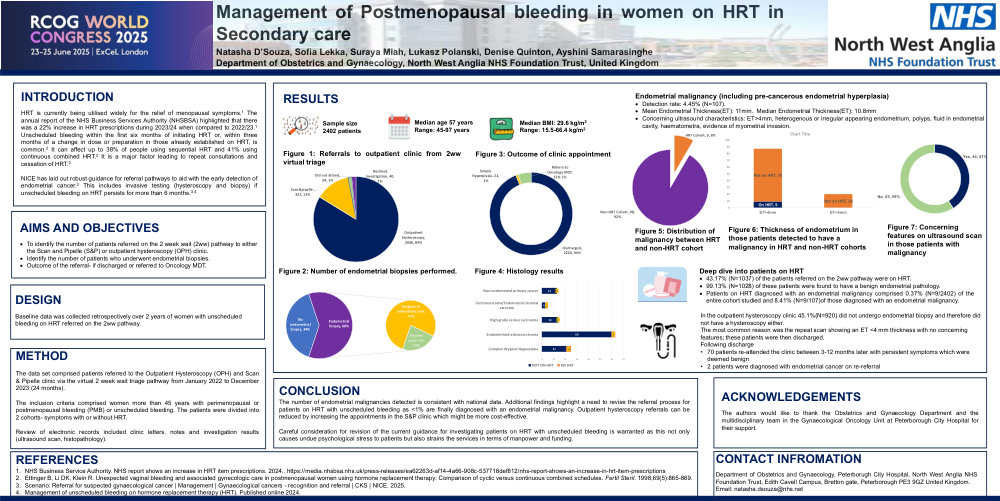
Baseline data was collected retrospectively over 2 years of women with unscheduled bleeding on HRT referred on the 2ww pathway.
METHOD
The data set comprised patients referred to the Outpatient Hysteroscopy (OPH) and Scan & Pipelle clinic via the virtual 2 week wait triage pathway from January 2022 to December 2023 (24 months).
The inclusion criteria comprised women more than 45 years with perimenopausal or postmenopausal bleeding (PMB) or unscheduled bleeding. The patients were divided into 2 cohorts- symptoms with or without HRT.
Review of electronic records included clinic letters, notes and investigation results (ultrasound scan, histopathology).
RESULTS
Endometrial malignancy (including pre-cancerous endometrial hyperplasia)
Deep dive into patients on HRT
In the outpatient hysteroscopy clinic 45.1%(N=920) did not undergo endometrial biopsy and therefore did not have a hysteroscopy either.
The most common reason was the repeat scan showing an ET <4 mm thickness with no concerning features; these patients were then discharged.
Following discharge
CONCLUSION
The number of endometrial malignancies detected is consistent with national data. Additional findings highlight a need to revise the referral process for patients on HRT with unscheduled bleeding as <1% are finally diagnosed with an endometrial malignancy. Outpatient hysteroscopy referrals can be reduced by increasing the appointments in the S&P clinic which might be more cost-effective.
Careful consideration for revision of the current guidance for investigating patients on HRT with unscheduled bleeding is warranted as this not only causes undue psychological stress to patients but also strains the services in terms of manpower and funding.
ACKNOWLEDGEMENTS
The authors would like to thank the Obstetrics and Gynaecology Department and the multidisciplinary team in the Gynaecological Oncology Unit at Peterborough City Hospital for their support.
REFERENCES
1. NHS Business Service Authority. NHS report shows an increase in HRT item prescriptions. 2024.. https://media.nhsbsa.nhs.uk/press-releases/ea62263d-af14-4a66-908c-537718def812/nhs-report-shows-an-increase-in-hrt-item-prescriptions
2. Ettinger B, Li DK, Klein R. Unexpected vaginal bleeding and associated gynecologic care in postmenopausal women using hormone replacement therapy: Comparison of cyclic versus continuous combined schedules. Fertil Steril. 1998;69(5):865-869.
3.Scenario: Referral for suspected gynaecological cancer | Management | Gynaecological cancers - recognition and referral | CKS | NICE. 2025.
CONTACT INFROMATION
Department of Obstetrics and Gynaecology, Peterborugh City Hospital, North West Anglia NHS Foundation Trust, Edith Cavell Campus, Bretton gate, Peterborough PE3 9GZ United Kingdom.
Email: natasha.dsouza@nhs.net