2,281 posters, 63 videos, 56 audios, 43 topics, 18 sessions, 6,174 authors, 2,323 institutions
ePostersLive by SciGen Technologies S.A. All rights reserved.
RCOG World Congress 2025
June 23 - 25, 2025 | ExCeL London, UK
PP.0074
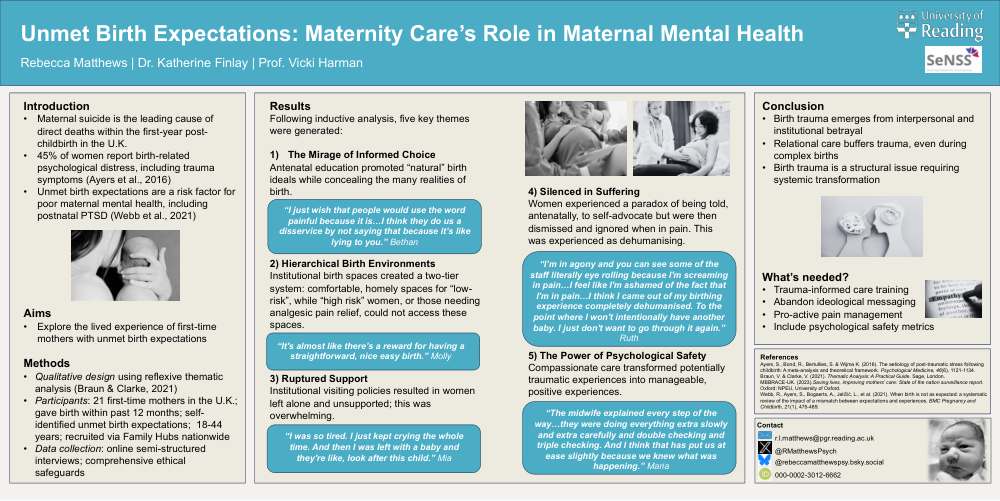
Unmet Birth Expectations: Maternity Care’s Role in Maternal Mental Health
Poster Presenter
Authors
Affiliations
Part of Topic
Hot topics (emerging research/issues) in obstetrics
Unmet Birth Expectations: Maternity Care’s Role in Maternal Mental Health
Rebecca Matthews | Dr. Katherine Finlay | Prof. Vicki Harman, University of Reading, U.K.
Introduction
Aims
Methods
Results
Following inductive analysis, five key themes were generated:
1)The Mirage of Informed Choice
Antenatal education promoted “natural” birth ideals while concealing the many realities of birth.
“I just wish that people would use the word painful because it is…I think they do us a disservice by not saying that because it’s like lying to you.” Bethan
2) Hierarchical Birth Environments
Institutional birth spaces created a two-tier system: comfortable, homely spaces for “low-risk”, while “high risk” women, or those needing analgesic pain relief, could not access these spaces.
“It's almost like there’s a reward for having a straightforward, nice easy birth.” Molly
3) Ruptured Support
Institutional visiting policies resulted in women left alone and unsupported; this was overwhelming.
“I was so tired. I just kept crying the whole time. And then I was left with a baby and they're like, look after this child.” Mia
4) Silenced in Suffering
Women experienced a paradox of being told, antenatally, to self-advocate but were then dismissed and ignored when in pain. This was experienced as dehumanising.
“I’m in agony and you can see some of the staff literally eye rolling because I'm screaming in pain…I feel like I'm ashamed of the fact that I'm in pain…I think I came out of my birthing experience completely dehumanised. To the point where I won't intentionally have another baby. I just don't want to go through it again.” Ruth
5) The Power of Psychological Safety
Compassionate care transformed potentially traumatic experiences into manageable, positive experiences.
“The midwife explained every step of the way…they were doing everything extra slowly and extra carefully and double checking and triple checking. And I think that has put us at ease slightly because we knew what was happening.” Maria
Conclusion
What’s needed?
References
Ayers, S., Bond, R., Bertullies, S. & Wijma K. (2016). The aetiology of post-traumatic stress following childbirth: A meta-analysis and theoretical framework. Psychological Medicine, 46(6), 1121-1134.
Braun, V. & Clarke, V. (2021). Thematic Analysis: A Practical Guide. Sage, London.
MBBRACE-UK. (2023).Saving lives, improving mothers’ care: State of the nation surveillance report. Oxford: NPEU, University of Oxford.
Webb, R., Ayers, S., Bogaerts, A., Jeličić, L., et al. (2021). When birth is not as expected: a systematic review of the impact of a mismatch between expectations and experiences. BMC Pregnancy and Childbirth, 21(1), 475-489.
Contact
r.l.matthews@pgr.reading.ac.uk
@RMatthewsPsych
@rebeccamatthewspsy.bsky.social
000-0002-3012-6662