2,281 posters, 63 videos, 56 audios, 43 topics, 18 sessions, 6,174 authors, 2,323 institutions
ePostersLive by SciGen Technologies S.A. All rights reserved.
RCOG World Congress 2025
June 23 - 25, 2025 | ExCeL London, UK
PP.0072
Role of Dexamethasone in Post-Caesarean Analgesia and Recovery
Poster Presenter
Authors
Sakshi Bajaj, Vatsla Dadhwal, Vimi Rewari, Soniya Dhiman, Neha Varun, Deepali Garg, Anubhuti Rana, Rajesh Kumari, Jyoti Meena, Aparna Sharma
Affiliations
Part of Topic
Hot topics (emerging research/issues) in obstetrics
Role of Dexamethasone in Post-Caesarean Analgesia and Recovery
Dr. Sakshi Bajaj, Dr Vatsla Dadhwal, Dr Vimi Rewari, Dr K Aparna Sharma, Dr Jyoti Meena, Dr Rajesh Kumari, Dr Deepali Garg, Dr Anubhuti Rana, Dr Neha Varun, Dr Soniya Dhiman
Introduction:
Post-caesarean analgesia not only promotes early ambulation and better recovery but also facilitates
bonding between the mother and her newborn allowing for early breastfeeding and a positive birth
experience. These goals are achieved through multimodal analgesia.
Dexamethasone inhibits cyclooxygenase and lipoxygenase pathways owing to its
immunosuppressive and anti-inflammatory effects. It may prolong the duration of analgesia, decrease
the intensity of postoperative pain and incidence of rebound pain.
Through this study, we wanted to study the efficacy of dexamethasone as a part of multimodal
analgesia in reducing postoperative pain and reducing opioid requirement.
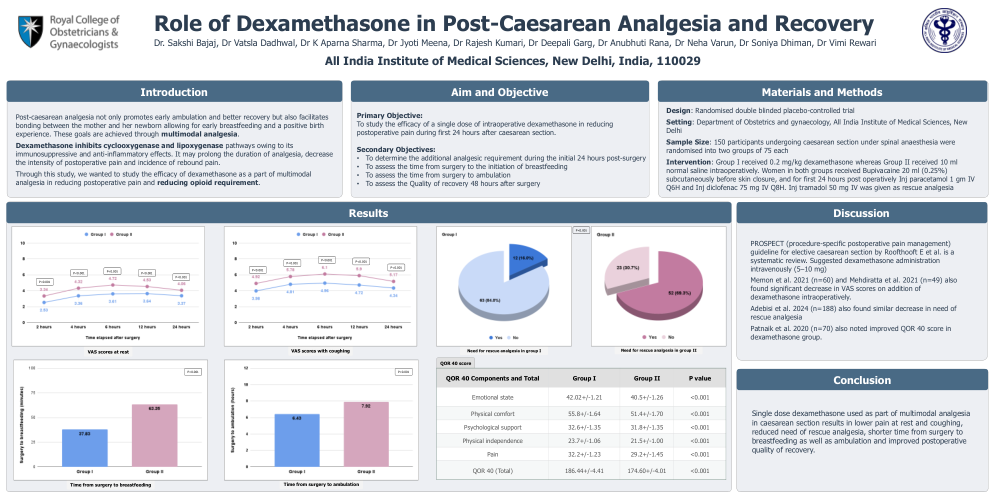
Primary Objective: To study the efficacy of a single dose of intraoperative dexamethasone in reducing postoperative pain during first 24 hours after caesarean section.
Secondary Objectives: •
• To determine the additional analgesic requirement during the initial 24 hours post-surgery
• To assess the time from surgery to the initiation of breastfeeding
• To assess the time from surgery to ambulation
• To assess the Quality of recovery 48 hours after surgery
Materials and Methods:
Design: Randomised double blinded placebo-controlled trial
Setting: Department of Obstetrics and gynaecology, All India
Institute of Medical Sciences, New Delhi
Sample Size: 150 participants undergoing caesarean section under
spinal anaesthesia were randomised into two groups of 75 each
Intervention:Group I received 0.2 mg/kg dexamethasone whereas Group II received 10 ml normal saline intraoperatively. Women in both groups received Bupivacaine 20 ml (0.25%) subcutaneously before skin closure, and for first 24 hours post operatively Inj paracetamol 1 gm IV Q6H and Inj diclofenac 75 mg IV Q8H. Inj tramadol 50 mg IV was given as rescue analgesia
Conclusion:
Single dose dexamethasone used as part of multimodal analgesia
in caesarean section results in lower pain at rest and coughing,
reduced need of rescue analgesia, shorter time from surgery to
breastfeeding as well as ambulation and improved postoperative
quality of recovery.