2,281 posters, 63 videos, 56 audios, 43 topics, 18 sessions, 6,174 authors, 2,323 institutions
ePostersLive by SciGen Technologies S.A. All rights reserved.
RCOG World Congress 2025
June 23 - 25, 2025 | ExCeL London, UK
PP.0067
Glove change during caesarean section: impact on maternity service budgets and capacity.
Part of Topic
Hot topics (emerging research/issues) in obstetrics
Glove change during caesarean birth: impact on maternity service budgets and capacity
Benedict Stanberry,1 Lesley Jordan,2 Anne Pullyblank,3 Judith Hargreaves4
1 Director, Institute of Healthcare Leadership and Management, Oxford, UK; 2 Consultant Anaesthetist, Royal United Hospitals Bath NHS Foundation Trust, Bath, UK and Clinical Lead, Health Innovation West of England, Bristol, UK; 3 Consultant Colorectal Surgeon, North Bristol NHS Trust, Bristol, UK; 4 Vice President, Global Health Economics and Government Affairs, Mölnlycke Health Care AB, Gothenburg, Sweden.
Introduction
Caesarean birth (CB) is a common obstetric surgical intervention. Although overall birth rates in the English National Health Service (NHS) are falling, CB rates are increasing significantly – from 29.7% in 2018-19 to 41.4% in 2023-24.[1]
The estimated incidence of post-CB surgical site infection (SSI) cited in the literature ranges from 3% to 18%.[2] Most infections are superficial and occur after discharge from hospital so are often not included in estimated incidence rates. However, they incur significant costs due to extended community midwife visits, general practitioner (GP) visits and antibiotic prescribing.
Deeper and more severe infections require extended hospital stays or readmission, increasing the burden on hospital maternity services and workforces that may already be under significant pressure.
A systematic review and meta-analysis of seven randomised controlled trials of 1,948 women by Narice et al has demonstrated that glove change after placental delivery during CB is associated with a statistically significantly lower incidence of wound infection complications (RR 0.41, 95% CI 0.26 – 0.65, p < 0.0001, GRADE moderate quality evidence).[3]
The objective of this study is therefore to analyse the impact glove change would have on the budget and capacity of a typical NHS maternity service and, more broadly, on the NHS in England.
Method
Budget impact analysis (BIA) enables decision-makers to see how the costs associated with the way they currently treat a specific condition would change if they adopted a new treatment or intervention and the effect this would consequently have on their annual budget and capacity.
Our BIA took the perspective of a typical NHS maternity service over a 5-year time horizon. It was built using real-world data from Royal United Hospitals Bath NHS Foundation Trust (RUHB) where 1,590 CB were performed in 2023-24 and the PreCiSSIon (Preventing CB Surgical Site Infection across a region) project is reliably collecting 30-day patient-reported SSI rates through digital distribution of the UK Health Security Agency (UKHSA) wound healing questionnaire.
Focus group interviews at RUHB were used to map all post-CB SSI treatment pathways. These maps were combined with NHS England national cost data and real-world incidence data to quantify current costs. Future costs were obtained by adjusting current costs using the relative risk ratio obtained by Narice et al.[2]
Net budget impact was calculated as the incremental difference between current and future costs, less the time and cost associated with pre-closure glove change.
Uncertainty in the model was explored through one-way sensitivity analysis and through alternative scenarios that investigated the impact of differing CB volumes, SSI incidence rates and readmission lengths of stay.
Results
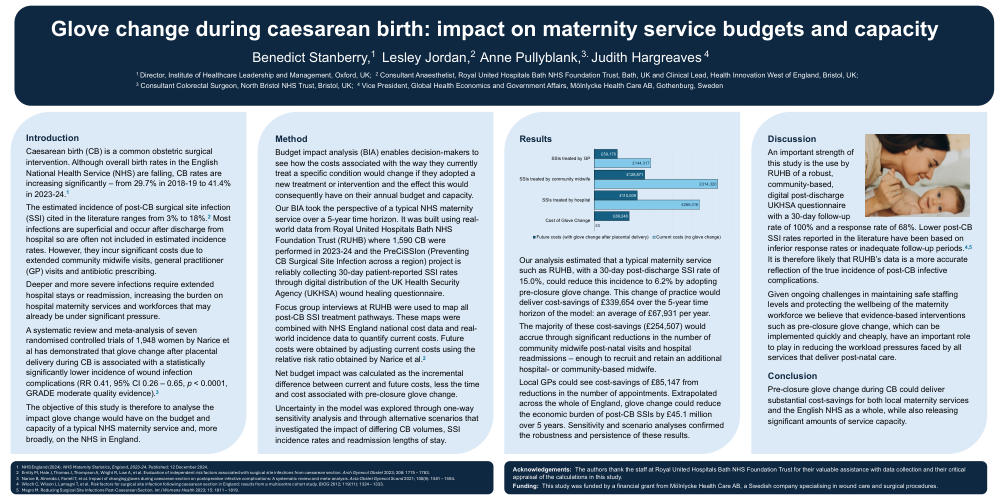
Our analysis estimated that a typical maternity service such as RUHB, with a 30-day post-discharge SSI rate of 15.0%, could reduce this incidence to 6.2% by adopting pre-closure glove change. This change of practice would deliver cost-savings of £339,654 over the 5-year time horizon of the model: an average of £67,931 per year.
The majority of these cost-savings (£254,507) would accrue through significant reductions in the number of community midwife post-natal visits and hospital readmissions – enough to recruit and retain an additional hospital- or community-based midwife.
Local GPs could see cost-savings of £85,147 from reductions in the number of appointments. Extrapolated across the whole of England, glove change could reduce the economic burden of post-CB SSIs by £45.1 million over 5 years. Sensitivity and scenario analyses confirmed the robustness and persistence of these results.
Discussion
An important strength of this study is the use by RUHB of a robust, community-based, digital post-discharge UKHSA questionnaire with a 30-day follow-up rate of 100% and a response rate of 68%. Lower post-CB SSI rates reported in the literature have been based on inferior response rates or inadequate follow-up periods.[4,5] It is therefore likely that RUHB’s data is a more accurate reflection of the true incidence of post-CB infective complications.
Given ongoing challenges in maintaining safe staffing levels and protecting the wellbeing of the maternity workforce we believe that evidence-based interventions such as pre-closure glove change, which can be implemented quickly and cheaply, have an important role to play in reducing the workload pressures faced by all services that deliver post-natal care.
Conclusion
Pre-closure glove change during CB could deliver substantial cost-savings for both local maternity services and the English NHS as a whole, while also releasing significant amounts of service capacity.
----
Acknowledgements: The authors thank the staff at Royal United Hospitals Bath NHS Foundation Trust for their valuable assistance with data collection and their critical appraisal of the calculations in this study.
Funding: This study was funded by a financial grant from Mölnlycke Health Care AB, a Swedish company specialising in wound care and surgical procedures.
----
References