2,281 posters, 63 videos, 56 audios, 43 topics, 18 sessions, 6,174 authors, 2,323 institutions
ePostersLive by SciGen Technologies S.A. All rights reserved.
RCOG World Congress 2025
June 23 - 25, 2025 | ExCeL London, UK
EP.0234
Isolated fallopian tube torsion in pregnancy: A case report and literature review
Poster Presenter
Authors
Affiliations
Part of Topic
Early pregnancy complications/early pregnancy and acute gynaecology
Isolated fallopian tube torsion in pregnancy: A case report and literature review
Objective
Isolated fallopian tube torsion (FTT) is rare, occurring in an estimated 1 in 1.5 million women.1,2,3 There are very few reported cases of it in pregnancy. We present a case of third-trimester FTT managed with caesarean section and salpingectomy.
Case Report
A Gravida 3, Para 2 woman presented at 33+1 weeks with sudden left-sided colicky pain and nausea. Her past medical history included a hiatus hernia and depression. A 3.4cm left ovarian cyst had been noted in a previous pregnancy but not in recent scans.
On examination, her vital signs were stable. She had left lower abdominal tenderness and a closed cervical os. CTG was normal. An initial impression of renal colic or ovarian cyst accident was made.
She was admitted for analgesia and investigations. Ultrasound revealed a 50×26×39mm left adnexal cyst with no vascularity, the left ovary was not separately visualised. Despite regular analgesia, the pain worsened. A bedside scan did not indicate torsion, but laparotomy was considered if the pain persisted.
The pain remained severe despite intravenous morphine. Fetal lung maturity steroids were administered. Due to uncontrolled pain with an unknown cause, an emergency caesarean section was performed under general anaesthesia.
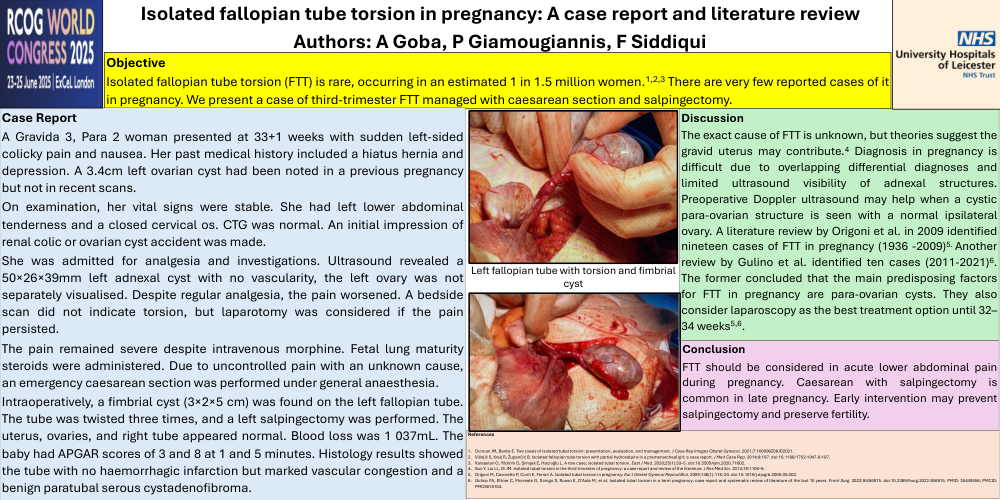
Intraoperatively, a fimbrial cyst (3×2×5 cm) was found on the left fallopian tube. The tube was twisted three times and a left salpingectomy was performed. The uterus, ovaries, and right tube appeared normal. Blood loss was 1 037mL. The baby had APGAR scores of 3 and 8 at 1 and 5 minutes. Histology results showed the tube with no haemorrhagic infarction but marked vascular congestion and a benign paratubal serous cystadenofibroma.
Discussion
The exact cause of FTT is unknown, but theories suggest the gravid uterus may contribute.4 Diagnosis in pregnancy is difficult due to overlapping differential diagnoses and limited ultrasound visibility of adnexal structures. Preoperative Doppler ultrasound may help when a cystic para-ovarian structure is seen with a normal ipsilateral ovary. A literature review by Origoni et al. in 2009 identified nineteen cases of FTT in pregnancy (1936 -2009)5. Another review by Gulino et al. identified ten cases (2011-2021)6. The former concluded that the main predisposing factors for FTT in pregnancy are para-ovarian cysts. They also consider laparoscopy as the best treatment option until 32–34 weeks5,6.
Conclusion
FTT should be considered in acute lower abdominal pain during pregnancy. Caesarean with salpingectomy is common in late pregnancy. Early intervention may prevent salpingectomy and preserve fertility.
References
- Duncan JM, Banks E. Two cases of isolated tubal torsion: presentation, evaluation, and management. J Case Rep Images Obstet Gynecol. 2021;7:100096Z08JD2021.
- Višnjić S, Kralj R, Župančić B. Isolated fallopian tube torsion with partial hydrosalpinx in a premenarcheal girl: a case report. J Med Case Rep. 2014;8:197. doi:10.1186/1752-1947-8-197.
- Karaaslan O, Yildirim D, Şimşek E, Hacıoğlu L. A rare case; isolated tubal torsion. East J Med. 2020;25(1):33–5. doi:10.5505/ejm.2020.71602.
- Sun Y, Liu LL, Di JM. Isolated tubal torsion in the third trimester of pregnancy: a case report and review of the literature. J Res Med Sci. 2014;19:1106–9.
- Origoni M, Cavoretto P, Conti E, Ferrari A. Isolated tubal torsion in pregnancy. Eur J Obstet Gynecol Reprod Biol. 2009;146(1):116–20. doi:10.1016/j.ejogrb.2009.05.002.
- Gulino FA, Ettore C, Morreale G, Siringo S, Russo E, D'Asta M, et al. Isolated tubal torsion in a term pregnancy: case report and systematic review of literature of the last 10 years. Front Surg. 2022;9:856915. doi:10.3389/fsurg.2022.856915. PMID: 35449556; PMCID: PMC9018104.