2,281 posters, 63 videos, 56 audios, 43 topics, 18 sessions, 6,174 authors, 2,323 institutions
ePostersLive by SciGen Technologies S.A. All rights reserved.
RCOG World Congress 2025
June 23 - 25, 2025 | ExCeL London, UK
PP.0059
Decoding Dysmenorrhea: Divergent Perspectives in Pain Management
Poster Presenter
Authors
Chethana Krishna Rao, Sangavi Satkunarajah, Parmis Vafapour, Jacqueline Hui, Sabthagi Sivathasan, Poppy Sullivan, Maryam Chaudhury, Amrit Marway, Freya Goodman, Natalia Olszewska, Emilia Olszewska, Nabihah Rahman, Sineka Sasuni Weeraman, Esther Murray, Roda Awil Mohammed
Affiliations
Queen Mary University of London, Barts & the London, Frimley Health NHS
Part of Topic
Women's health & policies
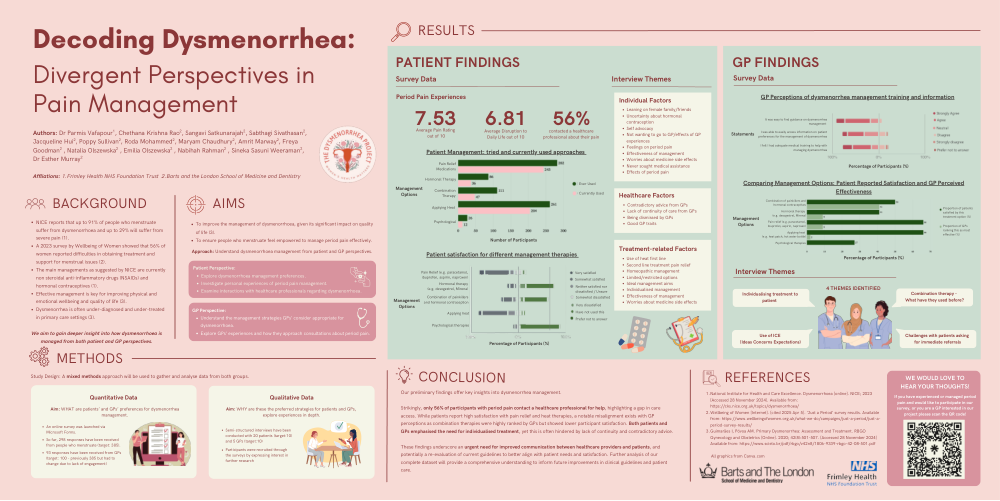
Title: Decoding Dysmenorrhea: Divergent Perspectives in Pain Management
Background:
NICE reports that up to 91% of people who menstruate suffer from dysmenorrhoea and up to 29% will suffer from severe pain (1).
A 2023 survey by Wellbeing of Women showed that 56% of women reported difficulties in obtaining treatment and support for menstrual issues (2).
The main managements as suggested by NICE are currently non steroidal anti-inflammatory drugs (NSAIDs) and hormonal contraceptives (1).
Effective management is key for improving physical and emotional wellbeing and quality of life (3).
Dysmenorrhea is often under-diagnosed and under-treated in primary care settings (3).
Aims:
-To improve the management of dysmenorrhoea, given its significant impact on quality of life (3).
-To ensure people who menstruate feel empowered to manage period pain effectively.
Approach: Understand dysmenorrhoea management from patient and GP perspectives. We aim to gain deeper insight into how dysmenorrhoea is
managed from both patient and GP perspectives.
Methods:
Study Design: A mixed methods approach will be used to gather and analyse data from both groups.
Quantitative:
Aim: WHAT are patients’ and GPs’ preferences for dysmenorrhea management.
An online survey was launched via Microsoft Forms.
So far, 298 responses have been received from people who menstruate (target: 385).
93 responses have been received from GPs (target: 100 - previously 385 but had to change due to lack of engagement)
Qualitative:
Aim: WHY are these the preferred strategies for patients and GPs, explore experiences in depth.
Semi-structured interviews have been conducted with 20 patients (target:10) and 5 GPs (target:10)
Participants were recruited through the surveys by expressing interest in further research
Conclusion:
Our preliminary findings offer key insights into dysmenorrhea management. Strikingly, only 56% of participants with period pain contact a healthcare professional for help, highlighting a gap in care access. While patients report high satisfaction with pain relief and heat therapies, a notable misalignment exists with GP perceptions as combination therapies were highly ranked by GPs but showed lower participant satisfaction. Both patients and GPs emphasised the need for individualised treatment, yet this is often hindered by lack of continuity and contradictory advice.
These findings underscore an urgent need for improved communication between healthcare providers and patients, and potentially a re-evaluation of current guidelines to better align with patient needs and satisfaction. Further analysis of our complete dataset will provide a comprehensive understanding to inform future improvements in clinical guidelines and patient care.