2,281 posters, 63 videos, 56 audios, 43 topics, 18 sessions, 6,174 authors, 2,323 institutions
ePostersLive by SciGen Technologies S.A. All rights reserved.
RCOG World Congress 2025
June 23 - 25, 2025 | ExCeL London, UK
PP.0054
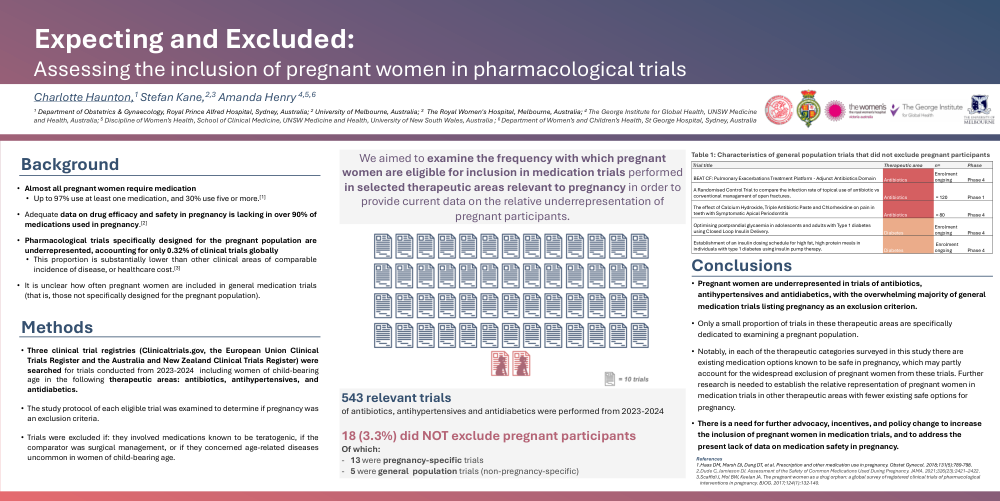
Expecting and excluded: Assessing inclusion of pregnant women in registered pharmacological trials
Part of Topic
Women's health & policies
Audio
BACKGROUND
•Almost all pregnant women require medication
•Up to 97% use at least one medication, and 30% use five or more.[1]
•
•Adequate data on drug efficacy and safety in pregnancy is lacking in over 90% of medications used in pregnancy.[2]
•
•Pharmacological trials specifically designed for the pregnant population are underrepresented, accounting for only 0.32% of clinical trials globally
•This proportion is substantially lower than other clinical areas of comparable incidence of disease, or healthcare cost.[3]
•
•It is unclear how often pregnant women are included in general medication trials (that is, those not specifically designed for the pregnant population).
METHODS
•Three clinical trial registries (Clinicaltrials.gov, the European Union Clinical Trials Register and the Australia and New Zealand Clinical Trials Register) were searched for trials conducted from 2023-2024 including women of child-bearing age in the following therapeutic areas: antibiotics, antihypertensives, and antidiabetics.
•
•The study protocol of each eligible trial was examined to determine if pregnancy was an exclusion criteria.
•
•Trials were excluded if: they involved medications known to be teratogenic, if the comparator was surgical management, or if they concerned age-related diseases uncommon in women of child-bearing age.
AIMS
We aimed to examine the frequency with which pregnant women are eligible for inclusion in medication trials performed in selected therapeutic areas relevant to pregnancy in order to provide current data on the relative underrepresentation of pregnant participants.
RESULTS
543 relevant trials
of antibiotics, antihypertensives and antidiabetics were performed from 2023-2024
18 (3.3%) did NOT exclude pregnant participants
Of which:
-13 were pregnancy-specific trials
-5 were general population trials (non-pregnancy-specific)
CONCLUSIONS
•Pregnant women are underrepresented in trials of antibiotics, antihypertensives and antidiabetics, with the overwhelming majority of general medication trials listing pregnancy as an exclusion criterion.
•
•Only a small proportion of trials in these therapeutic areas are specifically dedicated to examining a pregnant population.
•
•Notably, in each of the therapeutic categories surveyed in this study there are existing medication options known to be safe in pregnancy, which may partly account for the widespread exclusion of pregnant women from these trials. Further research is needed to establish the relative representation of pregnant women in medication trials in other therapeutic areas with fewer existing safe options for pregnancy.
•
•There is a need for further advocacy, incentives, and policy change to increase the inclusion of pregnant women in medication trials, and to address the present lack of data on medication safety in pregnancy.
•