2,281 posters, 63 videos, 56 audios, 43 topics, 18 sessions, 6,174 authors, 2,323 institutions
ePostersLive by SciGen Technologies S.A. All rights reserved.
RCOG World Congress 2025
June 23 - 25, 2025 | ExCeL London, UK
EP.0231
Two laparoscopies and Methotrexate: a report on managing persisting interstitial ectopic pregnancy
Poster Presenter
Part of Topic
Early pregnancy complications/early pregnancy and acute gynaecology
Two laparoscopies and Methotrexate: a report on managing persisting interstitial ectopic pregnancy
Objective: The management of interstitial pregnancies can pose significant clinical challenges. We present a case of shared care between two hospitals managing a persisting interstitial ectopic pregnancy in a patient with a previous ipsilateral salpingectomy of a tubal ectopic.
Case report:
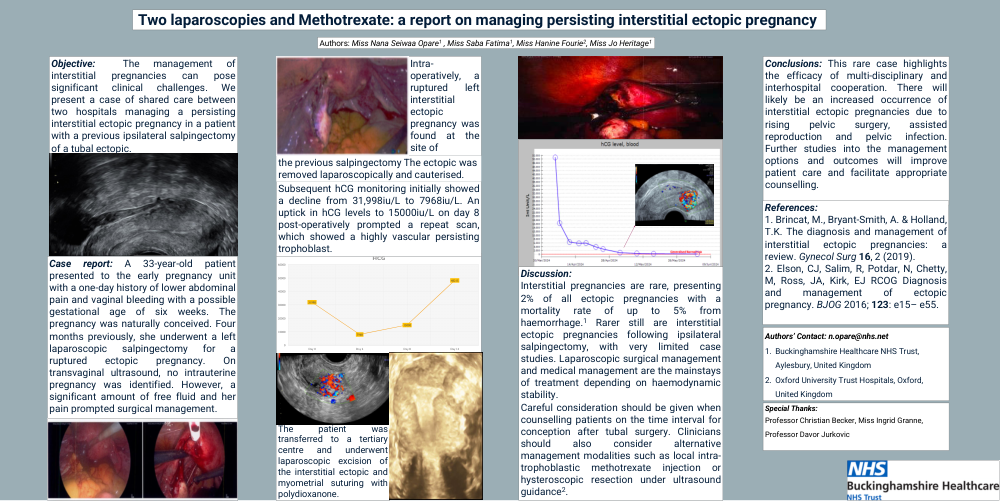
A 33-year-old patient presented to the early pregnancy unit with a one-day history of lower abdominal pain and vaginal bleeding with a possible gestational age of six weeks. The pregnancy was naturally conceived. Four months previously, she underwent a left laparoscopic salpingectomy for a ruptured ectopic pregnancy. On transvaginal ultrasound, no intrauterine pregnancy was identified. However, a significant amount of free fluid and her pain prompted surgical management. Intra-operatively, a ruptured left interstitial ectopic pregnancy was found at the site of the previous salpingectomy. The ectopic was removed laparoscopically and cauterised. Subsequent hCG monitoring initially showed a decline from 31,998iu/L to 7968iu/L. An uptick in hCG levels to 15000iu/L on day 8 post-operatively prompted a repeat scan, which showed a highly vascular persisting trophoblast. The patient was transferred to a tertiary centre and underwent laparoscopic excision of the interstitial ectopic and myometrial suturing with polydioxanone. The hCG levels, after initial decline, later increased. Following a multi-disciplinary team discussion, she was treated with methotrexate. The patient was monitored until non-pregnant hCG levels were achieved 3 months later.
Discussion:
Interstitial pregnancies are rare, presenting 2% of all ectopic pregnancies with a mortality rate of up to 5% from haemorrhage.1 Rarer still are interstitial ectopic pregnancies following ipsilateral salpingectomy, with very limited case studies. Laparoscopic surgical management and medical management are the mainstays of treatment depending on haemodynamic stability.
Careful consideration should be given when counselling patients on the time interval for conception after tubal surgery. Clinicians should also consider alternative management modalities such as local intra-trophoblastic methotrexate injection or hysteroscopic resection under ultrasound guidance2.
Conclusions:
This rare case highlights the efficacy of multi-disciplinary and interhospital cooperation. There will likely be an increased occurrence of interstitial ectopic pregnancies due to rising pelvic surgery, assisted reproduction and pelvic infection. Further studies into the management options and outcomes will improve patient care and facilitate appropriate counselling.
References:
1. Brincat, M., Bryant-Smith, A. & Holland, T.K. The diagnosis and management of interstitial ectopic pregnancies: a review. Gynecol Surg 16, 2 (2019).
2. Elson, CJ, Salim, R, Potdar, N, Chetty, M, Ross, JA, Kirk, EJ RCOG Diagnosis and management of ectopic pregnancy. BJOG 2016; 123: e15– e55.