2,281 posters, 63 videos, 56 audios, 43 topics, 18 sessions, 6,174 authors, 2,323 institutions
ePostersLive by SciGen Technologies S.A. All rights reserved.
RCOG World Congress 2025
June 23 - 25, 2025 | ExCeL London, UK
PP.0023
Understanding Menstrual Cycle Misconceptions: Insights from 386,811 UK based Women
Poster Presenter
Authors
Affiliations
Part of Topic
Education
Understanding Menstrual Cycle Misconceptions: Insights from 386,811 UK based Women
Authors: Zoya Ali 1. Esther Wainwright 1, Natalie Getreu 1,2, Helen C. O’Neill 1,2
1- Research & Development Department, Hertility Health Limited, UK.
2- Institute for Women’s Health, University College London (UCL), London, UK
Objective:
To explore common misconceptions about cycle length, regularity, and period length among women across various life stages, using large-scale data from an online health assessment.
Design:
A retrospective, cross-sectional study using self-reported data from an online health assessment (OHA).
Method:
Data was collected from 386,811 UK-based women aged 18–58 between September 2020 and January 2025. Participants completed an OHA covering demographics, menstrual and medical history, and lifestyle behaviors. Participants described their cycles as "regular," "irregular," "never had a period," "no longer get periods," or "no periods due to contraception/HRT." Cycle and period lengths were entered numerically or marked as "I don’t know."
Data analysis was performed using R.
Results:
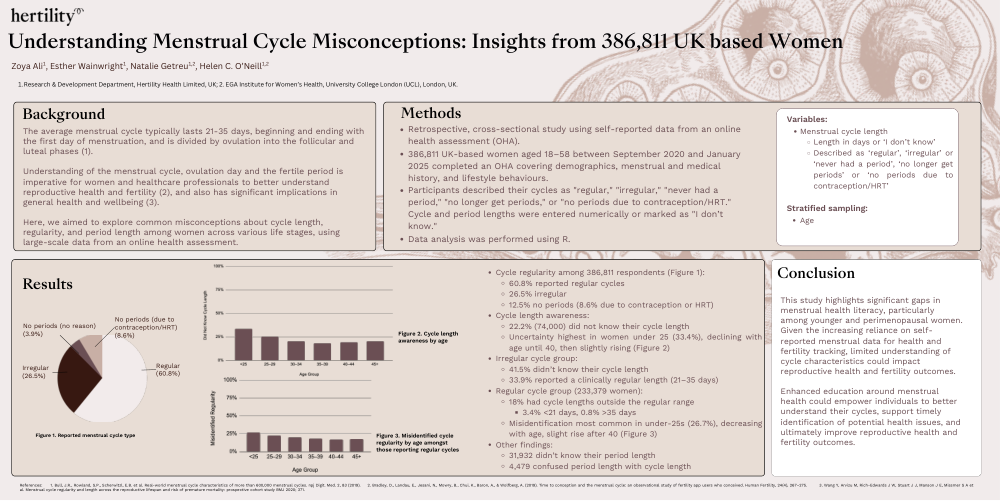
Of 386,811 respondents, 60.8% reported regular cycles, 26.5% irregular, and 12.5% no periods (8.6% due to contraception or HRT). Among all participants, 74,000 (22.2%) did not know their cycle length, with uncertainty most prevalent in women under 25 (33.4%) and gradually decreasing until age 40, where a slight increase was noted.
For those identifying as having irregular cycles, 41.5% did not know their cycle length, and 33.9% reported a length considered clinically regular (21-35 days). Of the 233,379 women who described their cycles as regular, 18% did not have a regular cycle length, with 3.4% below 21 days and 0.8% above 35 days. Misidentified regularity was most common in younger women (26.7% under 25) and decreased with age until 40, when a small rise was observed (16.9% 41-25, 17.2% 45+).
Additionally, 31,932 participants did not know their period length, and 4,479 mistakenly equated their period length with cycle length.
Conclusions:
This study highlights significant gaps in menstrual health literacy, particularly among younger and perimenopausal women.Given the increasing reliance on self-reported menstrual data for health and fertility tracking, limited understanding of cycle characteristics could impact reproductive health and fertility outcomes.
Enhanced education around menstrual health could empower individuals to better understand their cycles, support timely identification of potential health issues, and ultimately improve reproductive health and fertility outcomes.
.