2,281 posters, 63 videos, 56 audios, 43 topics, 18 sessions, 6,174 authors, 2,323 institutions
ePostersLive by SciGen Technologies S.A. All rights reserved.
RCOG World Congress 2025
June 23 - 25, 2025 | ExCeL London, UK
EP.2270
Remote hospital working: The impact on maternity care provision
Poster Presenter
Part of Topic
Women's health & policies
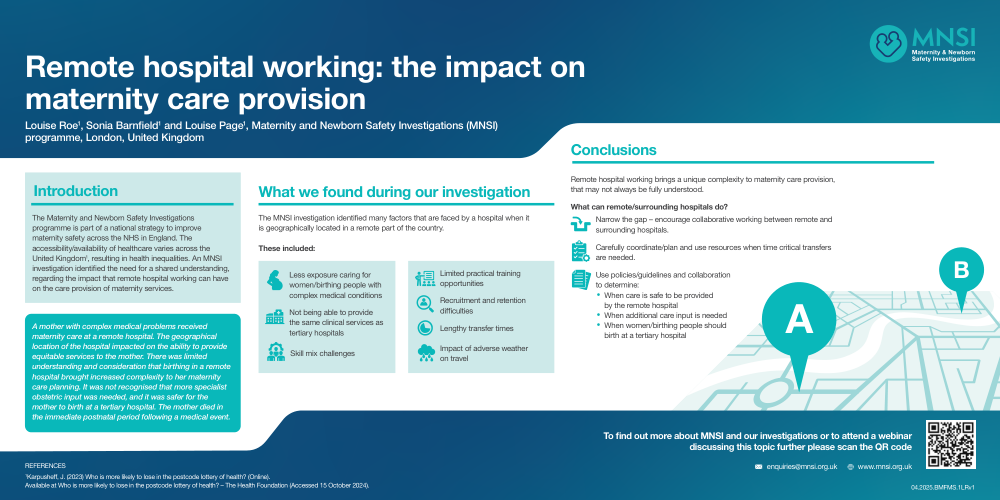
Remote hospital working: the impact on maternity care provision
Introduction
The Maternity and Newborn Safety Investigations
programme is part of a national strategy to improve
maternity safety across the NHS in England. The
accessibility/availability of healthcare varies across the
United Kingdom1, resulting in health inequalities. An MNSI
investigation identified the need for a shared understanding,
regarding the impact that remote hospital working can have
on the care provision of maternity services.
A mother with complex medical problems received
maternity care at a remote hospital. The geographical
location of the hospital impacted on the ability to provide
equitable services to the mother. There was limited
understanding and consideration that birthing in a remote
hospital brought increased complexity to her maternity
care planning. It was not recognised that more specialist
obstetric input was needed, and it was safer for the
mother to birth at a tertiary hospital. The mother died in
the immediate postnatal period following a medical event.
What we found during our investigation
The MNSI investigation identified many factors that are faced by a hospital when it
is geographically located in a remote part of the country.
These included:
- Less exposure caring for women/birthing people with complex medical conditions
- Not being able to provide the same clinical services as tertiary hospitals
- Skill mix challenges
- Limited practical training opportunities
- Recruitment and retention difficulties
- Lengthy transfer times
- Impact of adverse weather on travel
Conclusions
Remote hospital working brings a unique complexity to maternity care provision,
that may not always be fully understood.
What can remote/surrounding hospitals do?
- Narrow the gap – encourage collaborative working between remote and surrounding hospitals.
- Carefully coordinate/plan and use resources when time critical transfers are needed.
- Use policies/guidelines and collaboration to determine:
• When care is safe to be provided by the remote hospital
• When additional care input is needed
• When women/birthing people should birth at a tertiary hospital