2,281 posters, 63 videos, 56 audios, 43 topics, 18 sessions, 6,174 authors, 2,323 institutions
ePostersLive by SciGen Technologies S.A. All rights reserved.
RCOG World Congress 2025
June 23 - 25, 2025 | ExCeL London, UK
EP.2260
Emerging Preconception Behaviour Trends: A Cross-Sectional Analysis of 235,311 UK Women
Poster Presenter
Authors
Affiliations
Part of Topic
Women's health & policies
Emerging Preconception Behaviors Trends: A Cross-Sectional Analysis of 235,311 UK Women
Authors: Zoya Ali 1. Esther Wainwright 1, Natalie Getreu 1,2, Helen C. O’Neill 1,2
1- Research & Development Department, Hertility Health Limited, UK.
2- Institute for Women’s Health, University College London (UCL), London, UK
Objective
To analyse lifestyle behaviors among UK women of reproductive age and assess the prevalence of smoking, vaping, alcohol consumption, and recreational drug use in the context of preconception health.
Design
Cross-sectional study using self-reported data from an online health assessment (OHA).
Method
Data was collected from 235,311 UK-based women aged 18–58 between September 2020 and November 2024. Participants completed an OHA covering demographics, menstrual and medical history, and lifestyle behaviors. Reproductive intentions were categorized as “actively trying to conceive” (TTC) or “planning for future fertility” (PFF). Counts, means, and percentages were calculated using R software to compare lifestyle choices between groups.
Results
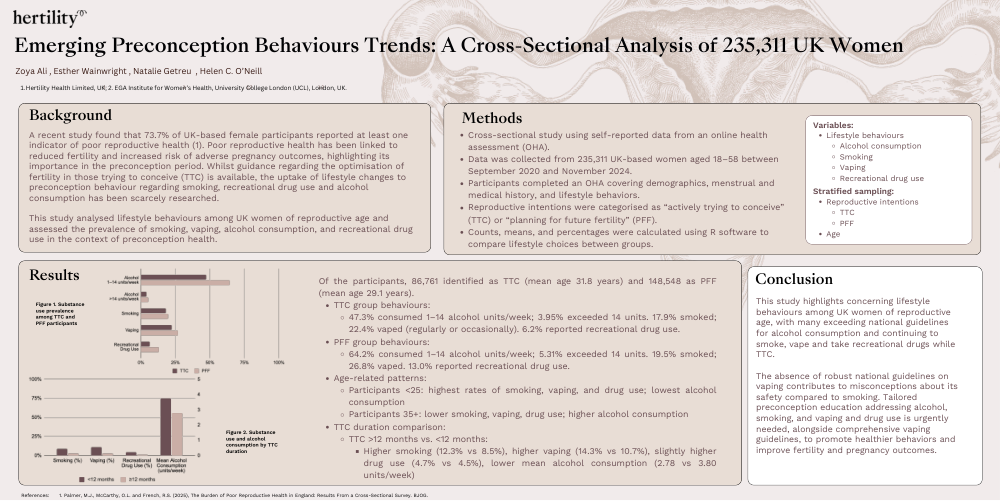
Of the participants, 86,761 identified as TTC (mean age 31.8 years) and 148,548 as PFF (mean age 29.1 years). Among TTC participants, 47.3% consumed 1–14 units of alcohol weekly, and 3.95% exceeded 14 units, the national recommendation for alcohol consumption. Smoking was reported by 17.9%, and 22.40% vaped regularly or occasionally. Recreational drug use was reported by 6.2%.
Among PFF participants, alcohol consumption was more prevalent, with 64.2% consuming 1–14 units weekly and 5.31% exceeding the recommended limit. Smoking and vaping were also more common, with 19.5% smoking and 26.8% vaping. Recreational drug use was reported by 13.0%.
Younger participants (under 25) in both groups reported the highest rates of vaping, smoking and recreational drug use but lower alcohol consumption. In contrast, participants aged 35 and above reported lower rates of smoking, vaping, and drug use but higher alcohol consumption. Among TTC participants trying for over 12 months, smoking ( 12.3% vs 8.5%), vaping (14.3% vs 10.7%) and recreational drug use rates (4.7% vs 4.5%) were higher, while mean alcohol consumption was lower (2.78 vs 3.80 units) than those TTC for less than 12 months.
Conclusions
This study highlights concerning lifestyle behaviors among UK women of reproductive age, with many exceeding national guidelines for alcohol consumption and continuing to smoke, vape and take recreational drugs while TTC. The absence of robust national guidelines on vaping contributes to misconceptions about its safety compared to smoking. Tailored preconception education addressing alcohol, smoking, and vaping and drug use is urgently needed, alongside comprehensive vaping guidelines, to promote healthier behaviors and improve fertility and pregnancy outcomes.