2,281 posters, 63 videos, 56 audios, 43 topics, 18 sessions, 6,174 authors, 2,323 institutions
ePostersLive by SciGen Technologies S.A. All rights reserved.
RCOG World Congress 2025
June 23 - 25, 2025 | ExCeL London, UK
EP.2241
Workplace experiences and supports for pregnancy loss under 24 weeks: National survey
Poster Presenter
Authors
Tommy Harty, Ruadh Kelly-Harrington, Marita Hennessy, Keelin O'Donoghue, Caroline Dalton-O'Connor, Maeve O'Sullivan, Mary Donnelly, Claire Murray, Daniel Nuzum, Sara Leitao
Affiliations
University Hospital Waterford, Pregnancy Loss Research Group, University College Cork, Catherine McAuley School of Nursing and Midwifery, University College Cork, J.E. Cairnes School of Business and Economics, University of Galway, School of Law, University College Cork
Part of Topic
Women's health & policies
BACKGROUND
Pregnancy loss under 24 weeks is the most common complication of pregnancy and can
have long-lasting physical and mental effects on individuals requiring supports that cover
physical, psychological and social domains of care. Based on the 2022 Irish census, over
two thirds of women aged 25-44 were in employment, therefore pregnancy loss is an
important workplace issue as most people are in employment at the time of their
pregnancy loss. In Ireland, currently there is no statutory leave entitlement for those who
experience a pregnancy loss under 24 weeks gestation and access to leave after a
pregnancy loss depends on an individual company's policy. Additional supports beyond
leave are also important in supporting individuals return to work after pregnancy loss.
The aim of this study is to quantitatively examine the workplace experiences of people
following pregnancy loss before 24 weeks according to their workplace characteristics.
METHODS
Purposefully designed onlinecross-sectional quantitative survey which drew upon pre-existing surveys.Inclusion criteria: Women and men in
paid employment in the Republic of Ireland with a lived experience of a pregnancy loss under 24 weeks, between 2018 and2023.
Survey distribution: Online through social media. Additional recruitment through research groups, trade unions, advocacy groups and supportgroups; tailored
recruitment strategy employed to include under-represented groups
RESULTS
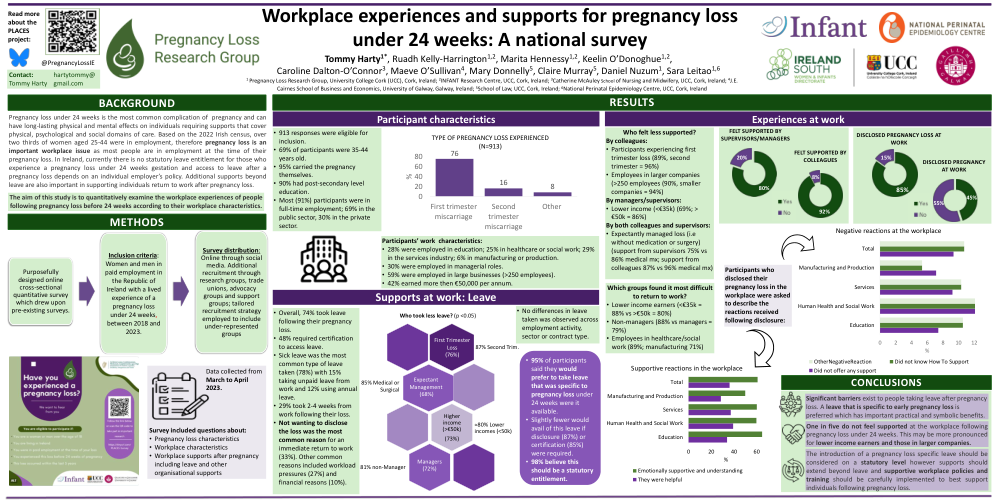
913 responses were eligible for inclusion. 69% of participants were 35-44years old. 95% carried the pregnancy themselves. 90% had post-secondary level education. Most (91%) participants were in full-time employment; 69% in the public sector, 30% in the private sector.
28% were employed in education; 25% in healthcare or social work; 29% in the services industry; 6% in manufacturing or production. 30% were employed in managerial roles. 59% were employed in large businesses (>250 employees).
Overall, 74% took leave following their pregnancy loss. 48% required certificationto access leave. Sick leave was the most common type of leave taken (78%) with 15% taking unpaid leave from work and 12% using annual leave. 29% took 2-4 weeks from work following their loss. Not wanting to disclose the loss was the most common reason for an immediate return to work (33%). Other common reasons included workload pressures (27%) and financial reasons (10%). No differences in leave taken was observed across employment activity, sector or contract type.
95% of participantssaid they would prefer to take leave that was specific to pregnancy loss under 24 weeks were it available. Slightly fewer would avail of this leave if disclosure (87%) or certification (85%) were required. 98% believe this should be a statutory entitlement.
Who felt less supported?
By colleagues: Participants experiencing first trimester loss (89%, second trimester = 96%) Employees in larger companies (>250 employees (90%, smaller companies = 94%) By managers/supervisors: Lower income (<35k 69%, > 50k 86%)By both colleagues and supervisors: Expectantly managed loss (i.e
without medication or surgery) (support from supervisors 75% vs 86% medical mx; support from colleagues 87% vs 96% medical).
Which groups found it most difficult to return to work? Non-managers (88% vs managers =
79%) Employees in healthcare/social work (89%; manufacturing 71%) Participants who disclosed their pregnancy loss in the workplace were asked to describe the reactions received following disclosure: Significant barriers exist to people taking leave after pregnancy loss.
Conclusions
Significant barriers exist to people taking leave after pregnancy
loss. A leave that is specific to early pregnancy loss is
preferred which has important practical and symbolic benefits.
One in five do not feel supported at the workplace following
pregnancy loss under 24 weeks. This may be more pronounced
for lower income earners and those in larger companies.
The introduction of a pregnancy loss specific leave should be
considered on a statutory level however supports should
extend beyond leave and supportive workplace policies and
training should be carefully implemented to best support
individuals following pregnancy loss.