2,281 posters, 63 videos, 56 audios, 43 topics, 18 sessions, 6,174 authors, 2,323 institutions
ePostersLive by SciGen Technologies S.A. All rights reserved.
RCOG World Congress 2025
June 23 - 25, 2025 | ExCeL London, UK
EP.0222
Isolated Fallopian Tube Torsion: More common than we think?
Poster Presenter
Authors
Affiliations
Part of Topic
Early pregnancy complications/early pregnancy and acute gynaecology
Isolated Fallopian Tube Torsion: More common than we think?
Isolated fallopian tube torsion (IFTT) is a gynaecological emergency requiring prompt recognition and treatment. It is extremely rare, with a reported incidence of 1 in 1.5 million women and occurs most commonly on the right side. [1] We present a case series of three patients who presented to our district general hospital, within a 10 month period, all diagnosed with a left sided IFTT. This may suggest this diagnosis is more common than the literature suggests.
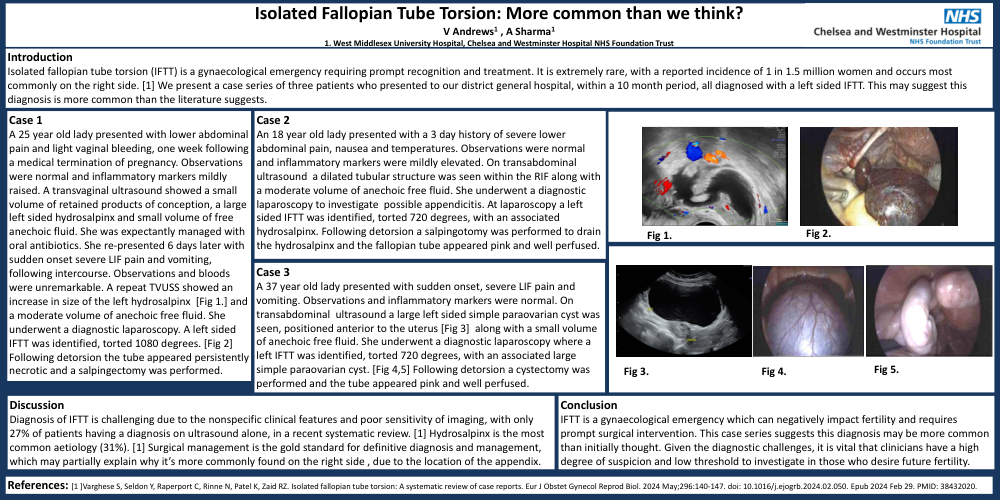
Case 1 A 25 year old lady presented with lower abdominal pain and light vaginal bleeding, one week following a medical termination of pregnancy. Observations were normal and inflammatory markers mildly raised. A transvaginal ultrasound showed a small volume of retained products of conception, a large left sided hydrosalpinx and small volume of free anechoic fluid. She was expectantly managed with oral antibiotics. She re-presented 6 days later with sudden onset severe LIF pain and vomiting, following intercourse. Observations and bloods were unremarkable. A repeat TVUSS showed an increase in size of the left hydrosalpinx [Fig 1.] and a moderate volume of anechoic free fluid. She underwent a diagnostic laparoscopy. A left sided IFTT was identified, torted 1080 degrees. [Fig 2] Following detorsion the tube appeared persistently necrotic and a salpingectomy was performed
Case 2
An 18 year old lady presented with a 3 day history of severe lower abdominal pain, nausea and temperatures. Observations were normal and inflammatory markers were mildly elevated. On transabdominal ultrasound a dilated tubular structure was seen within the RIF along with a moderate volume of anechoic free fluid. She underwent a diagnostic laparoscopy to investigate possible appendicitis. At laparoscopy a left sided IFTT was identified, torted 720 degrees, with an associated hydrosalpinx. Following detorsion a salpingotomy was performed to drain the hydrosalpinx and the fallopian tube appeared pink and well perfused.
Case 3 A 37 year old lady presented with sudden onset, severe LIF pain and vomiting. Observations and inflammatory markers were normal. On transabdominal ultrasound a large left sided simple paraovarian cyst was seen, positioned anterior to the uterus [Fig 3] along with a small volume of anechoic free fluid. She underwent a diagnostic laparoscopy where a left IFTT was identified, torted 720 degrees, with an associated large simple paraovarian cyst. [Fig 4,5] Following detorsion a cystectomy was performed and the tube appeared pink and well perfused.
Discussion Diagnosis of IFTT is challenging due to the nonspecific clinical features and poor sensitivity of imaging, with only 27% of patients having a diagnosis on ultrasound alone, in a recent systematic review. [1] Hydrosalpinx is the most common aetiology (31%). [1] Surgical management is the gold standard for definitive diagnosis and management, which may partially explain why it’s more commonly found on the right side , due to the location of the appendix.
Conclusion IFTT is a gynaecological emergency which can negatively impact fertility and requires prompt surgical intervention. This case series suggests this diagnosis may be more common than initially thought. Given the diagnostic challenges, it is vital that clinicians have a high degree of suspicion and low threshold to investigate in those who desire future fertility.