2,281 posters, 63 videos, 56 audios, 43 topics, 18 sessions, 6,174 authors, 2,323 institutions
ePostersLive by SciGen Technologies S.A. All rights reserved.
RCOG World Congress 2025
June 23 - 25, 2025 | ExCeL London, UK
EP.0216
When One Pregnancy Masks Another: A Rare Case of Heterotropic Pregnancy.
Poster Presenter
Authors
Affiliations
Part of Topic
Early pregnancy complications/early pregnancy and acute gynaecology
WHEN ONE PREGNANCY MASKS ANOTHER: A RARE CASE OF HETEROTOPIC PREGNANCY
Ms. Naima Shatry MBchB, Mmed, MRCOG, Dr. Akalya Ganeshamoorty MBBS, BSc, Ms. Nivedita Das, MBBS,
MRCS, MRCOG, Consultant Obstetrician and Gynaecologist. Mr. Raphael Laiyemo, MBBS, FRCOG, Consultant Obstetrician and Gynaecologist.
Sherwood Forest Hospitals NHS Foundation Trust, Nottinghamshire, United Kingdom
INTRODUCTION
Heterotopic pregnancy is rare and can present similarly to other types of ectopic pregnancy. If not diagnosed in a timely manner, it can be fatal. This case highlights the importance of maintaining a high index of suspicion to ensure early intervention and improve outcomes.
BACKGROUND
Heterotopic pregnancy is diagnosed when ultrasound detects both an intrauterine and ectopic pregnancy (1). Though rare, with an incidence of 1 in 4,000 to 1 in 30,000 (2,3), it can be fatal.
Cases have risen due to increased rates of pelvic inflammatory disease (PID), assisted reproductive technologies (ART), and ovarian stimulation (4). The most common type involves an intrauterine pregnancy with an ectopic in the ampullary portion of the fallopian tube (5), though other locations include the interstitial tube, ovary, cervix, rudimentary horn, or caesarean scar (5).
Symptoms mimic other ectopic pregnancies and may be overlooked if an intrauterine pregnancy is seen on ultrasound
(6). A high index of suspicion is essential for early diagnosis. This case highlights the importance of prompt recognition in managing heterotopic pregnancies.
CASE REPORT
Initial Presentation
We present the case of a 26-year-old Gravida 4 female with three previous early miscarriages. She conceived with Clomiphene and was referred to the early pregnancy unit at six weeks for sharp left iliac fossa pain.
At 6 weeks gestation:
•Presented with left iliac fossa pain
•An ultrasound showed an intrauterine gestational sac
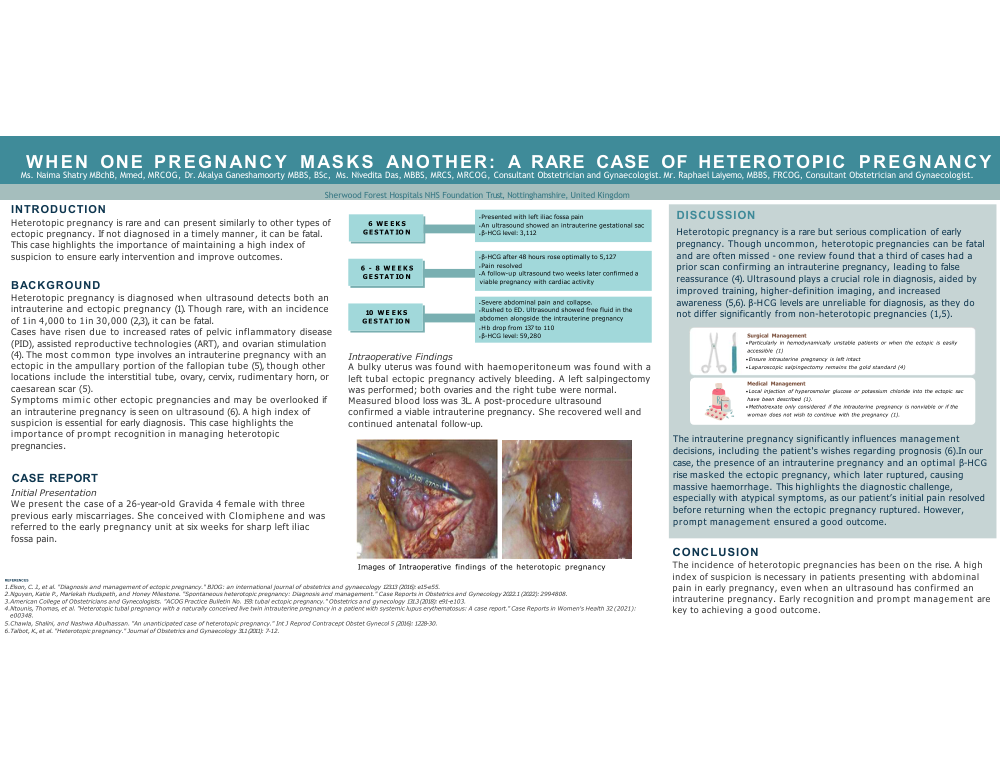
Intraoperative Findings
A bulky uterus was found with haemoperitoneum was found with a left tubal ectopic pregnancy actively bleeding. A left salpingectomy was performed; both ovaries and the right tube were normal. Measured blood loss was 3L. A post- procedure ultrasound confirmed a viable intrauterine pregnancy. She recovered well and continued antenatal follow-up.
DISCUSSION
Heterotopic pregnancy is a rare but serious complication of early pregnancy. Though uncommon, heterotopic pregnancies can be fatal and are often missed - one review found that a third of cases had a prior scan confirming an intrauterine pregnancy, leading to false reassurance (4). Ultrasound plays a crucial role in diagnosis, aided by improved training, higher- definition imaging, and increased awareness (5,6). β-HCG levels are unreliable for diagnosis, as they do not differ significantly from non- heterotopic pregnancies (1,5).
Surgical Management
Medical Management
The intrauterine pregnancy significantly influences management decisions, including the patient's wishes regarding prognosis (6).In our case, the presence of an intrauterine pregnancy and an optimal β-HCG rise masked the ectopic pregnancy, which later ruptured, causing massive haemorrhage. This highlights the diagnostic challenge, especially with atypical symptoms, as our patient’s initial pain resolved before returning when the ectopic pregnancy ruptured. However, prompt management ensured a good outcome.
CONCLUSION
The incidence of heterotopic pregnancies has been on the rise. A high index of suspicion is necessary in patients presenting with abdominal pain in early pregnancy, even when an ultrasound has confirmed an intrauterine pregnancy. Early recognition and prompt management are key to achieving a good outcome.
REFERENCES