2,281 posters, 63 videos, 56 audios, 43 topics, 18 sessions, 6,174 authors, 2,323 institutions
ePostersLive by SciGen Technologies S.A. All rights reserved.
RCOG World Congress 2025
June 23 - 25, 2025 | ExCeL London, UK
EP.0215
Interstitial ectopic pregnancy - a diagnostic and surgical challenge
Poster Presenter
Authors
Affiliations
Part of Topic
Early pregnancy complications/early pregnancy and acute gynaecology
Title: Interstitial ectopic pregnancy - a diagnostic and surgical challenge
Authors: Dr Samanta Favre-Bulle, Miss Charlotte Atkinson
Objective: Interstitial ectopic pregnancies are a rare but life-threatening form of ectopic pregnancy and present a clinical challenge given their potential for massive haemorrhage. Early detection is often difficult, and their management requires a high degree of suspicion and a multidisciplinary approach. Surgical management remains the cornerstone of treatment, and while it is most often successful in resolving the pregnancy, the risk of complications remains high.
Case report:
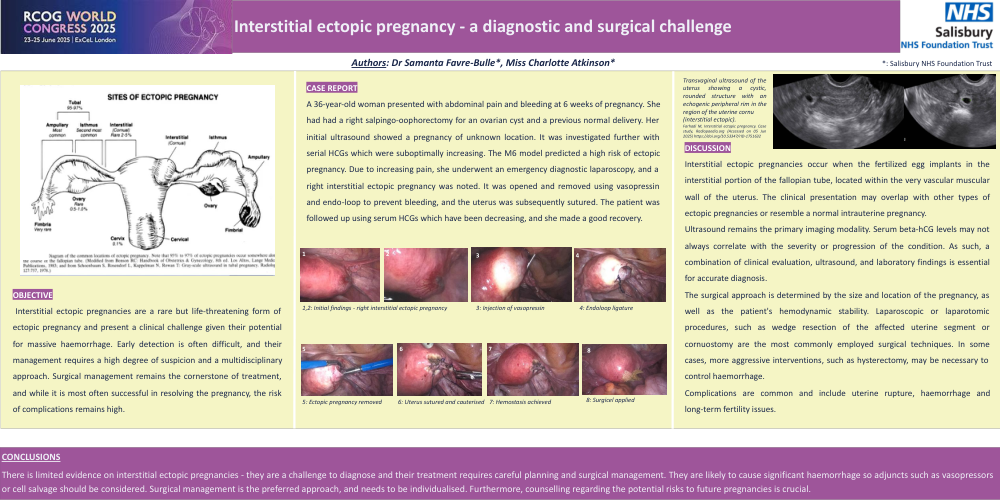
A 36-year-old woman presented with abdominal pain and bleeding at 6 weeks of pregnancy. She had had a right salpingo-ophorectomy for an ovarian cyst and a previous normal delivery. Her initial ultrasound showed a pregnancy of unknown location. It was investigated further with serial HCGs which were suboptimally increasing. The M6 model predicted a high risk of ectopic pregnancy. Due to increasing pain, she underwent an emergency diagnostic laparoscopy, and a right interstitial ectopic pregnancy was noted. It was opened and removed using vasopressin and endo-loop to prevent bleeding, and the uterus was subsequently sutured. The patient was followed up using serum HCGs which have been decreasing, and she made a good recovery.
Discussion:
Interstitial ectopic pregnancies occur when the fertilized egg implants in the interstitial portion of the fallopian tube, located within the very vascular muscular wall of the uterus. The clinical presentation may overlap with other types of ectopic pregnancies or resemble a normal intrauterine pregnancy. Ultrasound remains the primary imaging modality. Serum beta-hCG levels may not always correlate with the severity or progression of the condition. As such, a combination of clinical evaluation, ultrasound, and laboratory findings is essential for accurate diagnosis. The surgical approach is determined by the size and location of the pregnancy, as well as the patient's hemodynamic stability. Laparoscopic or laparotomic procedures, such as wedge resection of the affected uterine segment or cornuostomy are the most commonly employed surgical techniques. In some cases, more aggressive interventions, such as hysterectomy, may be necessary to control haemorrhage. Complications are common and include uterine rupture, haemorrhage and long-term fertility issues.
Conclusions:
There is limited evidence on interstitial ectopic pregnancies - they are a challenge to diagnose and their treatment requires careful planning and surgical management. They are likely to cause significant haemorrhage so adjuncts such as vasopressors or cell salvage should be considered. Surgical management is the preferred approach, and needs to be individualised. Furthermore, counselling regarding the potential risks to future pregnancies is crucial.