2,281 posters, 63 videos, 56 audios, 43 topics, 18 sessions, 6,174 authors, 2,323 institutions
ePostersLive by SciGen Technologies S.A. All rights reserved.
RCOG World Congress 2025
June 23 - 25, 2025 | ExCeL London, UK
EP.2113
Understanding the Risk Factors of Experiencing Reproductive Coercion
Part of Topic
Sexual & reproductive health
Video
Understanding the risk factors of experiencing reproductive coercion
Saldanha S¹, Botfield JR², LaGrappe D³, Moradi M⁴, Mazza D¹ ²
¹ SPHERE, NHMRC Centre of Research Excellence
² Department of General Practice, Monash University, Australia
³ Judith Lumley Centre, La Trobe University, Australia
⁴ Global Women’s Health Unit, Monash University, Australia
Background
-
Reproductive coercion (RC) refers to a range of behaviours that interfere with individual reproductive autonomy and decision-making.
-
Can be imposed by intimate partners, family members, health providers, coercive structures, and social systems.
-
Currently, there is limited understanding of the risk factors of experiencing RC across interpersonal and structural domains, limiting efforts to inform future prevention and intervention.
Aims
-
To explore the scope of evidence on the risk factors of experiencing reproductive coercion.
-
To contextualise identified risk factors from the perspective of health and social providers within the Australian setting.
Methods
1. Scoping review
-
Five databases searched: MEDLINE, Embase, Scopus, CINAHL, PsycINFO
-
English language, peer-reviewed articles searched from 1 Jan 2010 to 2 June 2024
2. Qualitative interviews
-
Semi-structured interviews conducted with Australian health and social service providers
-
Reflexive thematic analysis* within a narrative constructivist approach
Results
Scoping review
-
101 included articles reviewed across 27 countries
-
Most were cross-sectional surveys (n = 67)
-
Most focused on pregnancy coercion (n = 79) and contraceptive sabotage (n = 73)
-
Common perpetrators identified were male partners (n = 61)
-
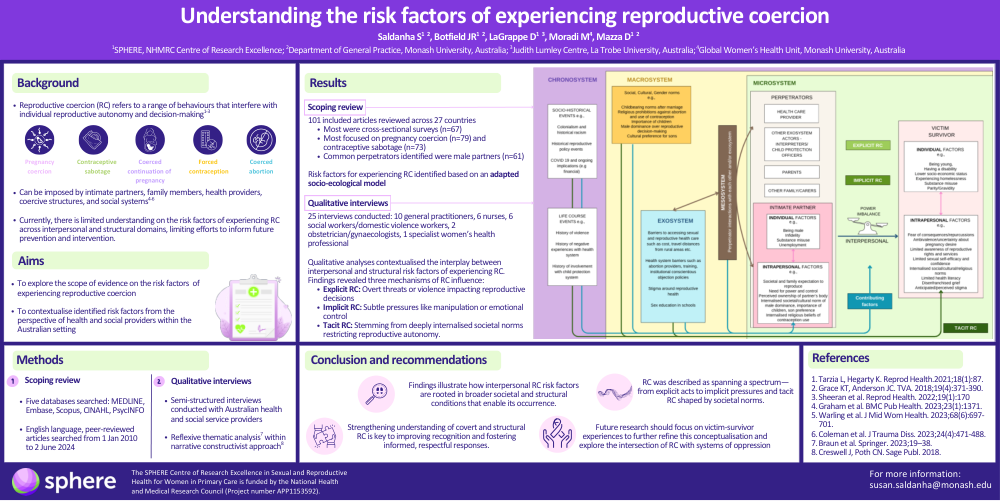
Risk factors for experiencing RC identified based on an adapted socio-ecological model
Qualitative interviews
-
25 interviews conducted:
-
10 general practitioners
-
6 nurses
-
6 social workers/domestic violence workers
-
2 obstetrician/gynaecologists
-
1 specialist women’s health professional
-
-
Qualitative analyses contextualised the interplay between interpersonal and structural risk factors of experiencing RC
-
Findings revealed three mechanisms of RC influence:
-
Explicit RC: Overt threats or violence impacting reproductive decisions
-
Implicit RC: Subtle pressures like manipulation or emotional control
-
Tacit RC: Stemming from deeply internalised societal norms restricting reproductive autonomy
-
Conclusion and recommendations
-
Findings illustrate how interpersonal RC risk factors are rooted in broader societal and structural conditions that enable its occurrence
-
RC spans a spectrum—from explicit acts to implicit pressures and tacit RC shaped by societal norms
-
Strengthening understanding of covert and structural RC is key to improving recognition and fostering informed, respectful responses
-
Future research should focus on victim-survivor experiences to further refine this conceptualisation and explore the intersection of RC with systems of oppression
References
-
Tarzia L, Hegarty K. Reprod Health. 2021;18(1):87.
-
Grace KT, Anderson JC. TVA. 2018;19(4):371–390.
-
Sheeran et al. Reprod Health. 2022;19(1):170.
-
Graham et al. BMC Public Health. 2023;23(1):1371.
-
Warling et al. J Midwifery Womens Health. 2023;68(6):697–701.
-
Coleman et al. J Trauma Dissociation. 2023;24(4):471–488.
-
Braun et al. Springer. 2023:19–38.
-
Creswell J, Poth CN. Sage Publications. 2018.