2,281 posters, 63 videos, 56 audios, 43 topics, 18 sessions, 6,174 authors, 2,323 institutions
ePostersLive by SciGen Technologies S.A. All rights reserved.
RCOG World Congress 2025
June 23 - 25, 2025 | ExCeL London, UK
EP.2112
MAYER-ROKITANSKY-KUSTER-HAUSER SYNDROME: IMPACT OF VAGINOPLASTY ON SEXUALITY AND QUALITY OF LIFE
Part of Topic
Sexual & reproductive health
Introduction:
Rokitansky syndrome, also known as Mayer-Rokitansky-Küster-Hauser (MRKH) syndrome, is a rare congenital anomaly characterized by uterovaginal aplasia (absence of the uterus and the upper two-thirds of the vagina). The primary goal of treatment is to create a neovagina and restore sexual function. However, postoperative outcomes regarding overall quality of life and sexual well-being remain debated. This study aimed to evaluate the quality of life and sexual function in patients who underwent surgical treatment for MRKH syndrome.
Methods :
We conducted a retrospective, longitudinal, descriptive study involving 30 women with MRKH syndrome who underwent vaginoplasty (Davydovor McIndoe technique) at least one year prior. This study was conducted from 1998 to 2023 at the Maternity Center of Tunis. Patients were recruited during outpatient consultations, and a control group of sexually active women without gynecologic or psychiatric conditions was also enrolled. Data were collected through medical records and structured interviews, assessing sociodemographic and clinical characteristics, vaginal length, postoperative complications, and subjective perceptions of femininity, sexuality, and motherhood. Standardized tools used included the Arabic versions of the Female Sexual Function Index (FSFI) and the SF-36 quality-of life questionnaire.
Results:
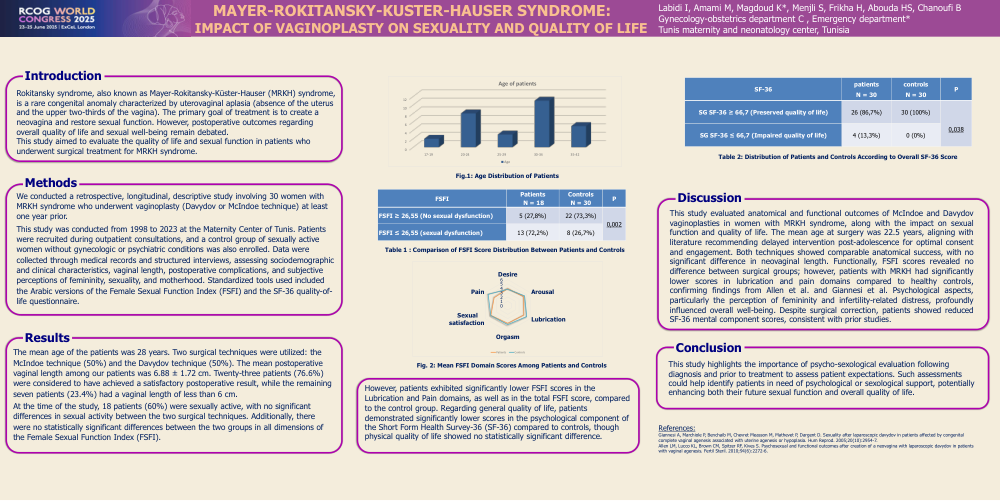
The mean age of the patients was 28 years. Two surgical techniques were utilized: the McIndoe technique (50%) and the Davydovtechnique (50%). The mean postoperative vaginal length among our patients was 6.88 ±1.72 cm. Twenty-three patients (76.6%) were considered to have achieved a satisfactory postoperative result, while the remaining seven patients (23.4%) had a vaginal length of less than 6 cm. At the time of the study, 18 patients (60%) were sexually active, with no significant differences in sexual activity between the two surgical techniques. Additionally, there were no statistically significant differences between the two groups in all dimensions of the Female Sexual Function Index (FSFI). However, patients exhibited significantly lower FSFI scores in the Lubrication and Pain domains, as well as in the total FSFI score, compared to the control group. Regarding general quality of life, patients demonstrated significantly lower scores in the psychological component of the Short Form Health Survey-36 (SF-36) compared to controls, though physical quality of life showed no statistically significant difference.
Discussion:
Thisstudyevaluatedanatomical andfunctional outcomesofMcIndoeandDavydov vaginoplasties inwomenwithMRKHsyndrome, alongwith the impact on sexual functionandqualityof life.Themeanageat surgerywas22.5years,aligningwith literaturerecommendingdelayed interventionpost-adolescence foroptimal consent andengagement.Bothtechniquesshowedcomparableanatomical success,withno significant difference in neovaginal length. Functionally, FSFI scores revealed no differencebetweensurgical groups;however, patients with MRKH had significantly lower scores in lubrication and pain domains compared to healthy controls, confirming findings fromAllen et al. and Giannesi et al. Psychological aspects, particularly the perception of femininity and infertility-relateddistress, profoundly influencedoverallwell-being.Despitesurgical correction, patients showed reduced SF-36mental component scores,consistent with prior studies.
Conclusion:
This study highlights the importance of psycho-sexologicalevaluation following diagnosis and prior to treatment to assess patient expectations. Such assessments could help identify patients in need of psychological or sexological support, potentially enhancing both their future sexual function and overall quality of life.