2,281 posters, 63 videos, 56 audios, 43 topics, 18 sessions, 6,174 authors, 2,323 institutions
ePostersLive by SciGen Technologies S.A. All rights reserved.
RCOG World Congress 2025
June 23 - 25, 2025 | ExCeL London, UK
EP.0208
Retroperitoneal Haematoma Following Vaginal Hysterectomy: Rare Complication with Diagnostic and Management Challenges
Poster Presenter
Authors
Affiliations
Part of Topic
Early pregnancy complications/early pregnancy and acute gynaecology
Retroperitoneal Hematoma Following Vaginal Hysterectomy: A Rare Complication with Diagnostic and Management Challenges
Introduction:
Vaginal hysterectomy is a common surgical procedure for treating conditions such as uterine prolapse and heavy menstrual bleeding. While generally low-risk, haemorrhage occurs in approximately 2.5% of cases, typically due to loose vascular pedicles or inadvertent injury to surrounding structures. Retroperitoneal hematoma following vaginal hysterectomy is an uncommon but significant complication, presenting diagnostic and management challenges due to its rare occurrence and potential for substantial morbidity.
Day 1 Post Op:
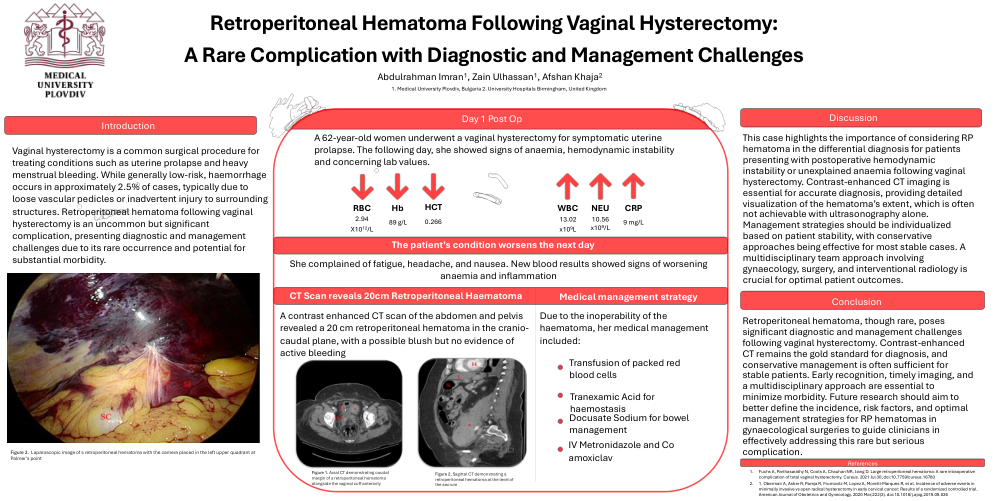
A 62-year-old women underwent a vaginal hysterectomy for symptomatic uterine prolapse. The following day, she showed signs of anaemia, hemodynamic instability and concerning lab values.
The patient’s condition worsens the next day
She complained of fatigue, headache, and nausea. New blood results showed signs of worsening anaemia and inflammation
CT Scan reveals 20cm Retroperitoneal Haematoma
A contrast enhanced CT scan of the abdomen and pelvis revealed a 20 cm retroperitoneal hematoma in the cranio-caudal plane, with a possible blush but no evidence of active bleeding
Medical management strategy:
Due to the inoperability of the haematoma, her medical management included:
Transfusion of packed red blood cells, Tranexamic Acid for haemostasis, Docusate Sodium for bowel management, IV Metronidazole and Co amoxiclav
Discussion:
This case highlights the importance of considering RP hematoma in the differential diagnosis for patients presenting with postoperative hemodynamic instability or unexplained anaemia following vaginal hysterectomy. Contrast-enhanced CT imaging is essential for accurate diagnosis, providing detailed visualization of the hematoma’s extent, which is often not achievable with ultrasonography alone. Management strategies should be individualized based on patient stability, with conservative approaches being effective for most stable cases. A multidisciplinary team approach involving gynaecology, surgery, and interventional radiology is crucial for optimal patient outcomes.
Conclusion:
Retroperitoneal hematoma, though rare, poses significant diagnostic and management challenges following vaginal hysterectomy. Contrast-enhanced CT remains the gold standard for diagnosis, and conservative management is often sufficient for stable patients. Early recognition, timely imaging, and a multidisciplinary approach are essential to minimize morbidity. Future research should aim to better define the incidence, risk factors, and optimal management strategies for RP hematomas in gynaecological surgeries to guide clinicians in effectively addressing this rare but serious complication.