2,281 posters, 63 videos, 56 audios, 43 topics, 18 sessions, 6,174 authors, 2,323 institutions
ePostersLive by SciGen Technologies S.A. All rights reserved.
RCOG World Congress 2025
June 23 - 25, 2025 | ExCeL London, UK
EP.2081
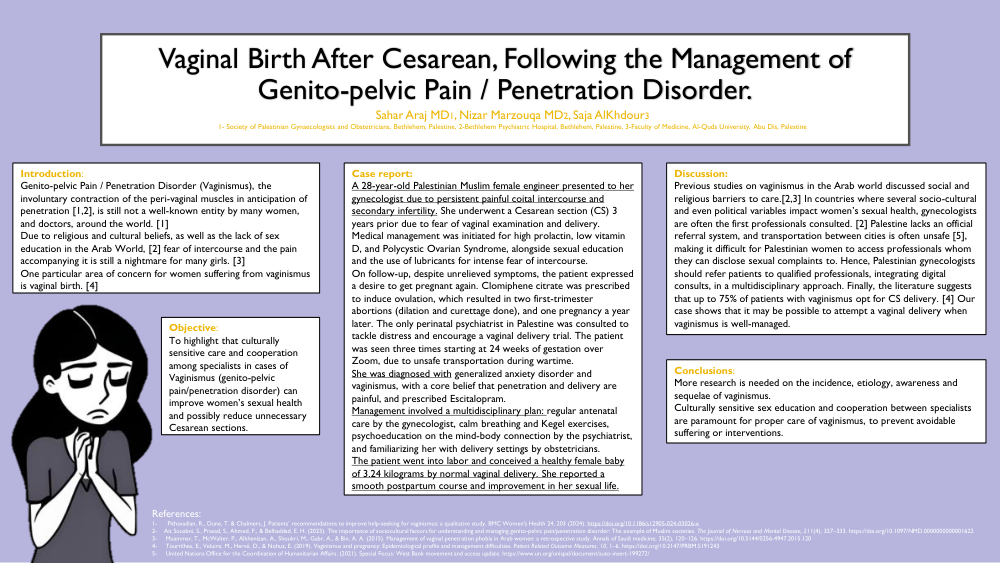
Vaginal Birth After Cesarean, Following the Management of Genito-pelvic Pain / Penetration Disorder.
Part of Topic
Sex and biopsychosocial aspects of O&G
Vaginal Birth After Cesarean, Following the Management of Genito-pelvic Pain / Penetration Disorder.
Sahar Araj MD1, Nizar Marzouqa MD2, Saja AlKhdour3
1- Society of Palestinian Gynaecologists and Obstetricians, Bethlehem, Palestine, 2-Bethlehem Psychiatric Hospital, Bethlehem, Palestine, 3-Faculty of Medicine, Al-Quds University, Abu Dis, Palestine
Introduction:
Genito-pelvic Pain / Penetration Disorder (Vaginismus), the involuntary contraction of the peri-vaginal muscles in anticipation of penetration [1,2], is still not a well-known entity by many women, and doctors, around the world. [1]
Due to religious and cultural beliefs, as well as the lack of sex education in the Arab World, [2] fear of intercourse and the pain accompanying it is still a nightmare for many girls. [3]
One particular area of concern for women suffering from vaginismus is vaginal birth. [4]
Case report:
A 28-year-old Palestinian Muslim female engineer presented to her gynecologist due to persistent painful coital intercourse and secondary infertility. She underwent a Cesarean section (CS) 3 years prior due to fear of vaginal examination and delivery. Medical management was initiated for high prolactin, low vitamin D, and Polycystic Ovarian Syndrome, alongside sexual education and the use of lubricants for intense fear of intercourse.
On follow-up, despite unrelieved symptoms, the patient expressed a desire to get pregnant again. Clomiphene citrate was prescribed to induce ovulation, which resulted in two first-trimester abortions (dilation and curettage done), and one pregnancy a year later. The only perinatal psychiatrist in Palestine was consulted to tackle distress and encourage a vaginal delivery trial. The patient was seen three times starting at 24 weeks of gestation over Zoom, due to unsafe transportation during wartime.
She was diagnosed with generalized anxiety disorder and vaginismus, with a core belief that penetration and delivery are painful, and prescribed Escitalopram.
Management involved a multidisciplinary plan: regular antenatal care by the gynecologist, calm breathing and Kegel exercises, psychoeducation on the mind-body connection by the psychiatrist, and familiarizing her with delivery settings by obstetricians.
The patient went into labor and conceived a healthy female baby of 3.24 kilograms by normal vaginal delivery. She reported a smooth postpartum course and improvement in her sexual life.
Discussion:
Previous studies on vaginismus in the Arab world discussed social and religious barriers to care.[2,3] In countries where several socio-cultural and even political variables impact women’s sexual health, gynecologists are often the first professionals consulted. [2] Palestine lacks an official referral system, and transportation between cities is often unsafe [5], making it difficult for Palestinian women to access professionals whom they can disclose sexual complaints to. Hence, Palestinian gynecologists should refer patients to qualified professionals, integrating digital consults, in a multidisciplinary approach. Finally, the literature suggests that up to 75% of patients with vaginismus opt for CS delivery. [4] Our case shows that it may be possible to attempt a vaginal delivery when vaginismus is well-managed.
Conclusions:
More research is needed on the incidence, etiology, awareness and sequelae of vaginismus.
Culturally sensitive sex education and cooperation between specialists are paramount for proper care of vaginismus, to prevent avoidable suffering or interventions.