2,281 posters, 63 videos, 56 audios, 43 topics, 18 sessions, 6,174 authors, 2,323 institutions
ePostersLive by SciGen Technologies S.A. All rights reserved.
RCOG World Congress 2025
June 23 - 25, 2025 | ExCeL London, UK
EP.2078
Exploring access to pyschosexual services across the UK
Poster Presenter
Part of Topic
Sex and biopsychosocial aspects of O&G
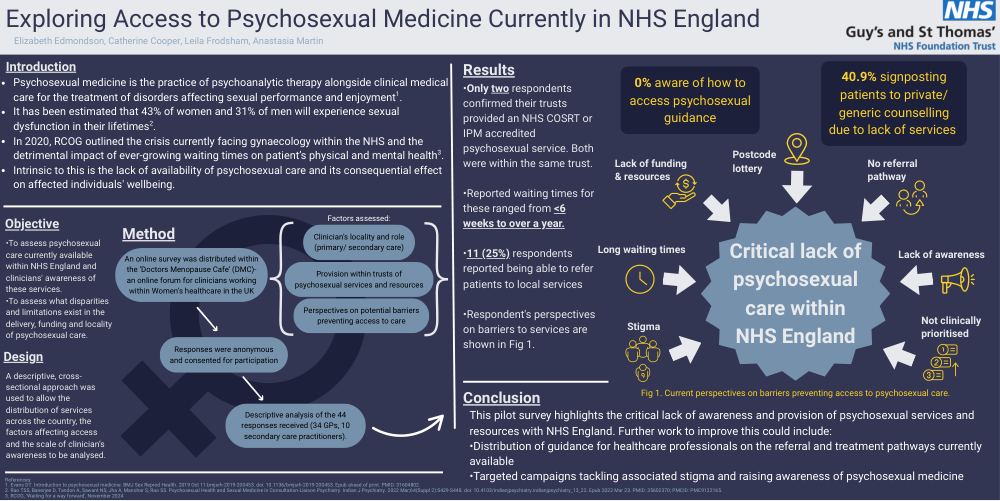
Exploring access to psychosexual medicine currently in NHS england.
Itroduction
Psychosexual medicine is the practice of psychoanalytic therapy alongside clinical medical care for the treatment of disorders affecting sexual performance and enjoyment (1).
It has been estimated that 43% of women and 31% of men will experience sexual dysfunction in their lifetimes (2).
In 2020, RCOG outlined the crisis currently facing gynaecology within the NHS and the detrimental impact of ever-growing waiting times on patient’s physical and mental health (3). Intrinsic to this is the lack of availability of psychosexual care and its consequential effect on affected individuals' wellbeing.
Objective
To assess psychosexual care currently available within NHS England and clinicians' awareness of these services.
To assess what disparities and limitations exist in the delivery, funding and locality of psychosexual care.
Design
A descriptive, cross- sectional approach was used to allow the distribution of services across the country, the factors affecting access and the scale of clinician’s awareness to be analysed.
Results
Only two respondents confirmed their trusts provided an NHS COSRT or IPM accredited psychosexual service. Both were within the same trust.
0% aware of how to access psychosexual guidance, 40.9% signposting patients to private/ generic counselling due to lack of services.
Reported waiting times for these ranged from <6 weeks to over a year.
11 (25%) respondents reported being able to refer patients to local services
Respondent's perspectives on barriers to services are shown in Fig 1.
Conclusion
This pilot survey highlights the critical lack of awareness and provision of psychosexual services and resources with NHS England.
Further work to improve this could include:
•Distribution of guidance for healthcare professionals on the referral and treatment pathways currently available
•Targeted campaigns tackling associated stigma and raising awareness of psychosexual medicine