2,281 posters, 63 videos, 56 audios, 43 topics, 18 sessions, 6,174 authors, 2,323 institutions
ePostersLive by SciGen Technologies S.A. All rights reserved.
RCOG World Congress 2025
June 23 - 25, 2025 | ExCeL London, UK
EP.0207
Wernicke’s Encephalopathy in Pregnancy: A Rare Complication of Severe Hyperemesis Gravidarum
Poster Presenter
Authors
Imene Labidi, Sana Menjli, Haithem Aloui, Hassine Saber Abouda
Affiliations
Part of Topic
Early pregnancy complications/early pregnancy and acute gynaecology
Introduction :
Wernicke’s encephalopathy (WE) is a neurological emergency resulting from thiamine (vitamin B1) deficiency, affecting primarily the hippocampo mamillo–thalamic circuit. It also typically involves the periaqueductal gray matter around the Sylvian aqueduct and the floor of the fourth ventricle. This condition is a serious central nervous system disorder. While WE is classically associated with chronic alcohol use, it may also occur in non alcoholic settings. We present a case of Wernicke’s encephalopathy triggered by intractable vomiting in a pregnant woman.
Case report:
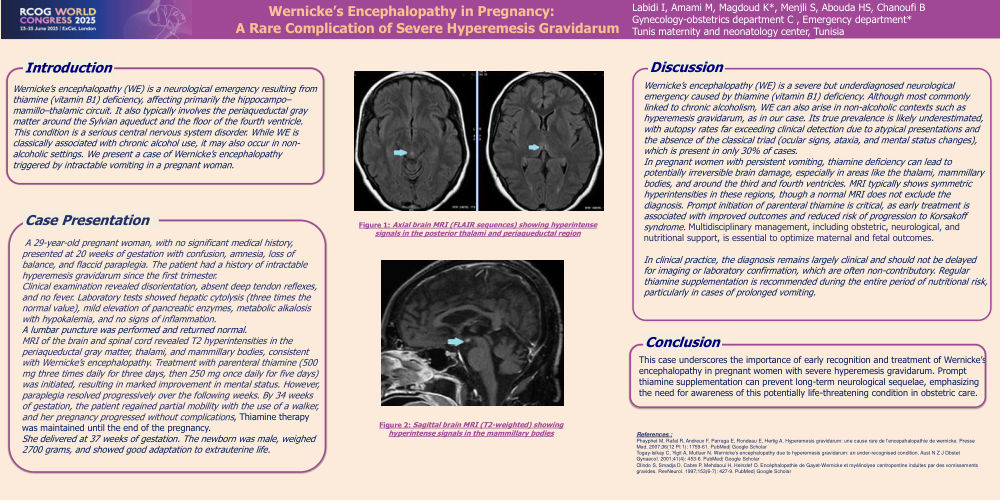
A 29-year-old pregnant woman, with no significant medical history, presented at 20 weeks of gestation with confusion, amnesia, loss of balance, and flaccid paraplegia. The patient had a history of intractable hyperemesis gravidarum since the first trimester. Clinical examination revealed disorientation, absent deep tendon reflexes, and no fever. Laboratory tests showed hepatic cytolysis (three times the normal value), mild elevation of pancreatic enzymes, metabolic alkalosis with hypokalemia, and no signs of inflammation. A lumbar puncture was performed and returned normal. MRI of the brain and spinal cord revealed T2 hyperintensities in the periaqueductal gray matter, thalami, and mammillary bodies, consistent with Wernicke’s encephalopathy. Treatment with parenteral thiamine (500 mg three times daily for three days, then 250 mg once daily for five days) was initiated, resulting in marked improvement in mental status. However, paraplegia resolved progressively over the following weeks. By 34 weeks of gestation, the patient regained partial mobility with the use of a walker, and her pregnancy progressed without complications, Thiamine therapy was maintained until the end of the pregnancy. She delivered at 37 weeks of gestation. The newborn was male, weighed 2700 grams, and showed good adaptation to extrauterine life.
Discussion:
Wernicke’s encephalopathy (WE) is a severe but underdiagnosed neurological emergency caused by thiamine (vitamin B1) deficiency. Although most commonly linked to chronic alcoholism, WE can also arise in non-alcoholic contexts such as hyperemesis gravidarum, as in our case. Its true prevalence is likely underestimated, with autopsy rates far exceeding clinical detection due to atypical presentations and the absence of the classical triad (ocular signs, ataxia, and mental status changes), which is present in only 30% of cases. In pregnant women with persistent vomiting, thiamine deficiency can lead to potentially irreversible brain damage, especially in areas like the thalami, mammillary bodies, and around the third and fourth ventricles. MRI typically shows symmetric hyperintensities in these regions, though a normal MRI does not exclude the diagnosis. Prompt initiation of parenteral thiamine is critical, as early treatment is associated with improved outcomes and reduced risk of progression to Korsakoff syndrome. Multidisciplinary management, including obstetric, neurological, and nutritional support, is essential to optimize maternal and fetal outcomes. In clinical practice, the diagnosis remains largely clinical and should not be delayed for imaging or laboratory confirmation, which are often non-contributory. Regular thiamine supplementation is recommended during the entire period of nutritional risk, particularly in cases of prolonged vomiting.
Conclusion:
This case underscores the importance of early recognition and treatment of Wernicke’s encephalopathy in pregnant women with severe hyperemesis gravidarum. Prompt thiamine supplementation can prevent long-term neurological sequelae, emphasizing the need for awareness of this potentially life-threatening condition in obstetric care.