2,281 posters, 63 videos, 56 audios, 43 topics, 18 sessions, 6,174 authors, 2,323 institutions
ePostersLive by SciGen Technologies S.A. All rights reserved.
RCOG World Congress 2025
June 23 - 25, 2025 | ExCeL London, UK
EP.2040
Navigating Uncertainty: Fertility-Sparing Management of Uterine STUMP
Poster Presenter
Authors
Affiliations
Part of Topic
Reproductive medicine/assisted reproduction
Audio
Navigating Uncertainty: Fertility-Sparing Management of Uterine STUMP
Introduction:
.Smooth Muscle Tumor of Uncertain Malignant Potential (STUMP) is a rare uterine tumor
diagnosis found in only 0.01% of cases. [1]
When a uterine leiomyoma can not be classified as a standard/variant leiomyoma, adenomyoma, or
leiomyosarcoma, it is commonly labeled as a uterine smooth muscle tumor of uncertain malignant
potential (STUMP).
The standard treatment currently recommended is total abdominal hysterectomy, [2] but ideal
management must be based on diagnosis. Given the patient's age and fertility issues, our Tumor Board
advised for expectant management in this case, with the use of IHC ,imaging and clinical markers.
Limited data exist on its behavior and prognosis, so ongoing research is focused on better
understanding it.
Case Particulars:
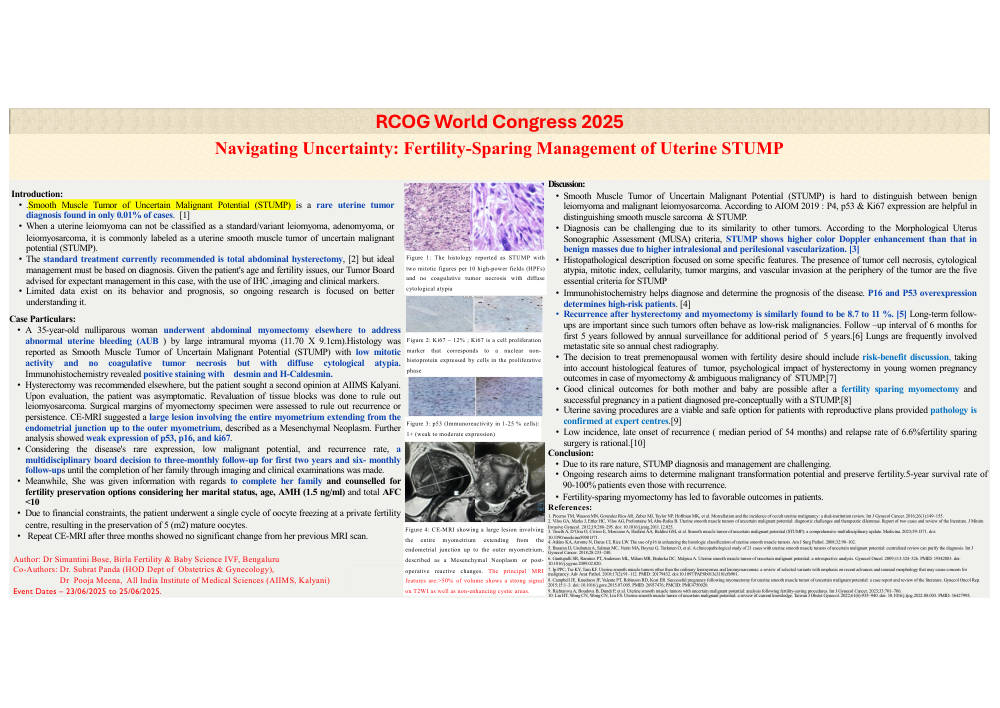
A 35-year-old nulliparous woman underwent abdominal myomectomy elsewhere to address
abnormal uterine bleeding (AUB ) by large intramural myoma (11.70 X 9.1cm).Histology was
reported as Smooth Muscle Tumor of Uncertain Malignant Potential (STUMP) with low mitotic
activity and no coagulative tumor necrosis but with diffuse cytological atypia.
Immunohistochemistry revealed positive staining with desmin and H-Caldesmin.
Hysterectomy was recommended elsewhere, but the patient sought a second opinion at AIIMS Kalyani.
Upon evaluation, the patient was asymptomatic. Revaluation of tissue blocks was done to rule out
leiomyosarcoma. Surgical margins of myomectomy specimen were assessed to rule out recurrence or
persistence. CE-MRI suggested a large lesion involving the entire myometrium extending from the
endometrial junction up to the outer myometrium, described as a Mesenchymal Neoplasm. Further
analysis showed weak expression of p53, p16, and ki67.
Considering the disease's rare expression, low malignant potential, and recurrence rate, a
multidisciplinary board decision to three-monthly follow-up for first two years and six- monthly
follow-ups until the completion of her family through imaging and clinical examinations was made.
Meanwhile, She was given information with regards to complete her family and counselled for
fertility preservation options considering her marital status, age, AMH (1.5 ng/ml) and total AFC
<10
Due to financial constraints, the patient underwent a single cycle of oocyte freezing at a private fertility
centre, resulting in the preservation of 5 (m2) mature oocytes.
Repeat CE-MRI after three months showed no significant change from her previous MRI scan.
Discussion:
Smooth Muscle Tumor of Uncertain Malignant Potential (STUMP) is hard to distinguish between benign
leiomyoma and malignant leiomyosarcoma. According to AIOM 2019 : P4, p53 & Ki67 expression are helpful in
distinguishing smooth muscle sarcoma & STUMP.
Diagnosis can be challenging due to its similarity to other tumors. According to the Morphological Uterus
Sonographic Assessment (MUSA) criteria, STUMP shows higher color Doppler enhancement than that in
benign masses due to higher intralesional and perilesional vascularization. [3]
Histopathological description focused on some specific features. The presence of tumor cell necrosis, cytological
atypia, mitotic index, cellularity, tumor margins, and vascular invasion at the periphery of the tumor are the five
essential criteria for STUMP
Immunohistochemistry helps diagnose and determine the prognosis of the disease. P16 and P53 overexpression
determines high-risk patients. [4]
Recurrence after hysterectomy and myomectomy is similarly found to be 8.7 to 11 %. [5] Long-term
follow-ups are important since such tumors often behave as low-risk malignancies. Follow –up interval of 6
months for first 5 years followed by annual surveillance for additional period of 5 years.[6] Lungs are frequently
involved metastatic site so annual chest radiography.
The decision to treat premenopausal women with fertility desire should include risk-benefit discussion, taking
into account histological features of tumor, psychological impact of hysterectomy in young women pregnancy
outcomes in case of myomectomy & ambiguous malignancy of STUMP.[7]
Good clinical outcomes for both mother and baby are possible after a fertility sparing myomectomy and
successful pregnancy in a patient diagnosed pre-conceptually with a STUMP.[8]
Uterine saving procedures are a viable and safe option for patients with reproductive plans provided pathology is
confirmed at expert centres.[9]
Low incidence, late onset of recurrence ( median period of 54 months) and relapse rate of 6.6%fertility sparing
surgery is rational.[10]
Conclusion:
Due to its rare nature, STUMP diagnosis and management are challenging.
Ongoing research aims to determine malignant transformation potential and preserve fertility.5-year survival rate of
90-100% patients even those with recurrence.
Fertility-sparing myomectomy has led to favorable outcomes in patients.
References:
1. Picerno TM, Wasson MN, Gonzalez Rios AR, Zuber MJ, Taylor NP, Hoffman MK, et al. Morcellation and the incidence of occult uterine malignancy: a dual-institution review. Int J Gynecol Cancer. 2016;26(1):149–155.
2. Vilos GA, Marks J, Ettler HC, Vilos AG, Prefontaine M, Abu-Rafea B. Uterine smooth muscle tumors of uncertain malignant potential: diagnostic challenges and therapeutic dilemmas. Report of two cases and review of the literature. J Minim
Invasive Gynecol. 2012;19:288–295. doi: 10.1016/j.jmig.2011.12.025.
3. Tinelli A, D’Oria O, Civino E, Morciano A, Hashmi AA, Baldini GM, et al. Smooth muscle tumor of uncertain malignant potential (STUMP): a comprehensive multidisciplinary update. Medicina. 2023;59:1371. doi:
10.3390/medicina59081371.
4. Atkins KA, Arronte N, Darus CJ, Rice LW. The use of p16 in enhancing the histologic classification of uterine smooth muscle tumors. Am J Surg Pathol. 2008;32:98–102.
5. Basaran D, Usubutun A, Salman MC, Narin MA, Boyraz G, Turkmen O, et al. A clinicopathological study of 21 cases with uterine smooth muscle tumors of uncertain malignant potential: centralized review can purify the diagnosis. Int J
Gynecol Cancer. 2018;28:233–240.
6. Guntupalli SR, Ramirez PT, Anderson ML, Milam MR, Bodurka DC, Malpica A. Uterine smooth muscle tumor of uncertain malignant potential: a retrospective analysis. Gynecol Oncol. 2009;113:324–326. PMID: 19342083. doi:
10.1016/j.ygyno.2009.02.020.
7. Ip PPC, Tse KY, Tam KF. Uterine smooth muscle tumors other than the ordinary leiomyomas and leiomyosarcomas: a review of selected variants with emphasis on recent advances and unusual morphology that may cause concern for
malignancy. Adv Anat Pathol. 2010;17(2):91–112. PMID: 20179432. doi:10.1097/PAP.0b013e3181cfb901.
8. Campbell JE, Knudtson JF, Valente PT, Robinson RD, Kost ER. Successful pregnancy following myomectomy for uterine smooth muscle tumor of uncertain malignant potential: a case report and review of the literature. Gynecol Oncol Rep.
2015;15:1–3. doi: 10.1016/j.gore.2015.07.005. PMID: 26937476; PMCID: PMC4750020.
9. Richtarova A, Boudova B, Dundr P, et al. Uterine smooth muscle tumors with uncertain malignant potential: analysis following fertility-saving procedures. Int J Gynecol Cancer. 2023;33:701–706.
10. Liu HT, Wong CN, Wong CN, Liu FS. Uterine smooth muscle tumor of uncertain malignant potential: a review of current knowledge. Taiwan J Obstet Gynecol. 2022;61(6):935–940. doi: 10.1016/j.tjog.2022.08.003. PMID: 36427995.
Author: Dr Simantini Bose, Birla Fertility & Baby Science IVF, Bengaluru
Co-Authors: Dr. Subrat Panda (HOD Dept of Obstetrics & Gynecology),
Dr Pooja Meena, All India Institute of Medical Sciences (AIIMS, Kalyani)
Event Dates – 23/06/2025 to 25/06/2025.