2,281 posters, 63 videos, 56 audios, 43 topics, 18 sessions, 6,174 authors, 2,323 institutions
ePostersLive by SciGen Technologies S.A. All rights reserved.
RCOG World Congress 2025
June 23 - 25, 2025 | ExCeL London, UK
EP.2038
Primary Sub-fertility with Male Factor Infertility due to Y Chromosome Microdeletion
Poster Presenter
Authors
Affiliations
Barking, Havering and Redbridge University Hospitals NHS Trus, BHRUT, London
Part of Topic
Reproductive medicine/assisted reproduction
Abstract for RCOG Conference: Case Report
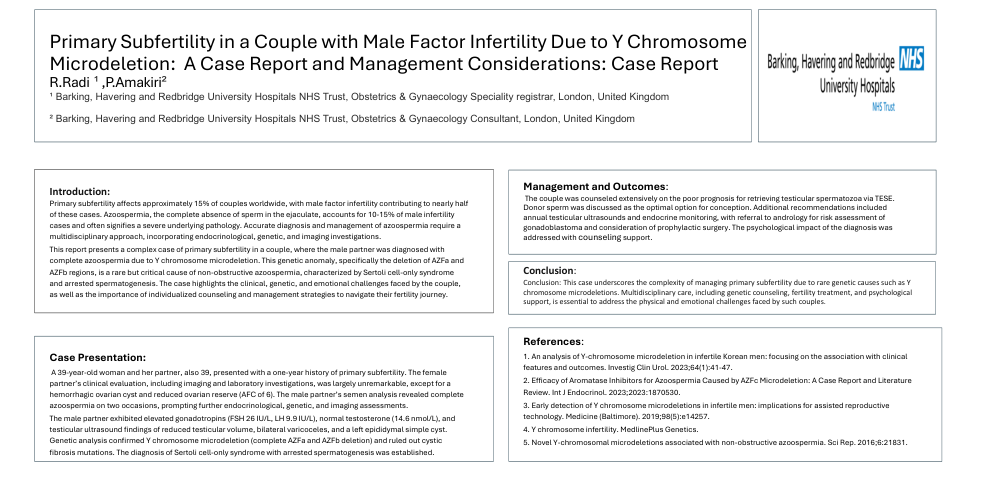
Title: Primary Subfertility in a Couple with Male Factor Infertility Due to Y Chromosome Microdeletion: A Case Report and Management Considerations
Introduction:
Primary subfertility affects approximately 15% of couples worldwide, with male factor infertility contributing to nearly half of these cases. Azoospermia, the complete absence of sperm in the ejaculate, accounts for 10-15% of male infertility cases and often signifies a severe underlying pathology. Accurate diagnosis and management of azoospermia require a multidisciplinary approach, incorporating endocrinological, genetic, and imaging investigations.
This report presents a complex case of primary subfertility in a couple, where the male partner was diagnosed with complete azoospermia due to Y chromosome microdeletion. This genetic anomaly, specifically the deletion of AZFa and AZFb regions, is a rare but critical cause of non-obstructive azoospermia, characterized by Sertoli cell-only syndrome and arrested spermatogenesis. The case highlights the clinical, genetic, and emotional challenges faced by the couple, as well as the importance of individualized counseling and management strategies to navigate their fertility journey.
Case Presentation: A 39-year-old woman and her partner, also 39, presented with a one-year history of primary subfertility. The female partner’s clinical evaluation, including imaging and laboratory investigations, was largely unremarkable, except for a hemorrhagic ovarian cyst and reduced ovarian reserve (AFC of 6). The male partner’s semen analysis revealed complete azoospermia on two occasions, prompting further endocrinological, genetic, and imaging assessments.
The male partner exhibited elevated gonadotropins (FSH 26 IU/L, LH 9.9 IU/L), normal testosterone (14.6 nmol/L), and testicular ultrasound findings of reduced testicular volume, bilateral varicoceles, and a left epididymal simple cyst. Genetic analysis confirmed Y chromosome microdeletion (complete AZFa and AZFb deletion) and ruled out cystic fibrosis mutations. The diagnosis of Sertoli cell-only syndrome with arrested spermatogenesis was established.
Management and Outcomes: The couple was counseled extensively on the poor prognosis for retrieving testicular spermatozoa via TESE. Donor sperm was discussed as the optimal option for conception. Additional recommendations included annual testicular ultrasounds and endocrine monitoring, with referral to andrology for risk assessment of gonadoblastoma and consideration of prophylactic surgery. The psychological impact of the diagnosis was addressed with counseling support.
Conclusion: This case underscores the complexity of managing primary subfertility due to rare genetic causes such as Y chromosome microdeletions. Multidisciplinary care, including genetic counseling, fertility treatment, and psychological support, is essential to address the physical and emotional challenges faced by such couples.
References:
1. An analysis of Y-chromosome microdeletion in infertile Korean men: focusing on the association with clinical features and outcomes. Investig Clin Urol. 2023;64(1):41-47.
2. Efficacy of Aromatase Inhibitors for Azoospermia Caused by AZFc Microdeletion: A Case Report and Literature Review. Int J Endocrinol. 2023;2023:1870530.
3. Early detection of Y chromosome microdeletions in infertile men: implications for assisted reproductive technology. Medicine (Baltimore). 2019;98(5):e14257.
4. Y chromosome infertility. MedlinePlus Genetics.
5. Novel Y-chromosomal microdeletions associated with non-obstructive azoospermia. Sci Rep. 2016;6:21831.