2,281 posters, 63 videos, 56 audios, 43 topics, 18 sessions, 6,174 authors, 2,323 institutions
ePostersLive by SciGen Technologies S.A. All rights reserved.
RCOG World Congress 2025
June 23 - 25, 2025 | ExCeL London, UK
EP.2036
Takotsubo Cardiomyopathy and Systemic Sepsis following Ovarian Hyperstimulation Syndrome
Poster Presenter
Authors
Affiliations
Part of Topic
Reproductive medicine/assisted reproduction
Title: Takotsubo Cardiomyopathy and Systemic Sepsis following Ovarian Hyperstimulation Syndrome
Authors: F. Mou1, B. Agyemang1 and H. Radwan1
Affiliation: 1 Ipswich Hospital, East Suffolk & North Essex NHS Foundation Trust
Objective
Due to increased awareness and recognition, the incidence of Takotsubo cardiomyopathy has been rising (15-30 cases per 100,000 per year); true incidence is unknown because the condition is likely underdiagnosed (1). This report highlights a rare case of severe ovarian hyperstimulation syndrome (OHSS) complicated by takotsubo cardiomyopathy and systemic sepsis in a nulliparous woman. It underscores the importance of multidisciplinary care in managing unusual complications associated with assisted reproductive technologies (ART).
Case Report
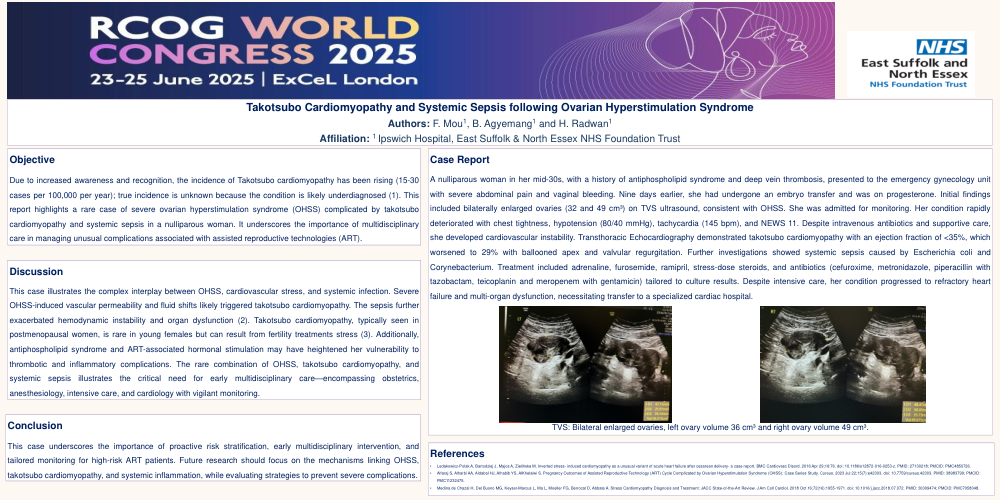
A nulliparous woman in her mid-30s, with a history of antiphospholipid syndrome and deep vein thrombosis, presented to the emergency gynecology unit with severe abdominal pain and vaginal bleeding. Nine days earlier, she had undergone an embryo transfer and was on progesterone. Initial findings included bilaterally enlarged ovaries (32 and 49 cm³) on TVS ultrasound, consistent with OHSS. She was admitted for monitoring. Her condition rapidly deteriorated with chest tightness, hypotension (80/40 mmHg), tachycardia (145 bpm), and NEWS 11. Despite intravenous antibiotics and supportive care, she developed cardiovascular instability. Transthoracic Echocardiography demonstrated takotsubo cardiomyopathy with an ejection fraction of <35%, which worsened to 29% with ballooned apex and valvular regurgitation. Further investigations showed systemic sepsis caused by Escherichia coli and Corynebacterium. Treatment included adrenaline, furosemide, ramipril, stress-dose steroids, and antibiotics (cefuroxime, metronidazole, piperacillin with tazobactam, teicoplanin and meropenem with gentamicin) tailored to culture results. Despite intensive care, her condition progressed to refractory heart failure and multi-organ dysfunction, necessitating transfer to a specialized cardiac hospital.
Discussion
This case illustrates the complex interplay between OHSS, cardiovascular stress, and systemic infection. Severe OHSS-induced vascular permeability and fluid shifts likely triggered takotsubo cardiomyopathy. The sepsis further exacerbated hemodynamic instability and organ dysfunction (2). Takotsubo cardiomyopathy, typically seen in postmenopausal women, is rare in young females but can result from fertility treatments stress (3). Additionally, antiphospholipid syndrome and ART-associated hormonal stimulation may have heightened her vulnerability to thrombotic and inflammatory complications. The rare combination of OHSS, takotsubo cardiomyopathy, and systemic sepsis illustrates the critical need for early multidisciplinary care—encompassing obstetrics, anesthesiology, intensive care, and cardiology with vigilant monitoring.
Conclusion
This case underscores the importance of proactive risk stratification, early multidisciplinary intervention, and tailored monitoring for high-risk ART patients. Future research should focus on the mechanisms linking OHSS, takotsubo cardiomyopathy, and systemic inflammation, while evaluating strategies to prevent severe complications.