2,281 posters, 63 videos, 56 audios, 43 topics, 18 sessions, 6,174 authors, 2,323 institutions
ePostersLive by SciGen Technologies S.A. All rights reserved.
RCOG World Congress 2025
June 23 - 25, 2025 | ExCeL London, UK
EP.2032
Morphokinetic selection of embryos among women undergoing IVF: A prospective cohort study
Poster Presenter
Authors
Supriya Kumari, Dr Neeta Singh, Maroof ahmad Khan, Monika Saini
Affiliations
Part of Topic
Reproductive medicine/assisted reproduction
TITLE- Morphokinetic selection of embryos among women undergoing IVF: A prospective cohort study
INTRODUCTION
•Current techniques available for embryo selection: PGT, proteomics, secretomics, embryo morphology, and Time lapse monitoring
•Invasive methods: Not preferred due to the risk of embryo damage, potential loss & issue of mosaicism.
•Unmet need for the potential non-invasive bio-markers for selecting the embryo with the maximum implantation potential.
•Morphokinetics based embryo selection is a evolving techniques on which this present work is focused.
METHODOLOGY
•Research question: Do morphokinetic parameters play a role in embryo selection and affect reproductive outcomes?
•Study Design &Duration : Prospective cohort study conducted at AIIMS, New Delhi, India June 2022-2024
•Subjects:99 IVF/ICSI cycles undergoing fresh single blastocyst transfer.
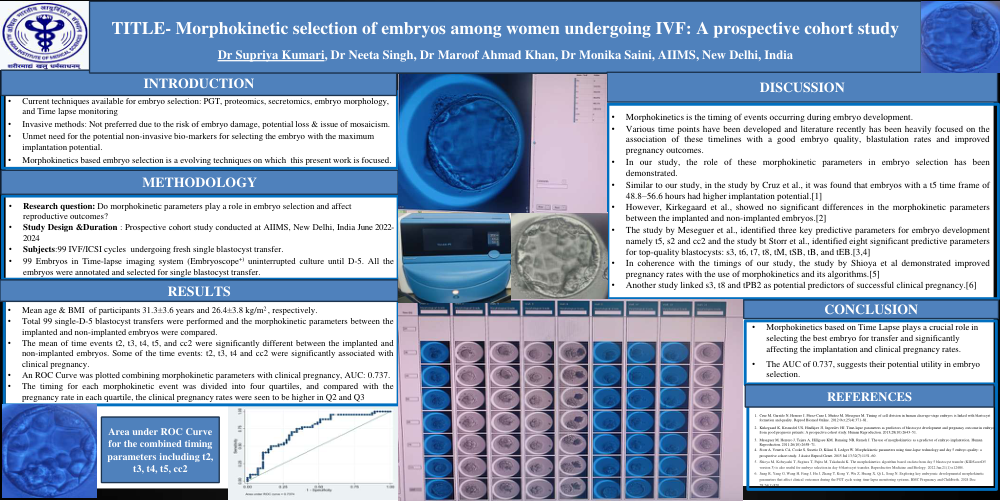
•99 Embryos in Time-lapse imaging system (Embryoscope+) uninterrupted culture until D-5. All the embryos were annotated and selected for single blastocyst transfer.
RESULTS
•Mean age & BMI of participants 31.3±3.6 years and 26.4±3.8 kg/m2 , respectively.
•Total 99 single-D-5 blastocyst transfers were performed and the morphokinetic parameters between the implanted and non-implanted embryos were compared.
•The mean of time events t2, t3, t4, t5, and cc2 were significantly different between the implanted and non-implanted embryos. Some of the time events: t2, t3, t4 and cc2 were significantly associated with clinical pregnancy.
•An ROC Curve was plotted combining morphokinetic parameters with clinical pregnancy, AUC: 0.737.
•The timing for each morphokinetic event was divided into four quartiles, and compared with the pregnancy rate in each quartile, the clinical pregnancy rates were seen to be higher in Q2 and Q3
CONCLUSION
•Morphokinetics based on Time Lapse plays a crucial role in selecting the best embryo for transfer and significantly affecting the implantation and clinical pregnancy rates.
•The AUC of 0.737, suggests their potential utility in embryo selection.