2,281 posters, 63 videos, 56 audios, 43 topics, 18 sessions, 6,174 authors, 2,323 institutions
ePostersLive by SciGen Technologies S.A. All rights reserved.
RCOG World Congress 2025
June 23 - 25, 2025 | ExCeL London, UK
EP.2031
Reproductive Outcomes of Dual versus Single Triggers in Assisted Reproductive Technology Cycles
Poster Presenter
Part of Topic
Reproductive medicine/assisted reproduction
Introduction
•In Assisted Reproductive Technology (ART), maximising egg retrieval + maturity is crucial for achieving live births.
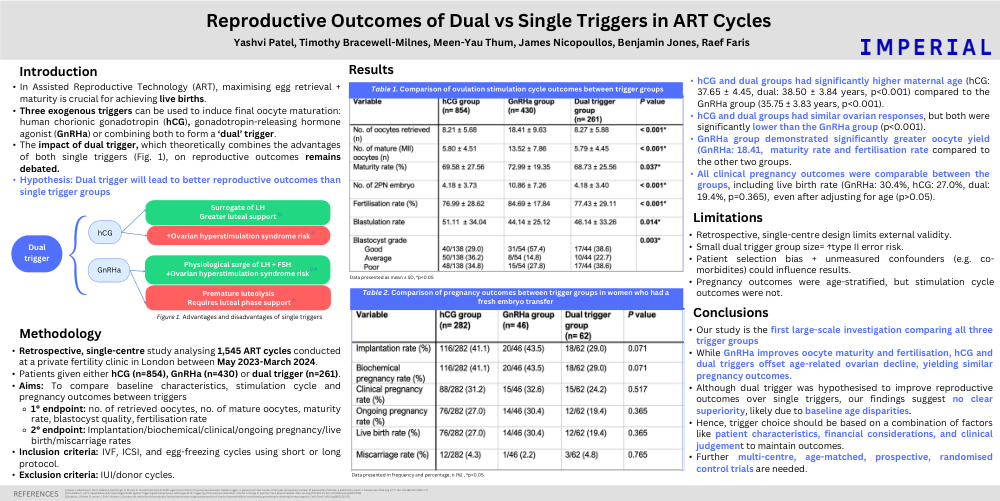
•Three exogenous triggers can be used to induce final oocyte maturation: human chorionic gonadotropin (hCG), gonadotropin-releasing hormone agonist (GnRHa) or combining both to form a ‘dual’ trigger.
•The impact of dual trigger, which theoretically combines the advantages of both single triggers (Fig. 1), on reproductive outcomes remains debated.
•Hypothesis: Dual trigger will lead to better reproductive outcomes than single trigger groups
Methodology
•Retrospective, single-centre study analysing 1,545 ART cycles conducted at a private fertility clinic in London between May 2023-March 2024.
•Patients given either hCG (n=854), GnRHa (n=430) or dual trigger (n=261).
•Aims: To compare baseline characteristics, stimulation cycle and pregnancy outcomes between triggers
⚬1° endpoint: no. of retrieved oocytes, no. of mature oocytes, maturity rate, blastocyst quality, fertilisation rate
⚬2° endpoint: Implantation/biochemical/clinical/ongoing pregnancy/live birth/miscarriage rates
•Inclusion criteria: IVF, ICSI, and egg-freezing cycles using short or long protocol.
•Exclusion criteria: IUI/donor cycles.
Results
•hCG and dual groups had significantly higher maternal age (hCG: 37.65 ± 4.45, dual: 38.50 ± 3.84 years, p<0.001) compared to the GnRHa group (35.75 ± 3.83 years, p<0.001).
•hCG and dual groups had similar ovarian responses, but both were significantly lower than the GnRHa group (p<0.001).
•GnRHa group demonstrated significantly greater oocyte yield (GnRHa: 18.41, maturity rate and fertilisation rate compared to the other two groups.
•All clinical pregnancy outcomes were comparable between the groups, including live birth rate (GnRHa: 30.4%, hCG: 27.0%, dual: 19.4%, p=0.365), even after adjusting for age (p>0.05).
Limitations
•Retrospective, single-centre design limits external validity.
•Small dual trigger group size= ↑type II error risk.
•Patient selection bias + unmeasured confounders (e.g. co-morbidites) could influence results.
•Pregnancy outcomes were age-stratified, but stimulation cycle outcomes were not.
Conclusions
•Our study is the first large-scale investigation comparing all three trigger groups
•While GnRHa improves oocyte maturity and fertilisation, hCG and dual triggers offset age-related ovarian decline, yielding similar pregnancy outcomes.
•Although dual trigger was hypothesised to improve reproductive outcomes over single triggers, our findings suggest no clear superiority, likely due to baseline age disparities.
•Hence, trigger choice should be based on a combination of factors like patient characteristics, financial considerations, and clinical judgement to maintain outcomes.
•Further multi-centre, age-matched, prospective, randomised control trials are needed.