2,281 posters, 63 videos, 56 audios, 43 topics, 18 sessions, 6,174 authors, 2,323 institutions
ePostersLive by SciGen Technologies S.A. All rights reserved.
RCOG World Congress 2025
June 23 - 25, 2025 | ExCeL London, UK
EP.2027
Use of PRP and Growth hormone in poor responders in ART
Poster Presenter
Authors
Affiliations
Part of Topic
Reproductive medicine/assisted reproduction
Use of PRP and Growth Hormone in Poor responders in ART
Background Dr Keya Parashar Jain, NOVA IVF, AGRA
Results
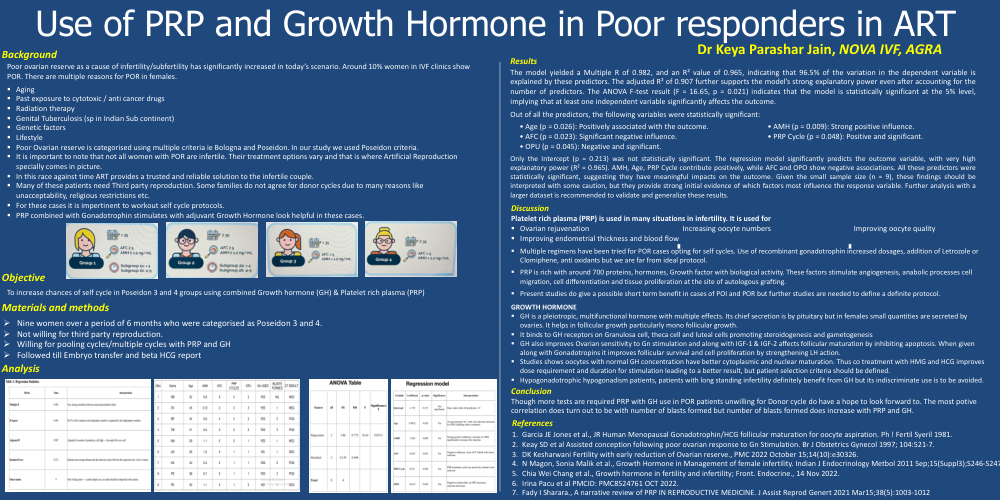
The model yielded a Multiple R of 0.982, and an R² value of 0.965, indicating that 96.5% of the variation in the dependent variable is
explained by these predictors. The adjusted R² of 0.907 further supports the model’s strong explanatory power even after accounting for the
number of predictors. The ANOVA F-test result (F = 16.65, p = 0.021) indicates that the model is statistically significant at the 5% level,
implying that at least one independent variable significantly affects the outcome.
Poor ovarian reserve as a cause of infertility/subfertility has significantly increased in today’s scenario. Around 10% women in IVF clinics show
POR. There are multiple reasons for POR in females.
Aging
Past exposure to cytotoxic / anti cancer drugs
Radiation therapy
Genital Tuberculosis (sp in Indian Sub continent)
Genetic factors
Lifestyle
Poor Ovarian reserve is categorised using multiple criteria ie Bologna and Poseidon. In our study we used Poseidon criteria.
It is important to note that not all women with POR are infertile. Their treatment options vary and that is where Artificial Reproduction
Out of all the predictors, the following variables were statistically significant:
• Age (p = 0.026): Positively associated with the outcome. • AMH (p = 0.009): Strong positive influence.
• AFC (p = 0.023): Significant negative influence. • PRP Cycle (p = 0.048): Positive and significant.
• OPU (p = 0.045): Negative and significant.
Only the Intercept (p = 0.213) was not statistically significant. The regression model significantly predicts the outcome variable, with very high
explanatory power (R² = 0.965). AMH, Age, PRP Cycle contribute positively, while AFC and OPO show negative associations. All these predictors were
statistically significant, suggesting they have meaningful impacts on the outcome. Given the small sample size (n = 9), these findings should be
interpreted with some caution, but they provide strong initial evidence of which factors most influence the response variable. Further analysis with a
larger dataset is recommended to validate and generalize these results.
specially comes in picture.
In this race against time ART provides a trusted and reliable solution to the infertile couple.
Many of these patients need Third party reproduction. Some families do not agree for donor cycles due to many reasons like
unacceptability, religious restrictions etc.
For these cases it is impertinent to workout self cycle protocols.
PRP combined with Gonadotrophin stimulates with adjuvant Growth Hormone look helpful in these cases.
Discussion
Platelet rich plasma (PRP) is used in many situations in infertility. It is used for
Ovarian rejuvenation Increasing oocyte numbers Improving oocyte quality
Improving endometrial thickness and blood flow
Multiple regimens have been tried for POR cases opting for self cycles. Use of recombinant gonadotrophin increased dosages, addition of Letrozole or
Clomiphene, anti oxidants but we are far from ideal protocol.
PRP is rich with around 700 proteins, hormones, Growth factor with biological activity. These factors stimulate angiogenesis, anabolic processes cell
Objective migration, cell differentiation and tissue proliferation at the site of autologous grafting.
To increase chances of self cycle in Poseidon 3 and 4 groups using combined Growth hormone (GH) & Platelet rich plasma (PRP) Present studies do give a possible short term benefit in cases of POI and POR but further studies are needed to define a definite protocol.
Materials and methods
Nine women over a period of 6 months who were categorised as Poseidon 3 and 4.
Not willing for third party reproduction.
Willing for pooling cycles/multiple cycles with PRP and GH
Followed till Embryo transfer and beta HCG report
GROWTH HORMONE
GH is a pleiotropic, multifunctional hormone with multiple effects. Its chief secretion is by pituitary but in females small quantities are secreted by
ovaries. It helps in follicular growth particularly mono follicular growth.
It binds to GH receptors on Granulosa cell, theca cell and luteal cells promoting steroidogenesis and gametogenesis
GH also improves Ovarian sensitivity to Gn stimulation and along with IGF-1 & IGF-2 affects follicular maturation by inhibiting apoptosis. When given
along with Gonadotropins it improves follicular survival and cell proliferation by strengthening LH action.
Studies shows oocytes with normal GH concentration have better cytoplasmic and nuclear maturation. Thus co treatment with HMG and HCG improves
Analysis dose requirement and duration for stimulation leading to a better result, but patient selection criteria should be defined.
Hypogonadotrophic hypogonadism patients, patients with long standing infertility definitely benefit from GH but its indiscriminate use is to be avoided.
7. Fady I Sharara., A narrative review of PRP IN REPRODUCTIVE MEDICINE. J Assist Reprod Genert 2021 Mar15;38(5):1003-1012
Use of PRP and Growth Hormone in Poor responders in ART