2,281 posters, 63 videos, 56 audios, 43 topics, 18 sessions, 6,174 authors, 2,323 institutions
ePostersLive by SciGen Technologies S.A. All rights reserved.
RCOG World Congress 2025
June 23 - 25, 2025 | ExCeL London, UK
PP.0118
Novel Approaches with Stem Cell Therapy for Endometrial Rejuvenation in Intrauterine Adhesion
Poster Presenter
Authors
Affiliations
Part of Topic
Reproductive medicine/assisted reproduction
Video
Abstract
“ Novel Approaches with Stem Cell Therapy for Endometrial Rejuvenation in Intrauterine Adhesion”
-Prof. Jesmine Banu
Background
Patients with intrauterine adhesion and damaged endometrium remain to be an unsolved problem in the treatment of patients with infertility. The presence of adhesion tissue may lead to partial or complete obliteration of the uterine cavity and/or cervical canal. For severely damaged endometrium, the loss of stem cells in the endometrium may affect its regeneration. At present, therapeutic approaches to intrauterine adhesion are limited due to the lack of effective methods to promote regeneration following severe endometrial injury.
So recent update and novel approach for endometrial rejuvenation with stem cell therapy is discussed in this study.
Objective
To identify the effect of stem cell therapy for endometrial rejuvenation in women with intrauterine adhesion.
Materials and Methods
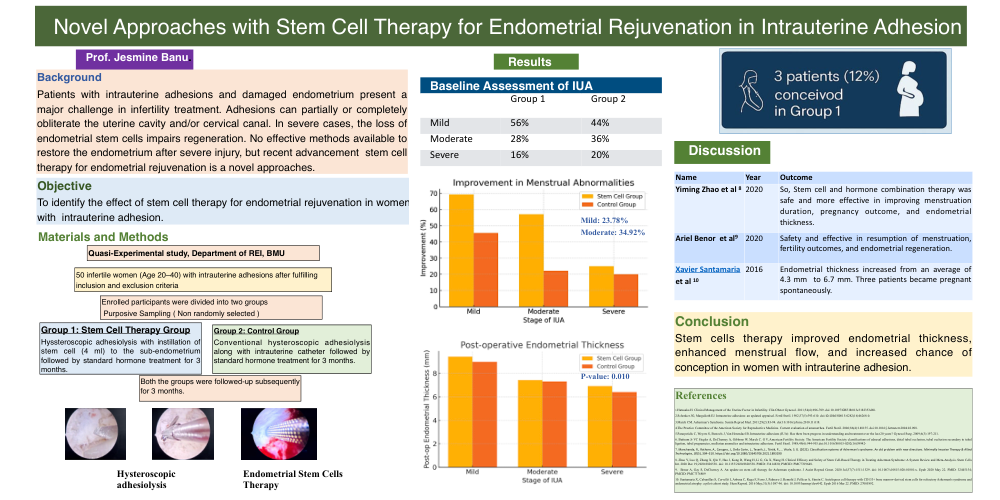
Total 50 patients diagnosed as infertility with intrauterine adhesion were included as study population maintaining inclusion and exclusion criteria in the department of REI, BSMMU and followed up subsequently for 3 months. With purposive sampling participants was non randomly selected (Quasi-experimental study) for group 1 (hysteroscopic adhesiolysis followed by Stem Cell therapy) group 2 (Hysteroscopic adhesiolysis followed by catheterization) followed by standard treatment with conjugated oestrogen for 3 months and norethisterone for last 10 days in both groups.
Results
A positive effect of this study in restoring endometrial functional activity and regenerative properties such as significant improvement of the endometrial thickness (p-value <0.010), improvement of menstrual flow (oligomenorrhoea: 23.8%, hypomenorrhoea: 34.92% and amenorrhoea: 5.0%) and increase chance of conception (12%) in stem cell therapy group.
Conclusion
Intrauterine adhesion urgently needs effective treatment methods other than adhesiolysis and assistant management. Stem cell-based therapy has gained considerable attraction in the recent years for treating intrauterine adhesion.
“ Novel Approaches with Stem Cell Therapy for Endometrial Rejuvenation in Intrauterine Adhesion”
Prof. Jesmine Banu
Background
Intrauterine adhesion occurs when scar tissue forms inside the uterus and/or the cervix. These adhesions occur after a dilatation and curettage, after surgery of the uterus (myomectomy), following tubercular endometritis or even after uterine compression suture during postpartum haemorrhage.1-3 It may occur up-to 13% of women with infertility and 7% with secondary amenorrhoea and between 5 and 39% with recurrent miscarriage.4-5 The American Fertility Society (1988) 6 classified the disease in three stages- stage I, II and III.
Patients with intrauterine adhesion and damaged endometrium remain to be an unsolved problem in the treatment of patients with infertility. The presence of adhesion tissue may lead to partial or complete obliteration of the uterine cavity and/or cervical canal. For sdamaged endometrium, the loss of stem cells in the endometrium may affect its regeneration. At present, therapeutic approaches to intrauterine adhesion are limited due to the lack of effective methods to promote regeneration following severe endometrial injury.
So recent update and novel approach for endometrial rejuvenation with stem cell therapy is discussed in this study.
Objective
To identify the effect of stem cell therapy for endometrial rejuvenation in women with intrauterine adhesion.
Materials and Methods
This is a Quasi-Experimental study. Total 50 patients diagnosed as infertility with intrauterine adhesion was included as study population maintaining inclusion and exclusion criteria in the department of REI, BSMMU and followed up subsequently. Age between 20 to 40 years. Patient having secondary amenorrhoea with negative estrogen progesterone challenge test, mild to severe intra-uterine adhesion which was diagnosed by hysterosalphingography during infertility work up were included in this study. POI, PCOS, DOR, Hypogonadotropic hypogonadism were excluded. Enrolled participants were divided into two groups: with purposive sampling participants were non randomly selected.
Group 1: Hysteroscopic adhesiolysis with instillation of stem cell to the endometrium followed by standard hormone treatment for 3 months.
Group 2: Conventional hysteroscopic adhesiolysis along with intrauterine catheter followed by standard hormone treatment for 3 months.
Both the groups were followed up subsequently for 3 months.
Results
A positive effect of this study in restoring endometrial functional activity and regenerative properties such as significant improvement of the endometrial thickness (p-value <0.010), improvement of menstrual flow (in stage I : 23.8%, in stage II: 34.92% and in stage III: 5.0%) and increase chance of conception (12%) in stem cell therapy group.
Discussion
Meta-analysis by Yiming Zhao et al, systematically reviewed and synthesized the outcomes of stem cell based therapy in treating intra uterine adhesion, which suggest that stem cell and hormone combination therapy have superior therapeutic effects in improving menstruation (risk ratio [RR] 22.43, 95% CI: 8.03 to 62.68, P < 0.00001), an enhancement of pregnancy outcome (risk ratio [RR] 11.1, 95% CI: 3.58 to 34.38, P < 0.0001), and a mean increase of 3-month endometrial thickness (standardized mean difference [SMD] 2.43, 95% CI: 1.72 to 3.13, P < 0.00001). Stem cell and hormone combination therapy was safe and more effective in improving menstruation duration, pregnancy outcome, and endometrial thickness.7 This is consistent with my study where endometrial thickness improved significantly (p-value <0.010) with increase chance of conception (12%). Ariel Benor et al reviewed different origins and administration modalities of stem cells in resumption of menstruation, fertility outcomes and endometrial regeneration.8 Chaitanya B Nagori et al demonstrated endometrial angiogenic stem cells isolated from autologous adult stem cells could regenerate injured endometrium not responding to conventional treatment for intra uterine adhesion. 9
In five out of six cases done by Neeta Singh et al, the autologous stem cell implantation leads to endometrial regeneration reflected by restoration of menstruation.10 Thus, Autologous stem cell implantation is becoming a promising novel cell based therapy even for refractory cases of intra uterine adhesion.
Conclusion
Intrauterine adhesion urgently needs effective treatment methods other than adhesiolysis and assistant management. Stem cell-based therapy has gained considerable attraction in the recent years for treating intrauterine adhesion.
References
1.Hatasaka H. Clinical Management of the Uterine Factor in Infertility. Clin Obstet Gynecol. 2011;54(4):696-709. doi:10.1097/GRF.0b013e3182353d68.
2.Schenker JG, Margalioth EJ. Intrauterine adhesions: an updated appraisal. Fertil Steril. 1982;37(5):593-610. doi:10.1016/S0015-0282(16)46268-0.
3.March CM. Asherman’s Syndrome. Semin Reprod Med. 2011;29(2):83-94. doi:10.1016/j.rbmo.2010.11.018.
4.The Practice Committee of the American Society for Reproductive Medicine. Current evaluation of amenorrhea. Fertil Steril. 2006;86(4):148155. doi:10.1016/j.fertnstert.2004.02.098.
5.Panayotidis C, Weyers S, Bosteels J, Van Herendael B. Intrauterine adhesions (IUA): Has there been progress in understanding and treatment over the last 20 years? Gynecol Surg. 2009;6(3):197-211.
6. Buttram Jr VC Siegler A, DeCherney A, Gibbons W, March C. G V, American Fertility Society. The American Fertility Society classifications of adnexal adhesions, distal tubal occlusion, tubal occlusion secondary to tubal ligation, tubal pregnancies, mullerian anomalies and intrauterine adhesions. Fertil Steril. 1988;49(6):944-955.doi:10.1016/S0015-0282(16)59942-7.
7. Zhao Y, Luo Q, Zhang X, Qin Y, Hao J, Kong D, Wang H, Li G, Gu X, Wang H. Clinical Efficacy and Safety of Stem Cell-Based Therapy in Treating Asherman Syndrome: A System Review and Meta-Analysis. Stem Cells Int. 2020 Dec 19;2020:8820538. doi: 10.1155/2020/8820538. PMID: 33414830; PMCID: PMC7769648.
8. Benor A, Gay S, DeCherney A. An update on stem cell therapy for Asherman syndrome. J Assist Reprod Genet. 2020 Jul;37(7):1511-1529. doi: 10.1007/s10815-020-01801-x. Epub 2020 May 22. PMID: 32445154; PMCID: PMC7376809.
9. Nagori CB, Panchal SY, Patel H. Endometrial regeneration using autologous adult stem cells followed by conception by in vitro fertilization in a patient of severe Asherman's syndrome. J Hum Reprod Sci. 2011 Jan;4(1):43-8.
10. Singh N, Mohanty S, Seth T, Shankar M, Bhaskaran S, Dharmendra S. Autologous stem cell transplantation in refractory Asherman's syndrome: A novel cell based therapy. J Hum Reprod Sci. 2014 Apr;7(2):93-8.
@font-face {font-family:Vrinda; panose-1:2 11 6 4 2 2 2 2 2 4; mso-font-charset:0; mso-generic-font-family:swiss; mso-font-pitch:variable; mso-font-signature:65539 0 0 0 1 0;}@font-face {font-family:"Cambria Math"; panose-1:2 4 5 3 5 4 6 3 2 4; mso-font-charset:0; mso-generic-font-family:roman; mso-font-pitch:variable; mso-font-signature:-536870145 1107305727 0 0 415 0;}@font-face {font-family:Calibri; panose-1:2 15 5 2 2 2 4 3 2 4; mso-font-charset:0; mso-generic-font-family:swiss; mso-font-pitch:variable; mso-font-signature:-469750017 -1040178053 9 0 511 0;}@font-face {font-family:"Segoe UI"; panose-1:2 11 5 2 4 2 4 2 2 3; mso-font-charset:0; mso-generic-font-family:swiss; mso-font-pitch:variable; mso-font-signature:-469750017 -1073683329 9 0 511 0;}p.MsoNormal, li.MsoNormal, div.MsoNormal {mso-style-unhide:no; mso-style-qformat:yes; mso-style-parent:""; margin-top:0cm; margin-right:0cm; margin-bottom:10.0pt; margin-left:0cm; line-height:115%; mso-pagination:widow-orphan; font-size:11.0pt; font-family:"Calibri",sans-serif; mso-ascii-font-family:Calibri; mso-ascii-theme-font:minor-latin; mso-fareast-font-family:"Times New Roman"; mso-fareast-theme-font:minor-fareast; mso-hansi-font-family:Calibri; mso-hansi-theme-font:minor-latin; mso-bidi-font-family:Vrinda; mso-bidi-theme-font:minor-bidi; mso-ansi-language:EN-SG; mso-fareast-language:EN-SG; mso-bidi-language:AR-SA;}h3 {mso-style-noshow:yes; mso-style-priority:9; mso-style-qformat:yes; mso-style-link:"Heading 3 Char"; mso-style-next:Normal; margin-top:10.0pt; margin-right:0cm; margin-bottom:0cm; margin-left:0cm; line-height:115%; mso-pagination:widow-orphan lines-together; page-break-after:avoid; mso-outline-level:3; font-size:11.0pt; font-family:"Cambria",serif; mso-ascii-font-family:Cambria; mso-ascii-theme-font:major-latin; mso-fareast-font-family:"Times New Roman"; mso-fareast-theme-font:major-fareast; mso-hansi-font-family:Cambria; mso-hansi-theme-font:major-latin; mso-bidi-font-family:Vrinda; mso-bidi-theme-font:major-bidi; color:#4F81BD; mso-themecolor:accent1; mso-ansi-language:EN-US; mso-fareast-language:EN-US; mso-bidi-language:EN-US;}p.MsoFooter, li.MsoFooter, div.MsoFooter {mso-style-priority:99; mso-style-link:"Footer Char"; margin:0cm; mso-pagination:widow-orphan; tab-stops:center 234.0pt right 468.0pt; font-size:11.0pt; font-family:"Calibri",sans-serif; mso-ascii-font-family:Calibri; mso-ascii-theme-font:minor-latin; mso-fareast-font-family:"Times New Roman"; mso-fareast-theme-font:minor-fareast; mso-hansi-font-family:Calibri; mso-hansi-theme-font:minor-latin; mso-bidi-font-family:Vrinda; mso-bidi-theme-font:minor-bidi; mso-ansi-language:EN-SG; mso-fareast-language:EN-SG; mso-bidi-language:AR-SA;}span.Heading3Char {mso-style-name:"Heading 3 Char"; mso-style-noshow:yes; mso-style-priority:9; mso-style-unhide:no; mso-style-locked:yes; mso-style-link:"Heading 3"; font-family:"Cambria",serif; mso-ascii-font-family:Cambria; mso-ascii-theme-font:major-latin; mso-fareast-font-family:"Times New Roman"; mso-fareast-theme-font:major-fareast; mso-hansi-font-family:Cambria; mso-hansi-theme-font:major-latin; mso-bidi-font-family:Vrinda; mso-bidi-theme-font:major-bidi; color:#4F81BD; mso-themecolor:accent1; mso-ansi-language:EN-US; mso-bidi-language:EN-US; font-weight:bold;}span.FooterChar {mso-style-name:"Footer Char"; mso-style-priority:99; mso-style-unhide:no; mso-style-locked:yes; mso-style-link:Footer; font-family:"Times New Roman",serif; mso-fareast-font-family:"Times New Roman"; mso-fareast-theme-font:minor-fareast; mso-fareast-language:EN-SG;}span.name {mso-style-name:name; mso-style-unhide:no;}.MsoChpDefault {mso-style-type:export-only; mso-default-props:yes; font-size:11.0pt; mso-ansi-font-size:11.0pt; mso-bidi-font-size:11.0pt; font-family:"Calibri",sans-serif; mso-ascii-font-family:Calibri; mso-ascii-theme-font:minor-latin; mso-fareast-font-family:Calibri; mso-fareast-theme-font:minor-latin; mso-hansi-font-family:Calibri; mso-hansi-theme-font:minor-latin; mso-bidi-font-family:Vrinda; mso-bidi-theme-font:minor-bidi; mso-font-kerning:0pt; mso-ligatures:none; mso-ansi-language:EN-SG; mso-fareast-language:EN-US; mso-bidi-language:AR-SA;}.MsoPapDefault {mso-style-type:export-only; margin-bottom:10.0pt; line-height:115%;}div.WordSection1 {page:WordSection1;}