2,281 posters, 63 videos, 56 audios, 43 topics, 18 sessions, 6,174 authors, 2,323 institutions
ePostersLive by SciGen Technologies S.A. All rights reserved.
RCOG World Congress 2025
June 23 - 25, 2025 | ExCeL London, UK
EP.2023
Research Proposal: Lived Experiences of First-Time Mothers during Their Breastfeeding Journey
Poster Presenter
Authors
Affiliations
Part of Topic
Reproductive medicine/assisted reproduction
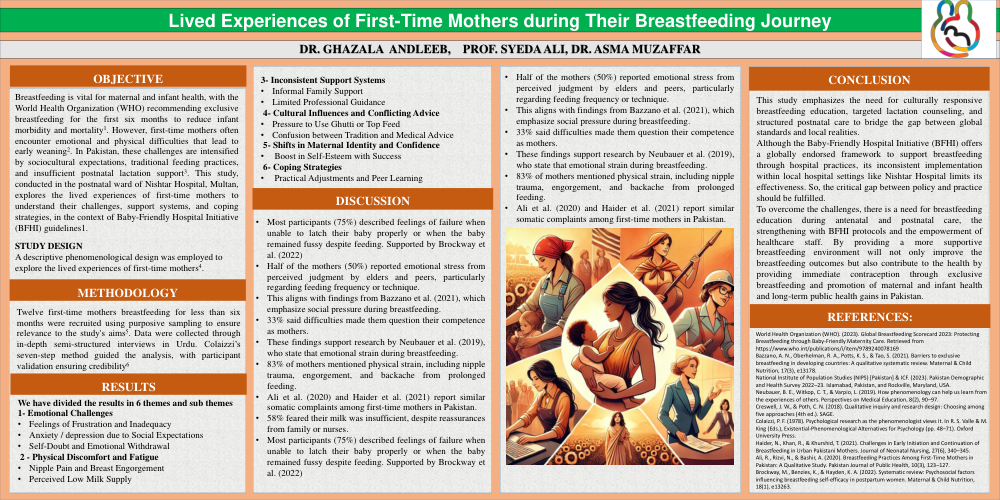
Lived Experiences of First-Time Mothers during Their Breastfeeding Journey
OBJECTIVE
Breastfeeding is vital for maternal and infant health, with the World Health Organization (WHO) recommending exclusive breastfeeding for the first six months to reduce infant morbidity and mortality1. However, first-time mothers often encounter emotional and physical difficulties that lead to early weaning2. In Pakistan, these challenges are intensified by sociocultural expectations, traditional feeding practices, and insufficient postnatal lactation support3. This study, conducted in the postnatal ward of Nishtar Hospital, Multan, explores the lived experiences of first-time mothers to understand their challenges, support systems, and coping strategies, in the context of Baby-Friendly Hospital Initiative (BFHI) guidelines1.
STUDY DESIGN
A descriptive phenomenological design was employed to explore the lived experiences of first-time mothers4.
METHODOLOGY
Twelve first-time mothers breastfeeding for less than six months were recruited using purposive sampling to ensure relevance to the study's aims5. Data were collected through in-depth semi-structured interviews in Urdu. Colaizzi’s seven-step method guided the analysis, with participant validation ensuring credibility6
RESULTS
We have divided the results in 6 themes and sub themes
1- Emotional Challenges
2 - Physical Discomfort and Fatigue
3- Inconsistent Support Systems
4- Cultural Influences and Conflicting Advice
5- Shifts in Maternal Identity and Confidence
6- Coping Strategies
DISCUSSION
CONCLUSION
This study emphasizes the need for culturally responsive breastfeeding education, targeted lactation counseling, and structured postnatal care to bridge the gap between global standards and local realities.
Although the Baby-Friendly Hospital Initiative (BFHI) offers a globally endorsed framework to support breastfeeding through hospital practices, its inconsistent implementation within local hospital settings like Nishtar Hospital limits its effectiveness. So, the critical gap between policy and practice should be fulfilled.
To overcome the challenges, there is a need for breastfeeding education during antenatal and postnatal care, the strengthening with BFHI protocols and the empowerment of healthcare staff. By providing a more supportive breastfeeding environment will not only improve the breastfeeding outcomes but also contribute to the health by providing immediate contraception through exclusive breastfeeding and promotion of maternal and infant health and long-term public health gains in Pakistan.
REFERENCES:
World Health Organization (WHO). (2023). Global Breastfeeding Scorecard 2023: Protecting Breastfeeding through Baby-Friendly Maternity Care. Retrieved from https://www.who.int/publications/i/item/9789240078169
Bazzano, A. N., Oberhelman, R. A., Potts, K. S., & Tao, S. (2021). Barriers to exclusive breastfeeding in developing countries: A qualitative systematic review. Maternal & Child Nutrition, 17(3), e13178.
National Institute of Population Studies (NIPS) [Pakistan] & ICF. (2023). Pakistan Demographic and Health Survey 2022–23. Islamabad, Pakistan, and Rockville, Maryland, USA.
Neubauer, B. E., Witkop, C. T., & Varpio, L. (2019). How phenomenology can help us learn from the experiences of others. Perspectives on Medical Education, 8(2), 90–97.
Creswell, J. W., & Poth, C. N. (2018). Qualitative inquiry and research design: Choosing among five approaches (4th ed.). SAGE.
Colaizzi, P. F. (1978). Psychological research as the phenomenologist views it. In R. S. Valle & M. King (Eds.), Existential-Phenomenological Alternatives for Psychology (pp. 48–71). Oxford University Press.
Haider, N., Khan, R., & Khurshid, T. (2021). Challenges in Early Initiation and Continuation of Breastfeeding in Urban Pakistani Mothers. Journal of Neonatal Nursing, 27(6), 340–345.
Ali, R., Rizvi, N., & Bashir, A. (2020). Breastfeeding Practices Among First-Time Mothers in Pakistan: A Qualitative Study. Pakistan Journal of Public Health, 10(3), 123–127.
Brockway, M., Benzies, K., & Hayden, K. A. (2022). Systematic review: Psychosocial factors influencing breastfeeding self-efficacy in postpartum women. Maternal & Child Nutrition, 18(1), e13263.