2,281 posters, 63 videos, 56 audios, 43 topics, 18 sessions, 6,174 authors, 2,323 institutions
ePostersLive by SciGen Technologies S.A. All rights reserved.
RCOG World Congress 2025
June 23 - 25, 2025 | ExCeL London, UK
EP.2019
Hysterosalpingogram Vs Laparoscopy for diagnosis of tubal factor in female infertility
Part of Topic
Reproductive medicine/assisted reproduction
Hysterosalpingogram Vs Laparoscopy for diagnosis of tubal factor in female infertility
Sanjida Mahmood1, Jitendra Jadhav1, Ifeoluwa Ajayi2, Thekla Charitou1
1Basildon University Hospital, Mid and South Essex NHS Foundation Trust, 2 The Princess Alexandra Hospital NHS Trust
Introduction
Infertility is a critical aspect of women’s health. According to the WHO, infertility affects approximately 10-15% of couples worldwide. Hysterosalpingography (HSG) and laparoscopy are diagnostic techniques used to assess female tubal and pelvic factors that could contribute to infertility. Although HSG is first line investigation for evaluating tubal issues, laparoscopy is regarded as gold standard.
Objective
Comparison of HSG and laparoscopy results in detecting tubal abnormalities to evaluate female infertility and determining the diagnostic value of HSG for assessing fallopian tube conditions.
Method
Data collected retrospectively from online electronic data system over the period of last 5 years, on demographics, obstetric history, duration of trying to conceive, chlamydia screening, transvaginal scan (TVS) prior to HSG, HSG and laparoscopy results.
Results
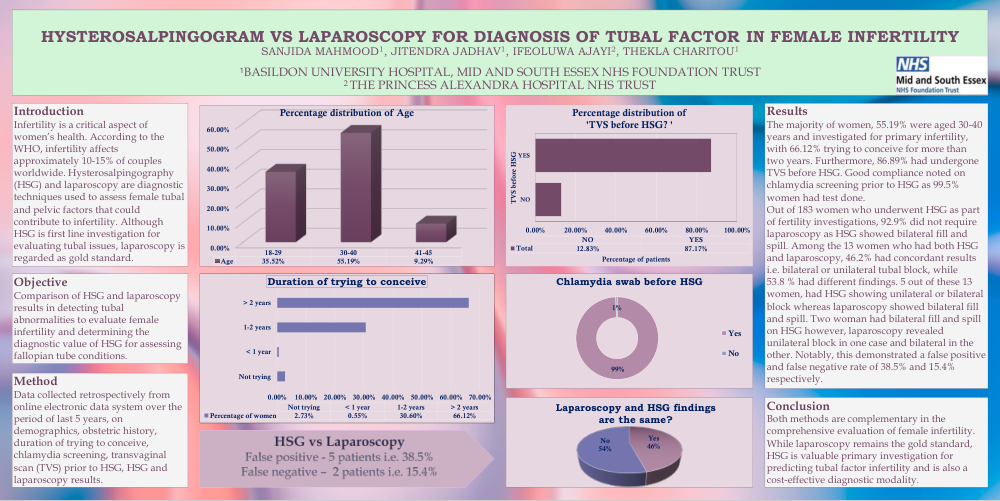
The majority of women, 55.19% were aged 30-40 years and investigated for primary infertility, with 66.12% trying to conceive for more than two years. Furthermore, 86.89% had undergone TVS before HSG. Good compliance noted on chlamydia screening prior to HSG as 99.5% women had test done.
Out of 183 women who underwent HSG as part of fertility investigations, 92.9% did not require laparoscopy as HSG showed bilateral fill and spill. Among the 13 women who had both HSG and laparoscopy, 46.2% had concordant results i.e. bilateral or unilateral tubal block, while
53.8 % had different findings. 5 out of these 13 women, had HSG showing unilateral or bilateral block whereas laparoscopy showed bilateral fill and spill. Two woman had bilateral fill and spill on HSG however, laparoscopy revealed unilateral block in one case and bilateral in the other. Notably, this demonstrated a false positive and false negative rate of 38.5% and 15.4% respectively.
Conclusion
Both methods are complementary in the comprehensive evaluation of female infertility.
While laparoscopy remains the gold standard, HSG is valuable primary investigation for predicting tubal factor infertility and is also a cost-effective diagnostic modality.