2,281 posters, 63 videos, 56 audios, 43 topics, 18 sessions, 6,174 authors, 2,323 institutions
ePostersLive by SciGen Technologies S.A. All rights reserved.
RCOG World Congress 2025
June 23 - 25, 2025 | ExCeL London, UK
EP.2017
IMPACT OF ORAL PENTOXIFYLLINE ON SPERM DNA INTEGRITYIN MALE INFERTILITY: SYSTEMATIC REVIEW
Part of Topic
Reproductive medicine/assisted reproduction
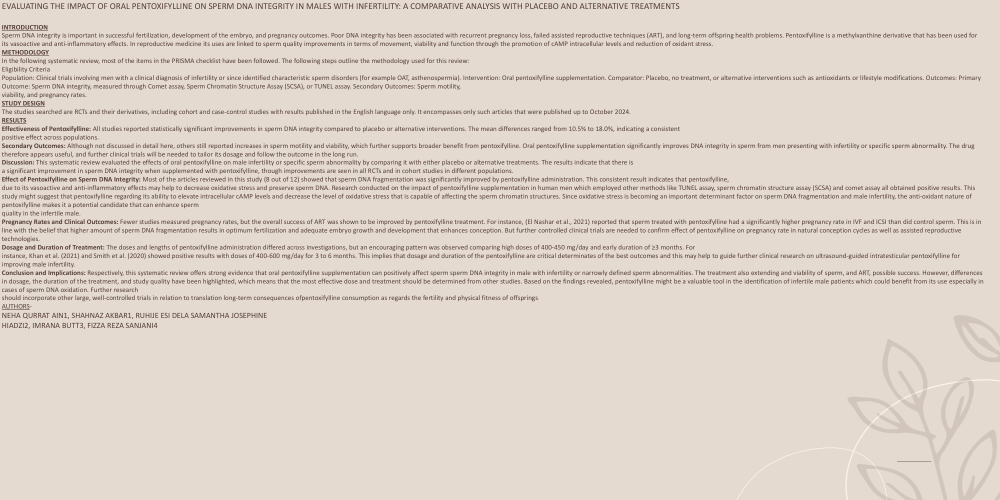
EVALUATING THE IMPACT OF ORAL PENTOXIFYLLINE ON SPERM DNA INTEGRITY IN MALES WITH INFERTILITY: A COMPARATIVE ANALYSIS WITH PLACEBO AND ALTERNATIVE TREATMENTS
INTRODUCTION
Sperm DNA integrity is important in successful fertilization, development of the embryo, and pregnancy outcomes. Poor DNA integrity has been associated with recurrent pregnancy loss, failed assisted reproductive techniques (ART), and long-term offspring health problems. Pentoxifylline is a methylxanthine derivative that has been used for its vasoactive and anti-inflammatory effects. In reproductive medicine its uses are linked to sperm quality improvements in terms of movement, viability and function through the promotion of cAMP intracellular levels and reduction of oxidant stress.
METHODOLOGY
In the following systematic review, most of the items in the PRISMA checklist have been followed. The following steps outline the methodology used for this review:
Eligibility Criteria
Population: Clinical trials involving men with a clinical diagnosis of infertility or since identified characteristic sperm disorders (for example OAT, asthenospermia). Intervention: Oral pentoxifylline supplementation. Comparator: Placebo, no treatment, or alternative interventions such as antioxidants or lifestyle modifications. Outcomes: Primary Outcome: Sperm DNA integrity, measured through Comet assay, Sperm Chromatin Structure Assay (SCSA), or TUNEL assay. Secondary Outcomes: Sperm motility,
viability, and pregnancy rates.
STUDY DESIGN
The studies searched are RCTs and their derivatives, including cohort and case-control studies with results published in the English language only. It encompasses only such articles that were published up to October 2024.
RESULTS
Effectiveness of Pentoxifylline: All studies reported statistically significant improvements in sperm DNA integrity compared to placebo or alternative interventions. The mean differences ranged from 10.5% to 18.0%, indicating a consistent
positive effect across populations.
Secondary Outcomes: Although not discussed in detail here, others still reported increases in sperm motility and viability, which further supports broader benefit from pentoxifylline. Oral pentoxifylline supplementation significantly improves DNA integrity in sperm from men presenting with infertility or specific sperm abnormality. The drug therefore appears useful, and further clinical trials will be needed to tailor its dosage and follow the outcome in the long run.
Discussion: This systematic review evaluated the effects of oral pentoxifylline on male infertility or specific sperm abnormality by comparing it with either placebo or alternative treatments. The results indicate that there is
a significant improvement in sperm DNA integrity when supplemented with pentoxifylline, though improvements are seen in all RCTs and in cohort studies in different populations.
Effect of Pentoxifylline on Sperm DNA Integrity: Most of the articles reviewed in this study (8 out of 12) showed that sperm DNA fragmentation was significantly improved by pentoxifylline administration. This consistent result indicates that pentoxifylline,
due to its vasoactive and anti-inflammatory effects may help to decrease oxidative stress and preserve sperm DNA. Research conducted on the impact of pentoxifylline supplementation in human men which employed other methods like TUNEL assay, sperm chromatin structure assay (SCSA) and comet assay all obtained positive results. This study might suggest that pentoxifylline regarding its ability to elevate intracellular cAMP levels and decrease the level of oxidative stress that is capable of affecting the sperm chromatin structures. Since oxidative stress is becoming an important determinant factor on sperm DNA fragmentation and male infertility, the anti-oxidant nature of pentoxifylline makes it a potential candidate that can enhance sperm
quality in the infertile male.
Pregnancy Rates and Clinical Outcomes: Fewer studies measured pregnancy rates, but the overall success of ART was shown to be improved by pentoxifylline treatment. For instance, (El Nashar et al., 2021) reported that sperm treated with pentoxifylline had a significantly higher pregnancy rate in IVF and ICSI than did control sperm. This is in line with the belief that higher amount of sperm DNA fragmentation results in optimum fertilization and adequate embryo growth and development that enhances conception. But further controlled clinical trials are needed to confirm effect of pentoxifylline on pregnancy rate in natural conception cycles as well as assisted reproductive technologies.
Dosage and Duration of Treatment: The doses and lengths of pentoxifylline administration differed across investigations, but an encouraging pattern was observed comparing high doses of 400-450 mg/day and early duration of ≥3 months. For
instance, Khan et al. (2021) and Smith et al. (2020) showed positive results with doses of 400-600 mg/day for 3 to 6 months. This implies that dosage and duration of the pentoxifylline are critical determinates of the best outcomes and this may help to guide further clinical research on ultrasound-guided intratesticular pentoxifylline for improving male infertility.
Conclusion and Implications: Respectively, this systematic review offers strong evidence that oral pentoxifylline supplementation can positively affect sperm sperm DNA integrity in male with infertility or narrowly defined sperm abnormalities. The treatment also extending and viability of sperm, and ART, possible success. However, differences in dosage, the duration of the treatment, and study quality have been highlighted, which means that the most effective dose and treatment should be determined from other studies. Based on the findings revealed, pentoxifylline might be a valuable tool in the identification of infertile male patients which could benefit from its use especially in cases of sperm DNA oxidation. Further research
should incorporate other large, well-controlled trials in relation to translation long-term consequences ofpentoxifylline consumption as regards the fertility and physical fitness of offsprings.
AUTHORS-
NEHA QURRAT AIN1, SHAHNAZ AKBAR1, RUHIJE ESI DELA SAMANTHA JOSEPHINE
HIADZI2, IMRANA BUTT3, FIZZA REZA SANJANI4