2,281 posters, 63 videos, 56 audios, 43 topics, 18 sessions, 6,174 authors, 2,323 institutions
ePostersLive by SciGen Technologies S.A. All rights reserved.
RCOG World Congress 2025
June 23 - 25, 2025 | ExCeL London, UK
EP.2014
Audit on Intra Uterine Insemination at Fertility Treatment Unit in Sri Lanka
Poster Presenter
Part of Topic
Reproductive medicine/assisted reproduction
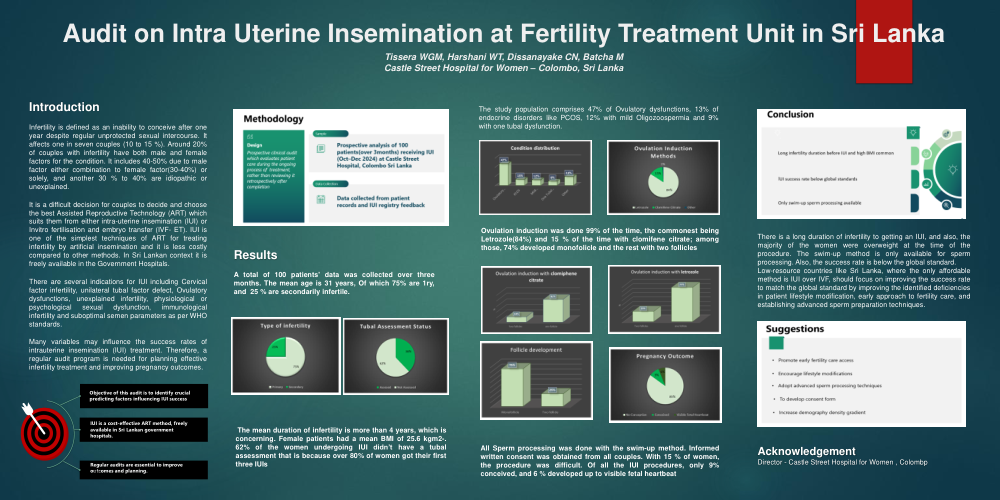
Audit on Intra Uterine Insemination at Fertility Treatment Unit in Sri Lanka
Tissera WGM, Harshani WT, Dissanayake CN, Batcha M
Castle Street Hospital for Women – Colombo, Sri Lanka
Introduction
Infertility is defined as an inability to conceive after one year despite regular unprotected sexual intercourse. It affects one in seven couples (10 to 15 %). Around 20% of couples with infertility have both male and female factors for the condition. It includes 40-50% due to male factor either combination to female factor(30-40%) or solely, and another 30 % to 40% are idiopathic or unexplained.
It is a difficult decision for couples to decide and choose the best Assisted Reproductive Technology (ART) which suits them from either intra-uterine insemination (IUI) or Invitro fertilisation and embryo transfer (IVF- ET). IUI is one of the simplest techniques of ART for treating infertility by artificial insemination and it is less costly compared to other methods. In Sri Lankan context it is freely available in the Government Hospitals.
There are several indications for IUI including Cervical factor infertility, unilateral tubal factor defect, Ovulatory dysfunctions, unexplained infertility, physiological or psychological sexual dysfunction, immunological infertility and suboptimal semen parameters as per WHO standards.
Many variables may influence the success rates of intrauterine insemination (IUI) treatment. Therefore, a regular audit program is needed for planning effective infertility treatment and improving pregnancy outcomes
Results
A total of 100 patients' data was collected over three months. The mean age is 31 years, Of which 75% are 1ry, and 25 % are secondarily infertile.
The mean duration of infertility is more than 4 years, which is concerning. Female patients had a mean BMI of 25.6 kgm2-. 62% of the women undergoing IUI didn’t have a tubal assessment that is because over 80% of women got their first three IUIs
The study population comprises 47% of Ovulatory dysfunctions, 13% of endocrine disorders like PCOS, 12% with mild Oligozoospermia and 9% with one tubal dysfunction
Ovulation induction was done 99% of the time, the commonest being Letrozole(84%) and 15 % of the time with clomifene citrate; among those, 74% developed monofolicle and the rest with two follicles
All Sperm processing was done with the swim-up method. Informed written consent was obtained from all couples. With 15 % of women, the procedure was difficult. Of all the IUI procedures, only 9% conceived, and 6 % developed up to visible fetal heartbeat
There is a long duration of infertility to getting an IUI, and also, the majority of the women were overweight at the time of the procedure. The swim-up method is only available for sperm processing. Also, the success rate is below the global standard.
Low-resource countries like Sri Lanka, where the only affordable method is IUI over IVF, should focus on improving the success rate to match the global standard by improving the identified deficiencies in patient lifestyle modification, early approach to fertility care, and establishing advanced sperm preparation techniques.
Acknowledgement
Director - Castle Street Hospital for Women , Colombp