2,281 posters, 63 videos, 56 audios, 43 topics, 18 sessions, 6,174 authors, 2,323 institutions
ePostersLive by SciGen Technologies S.A. All rights reserved.
RCOG World Congress 2025
June 23 - 25, 2025 | ExCeL London, UK
EP.2013
Correlation between AMH and oocytes retrieved in IVF: A Single-Centre study
Part of Topic
Reproductive medicine/assisted reproduction
Correlation between AMH and oocytes retrieved in IVF: A Single-Centre study
Background
In-vitro fertilization (IVF) is becoming increasingly prominent in today’s society, as evidenced by the steady increase in IVF cycles per year in Singapore over the past few years. Ovarian reserve is a key contributory factor to the success of IVF. Anti-Müllerian hormone (AMH) is a glycoprotein produced by granulosa cells of developing follicles in women and is widely used to assess ovarian reserve. It is also a valuable predictor of ovarian response to stimulation in IVF, alongside other factors such as antral follicle count (AFC), age and follicular stimulating hormone (FSH).
This study aims to correlate AMH level with the oocytes retrieved during IVF in an Asian-dominant population.
Methods
This is a retrospective study of patients who underwent IVF cycles in a tertiary hospital in Singapore between January 2023 and September 2023.
All women underwent standard controlled ovarian stimulation (COH) protocols with treatment regime determined by their doctors. Serum AMH levels were measured during the first 2 to 4 days of the menstrual cycle.
Data was collected from the hospital computer medical records. Spearman correlation was used to analyse the correlation between AMH and retrieved oocytes.
Results and Discussion
A total of 471 patients with a mean age of 36.4 years were included in the study. 319 patients (67.7%) are of advanced maternal age (above age of 35 years). Majority of the patients are Chinese (62.4%), followed by Malay (20.8%), other Asian ethnicities (8.1%), Indian (6.4%) and other ethnicities (2.3%), which is reflective of the social demographics in Singapore. The average BMI is 20.2. The most common infertility diagnosis among the patients is combined factor (45.9%), followed by male factor (33.8%).
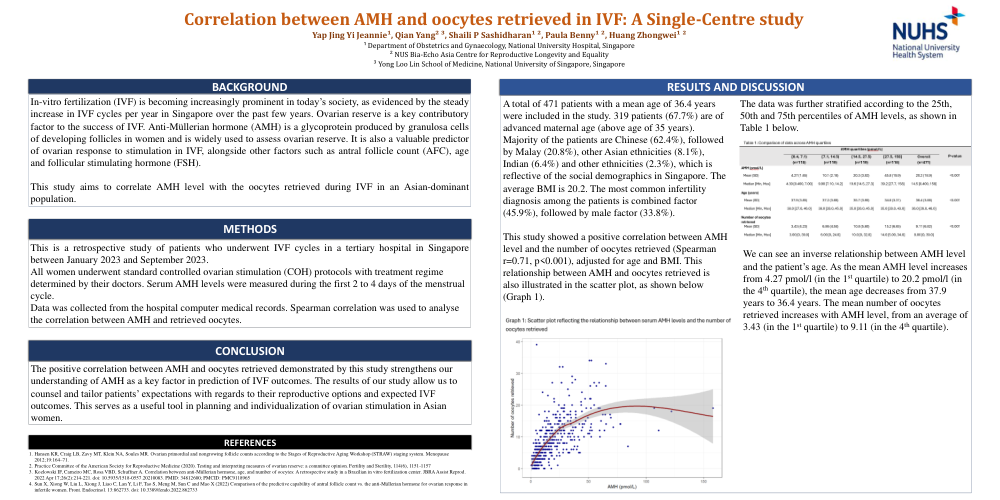
This study showed a positive correlation between AMH level and the number of oocytes retrieved (Spearman r=0.71, p<0.001), adjusted for age and BMI. This relationship between AMH and oocytes retrieved is also illustrated in the scatter plot, as shown below (Graph 1).
The data was further stratified according to the 25th, 50th and 75th percentiles of AMH levels, as shown in Table 1 below.
We can see an inverse relationship between AMH level and the patient’s age. As the mean AMH level increases from 4.27 pmol/l (in the 1st quartile) to 20.2 pmol/l (in the 4th quartile), the mean age decreases from 37.9 years to 36.4 years. The mean number of oocytes retrieved increases with AMH level, from an average of 3.43 (in the 1st quartile) to 9.11 (in the 4th quartile).
Conclusion
The positive correlation between AMH and oocytes retrieved demonstrated by this study strengthens our understanding of AMH as a key factor in prediction of IVF outcomes. The results of our study allow us to counsel and tailor patients’ expectations with regards to their reproductive options and expected IVF outcomes. This serves as a useful tool in planning and individualization of ovarian stimulation in Asian women.