2,281 posters, 63 videos, 56 audios, 43 topics, 18 sessions, 6,174 authors, 2,323 institutions
ePostersLive by SciGen Technologies S.A. All rights reserved.
RCOG World Congress 2025
June 23 - 25, 2025 | ExCeL London, UK
EP.2011
Female Fertility Preservation in a Primary Brain Tumour Cohort
Poster Presenter
Part of Topic
Reproductive medicine/assisted reproduction
Female fertility preservation in a primary brain tumour cohort
Meghna Balakrishnan 1, Dr Zachary Nash 2,3, Professor Melanie Davies 2,3
1- UCL Medical School, 2 - EGA Institute for Women’s Health, UCL, 3 - Reproductive Medicine Unit, EGA Wing, University College London Hospitals
INTRODUCTION
Primary Brain Tumours (PBTu’s) 1,2
These are the most common types of PBTu’s with some 5-year survival statistics (%):
Gliomas
Astrocytomas
- Grade I Pilocytic Astrocytoma
- Grade II Diffuse Astrocytoma (45%)
- Grade III Anaplastic Astrocytomas (>20%)
- Grade IV Glioblastomas (>5%)
Oligodendrogliomas (55%)
Ependymomas (85%)
Mixed Gliomas
Gliomas make up 78% of all PBTu’s 3
Medulloblastomas
Pineoblastomas (70-75%)
Germ cell tumours
Patients undergoing cancer treatment are often exposed to gonadotoxic treatment (radiation and chemotherapy) necessitating discussion of FP.
AIMS AND OBJECTIVES
To analyse prospectively collected primary data on female PBTu patients referred for FP at the Reproductive Medicine Unit, EGA Wing, UCLH, focussing on long-term outcomes.
METHODS
A retrospective audit was carried out on prospectively collected data between 2017 and 2024 of female PBTu patients from secure databases and EPIC, primarily analysed with descriptive statistics.
Baseline data collated included: PBTu type, age at diagnosis, age at FP, time elapsed since FP, chemotherapy regimen, type of FP and number of oocytes/embryos/ovarian tissue cryopreserved per cycle of stimulation (COS).
A systematic literature search was conducted on 6 databases, identifying 20 eligible full-text studies. Exclusion criteria included data not disaggregated by sex, interventions not currently used in practice, and document-type exclusion (case reports, review articles, guidelines, protocols).
Standardised search terms included ‘fertility preservation’, ‘brain tumo*’, ‘treatment’.
5 key themes were identified:
Adverse reproductive outcomes of PBTu treatment (n=8)
Spontaneous pregnancy rates of PBTu cancer survivors (n=3)
Methods and short-term FP outcomes (n=4)
FP counselling (n=4)
FP long-term outcomes (n=1)
Despite 1 study analysing long-term utilisation of stored gametes, the following factors were not mentioned that this study aims to cover:
• Spontaneous pregnancy rates
• Mortality rates
• Mortality rates
RESULTS
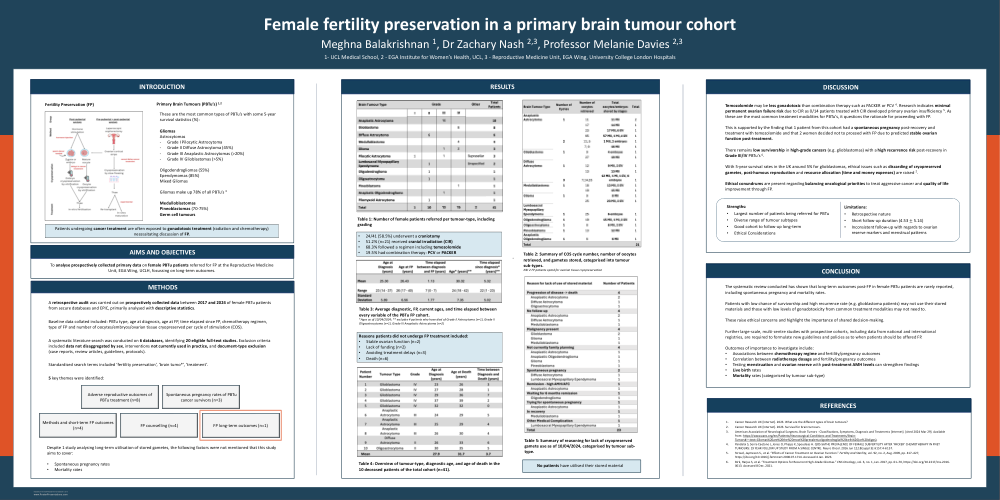
Table 1: Number of female patients referred per tumour-type, including grading
• 24/41 (58.5%) underwent a craniotomy
• 51.2% (n=21) received cranial irradiation (CIR)
• 68.3% followed a regimen including temozolomide
• 19.5% had combination therapy: PCV or PACKER
• 19.5% had combination therapy: PCV or PACKER
Table 2: Summary of COS cycle number, number of oocytes retrieved, and gametes stored, categorised into tumour sub-types.
NB: 2 FP patients opted for ovarian tissue cryopreservation
Table 3: Average diagnostic, FP, current ages, and time elapsed between every variable of the PBTu FP cohort.
*Ages as of 10/04/2024; ** excludes 4 patients who have died of Grade II Astrocytoma (n=1), Grade II Oligoastrocytoma (n=1), Grade III Anaplastic Astrocytoma (n=2)
Reasons patients did not undergo FP treatment included:
• Stable ovarian function (n=2)
• Lack of funding (n=2)
• Avoiding treatment delays (n=3)
• Death (n=6)
Table 4: Overview of tumour-type, diagnostic age, and age of death in the 10 deceased patients of the total cohort (n=41).
Table 5: Summary of reasoning for lack of cryopreserved gamete use as of 10/04/2024, categorised by tumour sub-type.
No patients have utilised their stored material.
DISCUSSION
Temozolomide may be less gonadotoxic than combination therapy such as PACKER or PCV
Research indicates minimal permanent ovarian failure risk due to CIR as 0/14 patients treated with CIR developed primary ovarian insufficiency
As these are the most common treatment modalities for PBTu’s, it questions the rationale for proceeding with FP.
This is supported by the finding that 1 patient from this cohort had a spontaneous pregnancy post-recovery and treatment with temozolomide and that 2 women decided not to proceed with FP due to predicted stable ovarian function post-treatment.
There remains low survivorship in high-grade cancers (e.g. glioblastomas) with a high recurrence risk post-recovery in Grade III/IV PBTu’s.
With 5-year survival rates in the UK around 5% for glioblastomas, ethical issues such as discarding of cryopreserved gametes, post-humous reproduction and resource allocation (time and money expenses) are raised.
Ethical conundrums are present regarding balancing oncological priorities to treat aggressive cancer and quality of life improvement through FP.
Strengths:
• Largest number of patients being referred for PBTu
• Diverse range of tumour subtypes
• Good cohort to follow-up long-term
• Ethical Considerations
Limitations:
• Retrospective nature
• Short follow-up duration (4.53 ± 5.14)
• Inconsistent follow-up with regards to ovarian reserve markers and menstrual patterns
CONCLUSION
The systematic review conducted has shown that long-term outcomes post-FP in female PBTu patients are rarely reported, including spontaneous pregnancy and mortality rates. Patients with low chance of survivorship and high recurrence rate (e.g. glioblastoma patients) may not use their stored materials and those with low levels of gonadotoxicity from common treatment modalities may not need to.
These raise ethical concerns and highlight the importance of shared decision-making.
Further large-scale, multi-centre studies with prospective cohorts, including data from national and international registries, are required to formulate new guidelines and policies as to when patients should be offered FP.
Outcomes of important to investigate include:
• Associations between chemotherapy regime and fertility/pregnancy outcomes
• Correlation between radiotherapy dosage and fertility/pregnancy outcomes
• Testing menstruation and ovarian reserve with post-treatment AMH levels can strengthen findings
• Live birth rates
• Mortality rates (categorised by tumour sub-type)
REFERENCES
1. Cancer Research UK [Internet]. 2023. What are the different types of brain tumours?
2. Cancer Research UK [Internet]. 2023. Survival for brain tumours.
3. American Association of Neurological Surgeons. Brain Tumors - Classifications, Symptoms, Diagnosis and Treatments [Internet]. [cited 2024 Mar 29]. Available from: https://www.aans.org/en/Patients/Neurosurgical-Conditions-and-Treatments/Brain-Tumors#:~:text=Gliomas%20are%20the%20most%20prevalent,oligodendroglial%20cells%20(or%20oligos).
4. Pandalai S, Serra-Caetano J, Jones O, Phipps K, Spoudeas H. QOS-56THE PREVALENCE OF FEMALE SUBFERTILITY AFTER ‘PACKER’ CHEMOTHERAPY IN PNET TUMOURS: 19 YEAR FOLLOW UP STUDY FROM A SINGLE CENTRE. Neuro Oncol. 2016 Jun 12;18(suppl 3):iii157.4-iii157.
5. Stroud, Jaymeson S., et al. “Effects of Cancer Treatment on Ovarian Function.” Fertility and Sterility, vol. 92, no. 2, Aug. 2009, pp. 417–427, https://doi.org/10.1016/j.fertnstert.2008.07.1714. Accessed 4 Jan. 2023.
6. Birk, Harjus S, et al. “Treatment Options for Recurrent High-Grade Gliomas.” CNS Oncology, vol. 6, no. 1, Jan. 2017, pp. 61–70, https://doi.org/10.2217/cns-2016-0013. Accessed 8 Dec. 2021.