2,281 posters, 63 videos, 56 audios, 43 topics, 18 sessions, 6,174 authors, 2,323 institutions
ePostersLive by SciGen Technologies S.A. All rights reserved.
RCOG World Congress 2025
June 23 - 25, 2025 | ExCeL London, UK
EP.2010
EFFECT OF PRP ON ENDOMETRIAL RECEPTIVITY AND CLINICAL PREGNANCY IN UNEXPLAINED INFERTILITY
Poster Presenter
Authors
Affiliations
Part of Topic
Reproductive medicine/assisted reproduction
Audio
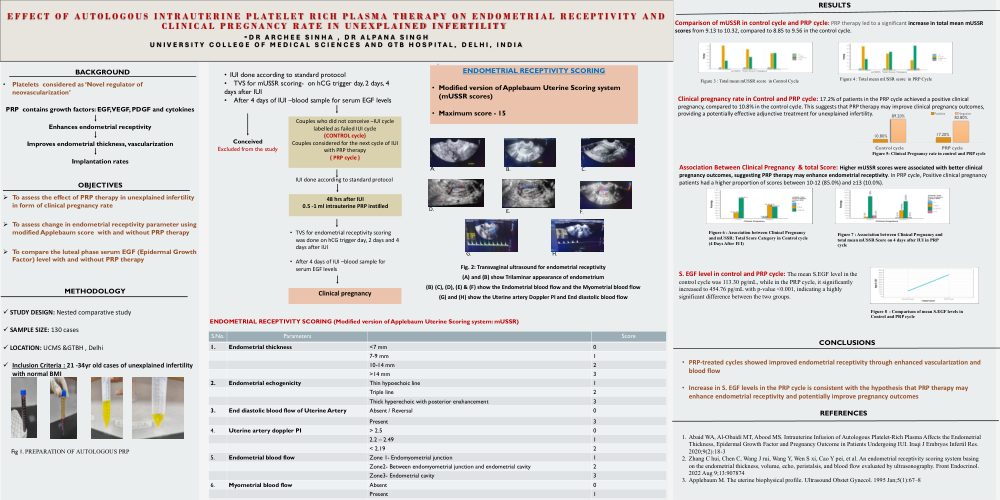
EFFECT OF AUTOLOGOUS INTRAUTERINE PLATELET RICH PLASMA THERAPY ON ENDOMETRIAL RECEPTIVITY AND CLINICAL PREGNANCY RATE IN UNEXPLAINED INFERTILITY
-Dr archee Sinha , dr alpana singh
university college of medical sciences and GTB hospital, delhi, india
BACKGROUND
PRP contains growth factors: EGF, VEGF, PDGF and cytokines
Enhances endometrial receptivity
Improves endometrial thickness, vascularization
Implantation rates
OBJECYIVES-
METHODOLOGY
ENDOMETRIAL RECEPTIVITY SCORING
Comparison of mUSSR in control cycle and PRP cycle: PRP therapy led to a significant increase in total mean mUSSR scores from 9.13 to 10.32, compared to 8.85 to 9.56 in the control cycle.
Clinical pregnancy rate in Control and PRP cycle: 17.2% of patients in the PRP cycle achieved a positive clinical pregnancy, compared to 10.8% in the control cycle. This suggests that PRP therapy may improve clinical pregnancy outcomes, providing a potentially effective adjunctive treatment for unexplained infertility.
Association Between Clinical Pregnancy & total Score: Higher mUSSR scores were associated with better clinical pregnancy outcomes, suggesting PRP therapy may enhance endometrial receptivity. In PRP cycle, Positive clinical pregnancy patients had a higher proportion of scores between 10-12 (85.0%) and ≥13 (10.0%).
S. EGF level in control and PRP cycle: The mean S.EGF level in the control cycle was 113.30 pg/mL, while in the PRP cycle, it significantly increased to 454.76 pg/mL with p-value <0.001, indicating a highly significant difference between the two groups.
CONCLUSIONS