2,281 posters, 63 videos, 56 audios, 43 topics, 18 sessions, 6,174 authors, 2,323 institutions
ePostersLive by SciGen Technologies S.A. All rights reserved.
RCOG World Congress 2025
June 23 - 25, 2025 | ExCeL London, UK
EP.0200
A rare case of a Recurrent Tubal Stump Ruptured Ectopic pregnancy
Poster Presenter
Authors
Affiliations
Part of Topic
Early pregnancy complications/early pregnancy and acute gynaecology
A rare case of Recurrent Tubal Stump Ruptured Ectopic Pregnancy
M. Mouhajer¹
1. MEDWAY NHS FOUNDATION TRUST, OBSTETRICS AND GYNAECOLOGY, KENT, UNITED KINGDOM
CASE REPORT
33-year-old, P3+2, 3 previous caesarean deliveries, 1 previous termination of pregnancy and 1 previous ectopic pregnancy, managed by left salpingectomy 5 years ago. She was unsure of her last menstrual period. She presented with 4 days of worsening lower abdominal pain with mild spotting. Urine pregnancy test was positive.
Examination revealed a haemodynamically stable patient with marked lower abdominal tenderness, rebound tenderness and guarding. An urgent ultrasound scan showed an empty uterus with a homogenous mass in the right adnexa and hemoperitoneum. Patient underwent urgent laparoscopy for a suspected ruptured ectopic pregnancy.
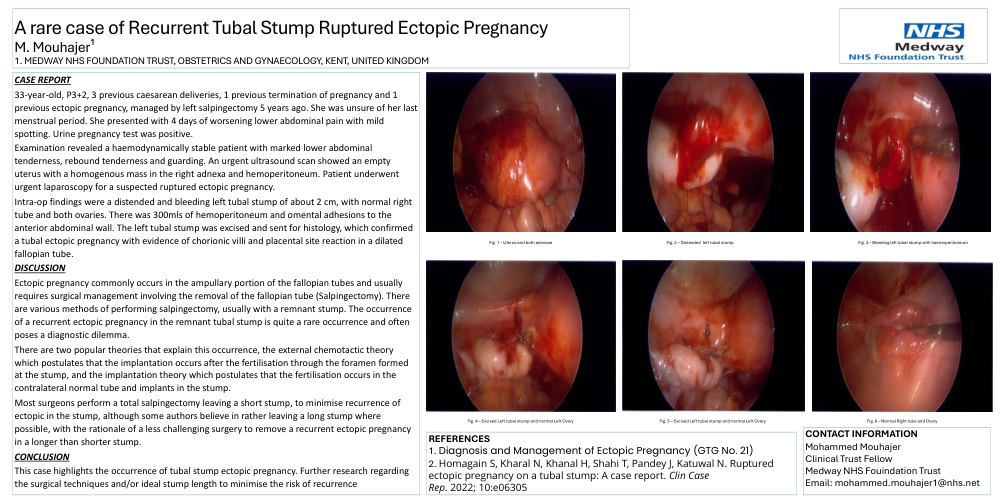
Intra-op findings were a distended and bleeding left tubal stump of about 2 cm, with normal right tube and both ovaries. There was 300mls of hemoperitoneum and omental adhesions to the anterior abdominal wall. The left tubal stump was excised and sent for histology, which confirmed a tubal ectopic pregnancy with evidence of chorionic villi and placental site reaction in a dilated fallopian tube.
DISCUSSION
Ectopic pregnancy commonly occurs in the ampullary portion of the fallopian tubes and usually requires surgical management involving the removal of the fallopian tube (Salpingectomy). There are various methods of performing salpingectomy, usually with a remnant stump. The occurrence of a recurrent ectopic pregnancy in the remnant tubal stump is quite a rare occurrence and often poses a diagnostic dilemma.
There are two popular theories that explain this occurrence, the external chemotactic theory which postulates that the implantation occurs after the fertilisation through the foramen formed at the stump, and the implantation theory which postulates that the fertilisation occurs in the contralateral normal tube and implants in the stump.
Most surgeons perform a total salpingectomy leaving a short stump, to minimise recurrence of ectopic in the stump, although some authors believe in rather leaving a long stump where possible, with the rationale of a less challenging surgery to remove a recurrent ectopic pregnancy in a longer than shorter stump.
CONCLUSION
This case highlights the occurrence of tubal stump ectopic pregnancy. Further research regarding the surgical techniques and/or ideal stump length to minimise the risk of recurrence