2,281 posters, 63 videos, 56 audios, 43 topics, 18 sessions, 6,174 authors, 2,323 institutions
ePostersLive by SciGen Technologies S.A. All rights reserved.
RCOG World Congress 2025
June 23 - 25, 2025 | ExCeL London, UK
EP.2003
Evaluating Machine Learning Predictions in PCOS: A Step Towards Advanced Fertility Solutions.
Poster Presenter
Authors
Affiliations
Part of Topic
Reproductive medicine/assisted reproduction
Evaluating Machine Learning Predictions in PCOS: A Step Towards Advanced Fertility Solutions.
Mr. Mikaiel Shuaib1, Dr. Yusuf Beebeejaun1, Dr. James Duffy2
1King’s College London, London, United Kingdom
2Barts Health NHS Trust, London, United Kingdom
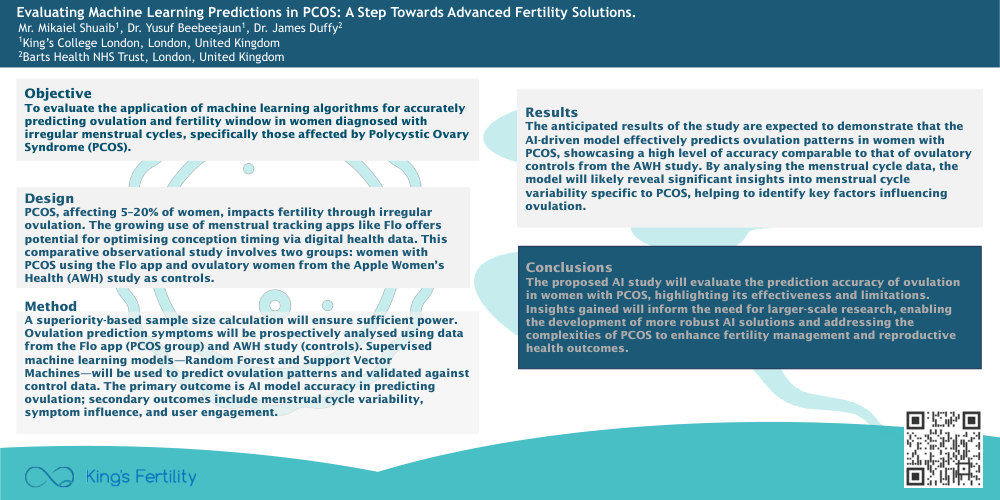
Objective
To evaluate the application of machine learning algorithms for accurately predicting ovulation and fertility window in women diagnosed with irregular menstrual cycles, specifically those affected by Polycystic Ovary Syndrome (PCOS).
Results
The anticipated results of the study are expected to demonstrate that the AI-driven model effectively predicts ovulation patterns in women with PCOS, showcasing a high level of accuracy comparable to that of ovulatory controls from the AWH study. By analysing the menstrual cycle data, the model will likely reveal significant insights into menstrual cycle variability specific to PCOS, helping to identify key factors influencing ovulation.
Design
PCOS, affecting 5–20% of women, impacts fertility through irregular ovulation. The growing use of menstrual tracking apps like Flo offers potential for optimising conception timing via digital health data. This comparative observational study involves two groups: women with PCOS using the Flo app and ovulatory women from the Apple Women’s Health (AWH) study as controls.
Conclusions
The proposed AI study will evaluate the prediction accuracy of ovulation in women with PCOS, highlighting its effectiveness and limitations. Insights gained will inform the need for larger-scale research, enabling the development of more robust AI solutions and addressing the complexities of PCOS to enhance fertility management and reproductive health outcomes.
Method
A superiority-based sample size calculation will ensure sufficient power. Ovulation prediction symptoms will be prospectively analysed using data from the Flo app (PCOS group) and AWH study (controls). Supervised machine learning models—Random Forest and Support Vector Machines—will be used to predict ovulation patterns and validated against control data. The primary outcome is AI model accuracy in predicting ovulation; secondary outcomes include menstrual cycle variability, symptom influence, and user engagement.