2,281 posters, 63 videos, 56 audios, 43 topics, 18 sessions, 6,174 authors, 2,323 institutions
ePostersLive by SciGen Technologies S.A. All rights reserved.
RCOG World Congress 2025
June 23 - 25, 2025 | ExCeL London, UK
EP.2002
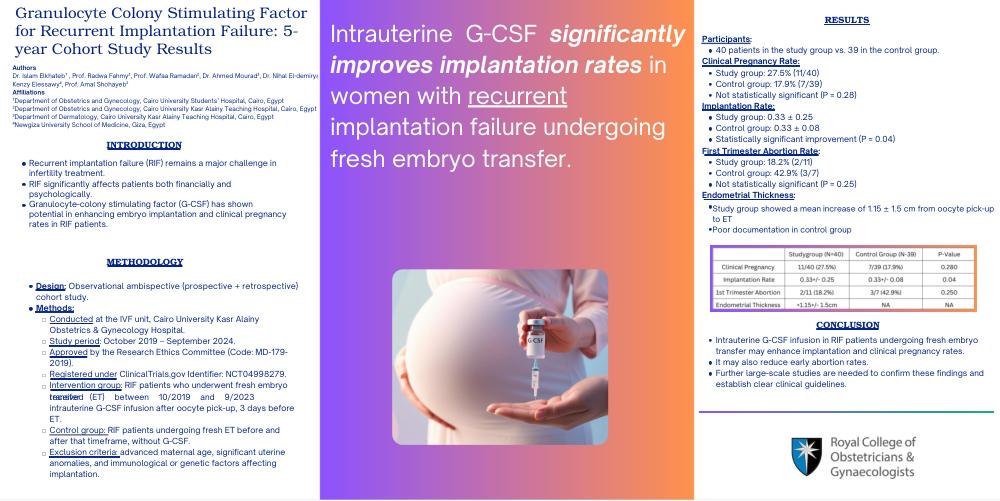
Granulocyte Colony Stimulating Factor for Recurrent Implantation Failure: 5-year Cohort Study Results
Poster Presenter
Authors
Islam Elkhateb, Radwa Fahmy, Wafaa Ramadan, Ahmed Mourad, Nihal El-demiry, Kenzy Elessawy, Amal Shohayeb
Affiliations
Department of Obstetrics and Gynecology, Cairo University Students’ Hospital, Department of Obstetrics and Gynaecology, Cairo University Kasr Alainy Teaching Hospital, Department of Dermatology, Cairo University Kasr Alainy Teaching Hospital, Newgiza University School of Medicin
Part of Topic
Reproductive medicine/assisted reproduction
Granulocyte Colony Stimulating Factor for Recurrent Implantation Failure: 5- year Cohort Study Results
Authors Dr. Islam Elkhateb¹ , Prof. Radwa Fahmy², Prof. Wafaa Ramadan², Dr. Ahmed Mourad³, Dr. Nihal El-demiry, ²
Kenzy Elessawy⁴, Prof. Amal Shohayeb² Affiliations ¹Department of Obstetrics and Gynecology, Cairo University Students’ Hospital, Cairo, Egypt ²Department of Obstetrics and Gynecology, Cairo University Kasr Alainy Teaching Hospital, Cairo, Egypt ³Department of Dermatology, Cairo University Kasr Alainy Teaching Hospital, Cairo, Egypt ⁴Newgiza University School of Medicine, Giza, Egypt
INTRODUCTION
Recurrent implantation failure (RIF) remains a major challenge in infertility treatment. RIF significantly affects patients both financially and psychologically. Granulocyte-colony stimulating factor (G-CSF) has shown potential in enhancing embryo implantation and clinical pregnancy rates in RIF patients.
METHODOLOGY
Design: Observational ambispective (prospective + retrospective) cohort study.
Methods:
Conducted at the IVF unit, Cairo University Kasr Alainy
Obstetrics & Gynecology Hospital.
Study period: October 2019 – September 2024.
Approved by the Research Ethics Committee (Code: MD-179-
2019).
Registered under ClinicalTrials.gov Identifier: NCT04998279.
Intervention group: RIF patients who underwent fresh embryo
transfer (ET) between 10/2019 and 9/2023
received intrauterine G-CSF infusion after oocyte pick-up, 3 days before ET. Control group: RIF patients undergoing fresh ET before and after that timeframe, without G-CSF. Exclusion criteria: advanced maternal age, significant uterine anomalies, and immunological or genetic factors affecting implantation.
Intrauterine G-CSF significantly improves implantation rates in women with recurrent implantation failure undergoing fresh embryo transfer.
RESULTS
Participants:
40 patients in the study group vs. 39 in the control group. Clinical Pregnancy Rate:
Study group: 27.5% (11/40)
Control group: 17.9% (7/39)
Not statistically significant (P = 0.28) Implantation Rate:
Study group: 0.33 ± 0.25
Control group: 0.33 ± 0.08
Statistically significant improvement (P = 0.04) First Trimester Abortion Rate:
Study group: 18.2% (2/11)
Control group: 42.9% (3/7)
Not statistically significant (P = 0.25) Endometrial Thickness:
Study group showed a mean increase of 1.15 ± 1.5 cm from oocyte pick-up to ET Poor documentation in control group
CONCLUSION
Intrauterine G-CSF infusion in RIF patients undergoing fresh embryo transfer may enhance implantation and clinical pregnancy rates. It may also reduce early abortion rates. Further large-scale studies are needed to confirm these findings and establish clear clinical guidelines.