2,281 posters, 63 videos, 56 audios, 43 topics, 18 sessions, 6,174 authors, 2,323 institutions
ePostersLive by SciGen Technologies S.A. All rights reserved.
RCOG World Congress 2025
June 23 - 25, 2025 | ExCeL London, UK
EP.2001
Comparison of Gender-Based Delay in the Diagnosis and Management of Adnexal Torsion:
Poster Presenter
Part of Topic
Reproductive medicine/assisted reproduction
Comparison of Gender-Based Delay in the Diagnosis and Management of Adnexal Torsion: A Retrospective Cohort Study at Sultan Qaboos University Hospital, Oman.
Maisa Khalifa Al Falahi, Maryam Al Shukri, Khurram Siddiqui, vaidyanathan Gowri
Background:
Adnexal torsion is an emergency in both genders. Torsion of testis or ovary leads to vascular compromise. Delayed diagnosis can result in ischemia, infarction, and loss of gonadal function. Though adnexal torsion predominantly affects females and males of reproductive age, there is limited research comparing diagnostic delays and management outcomes based on gender. This study aims to analyze gender-based disparities in the diagnosis and management of adnexal torsion and to identify factors contributing to delays in treatment.
Methods:
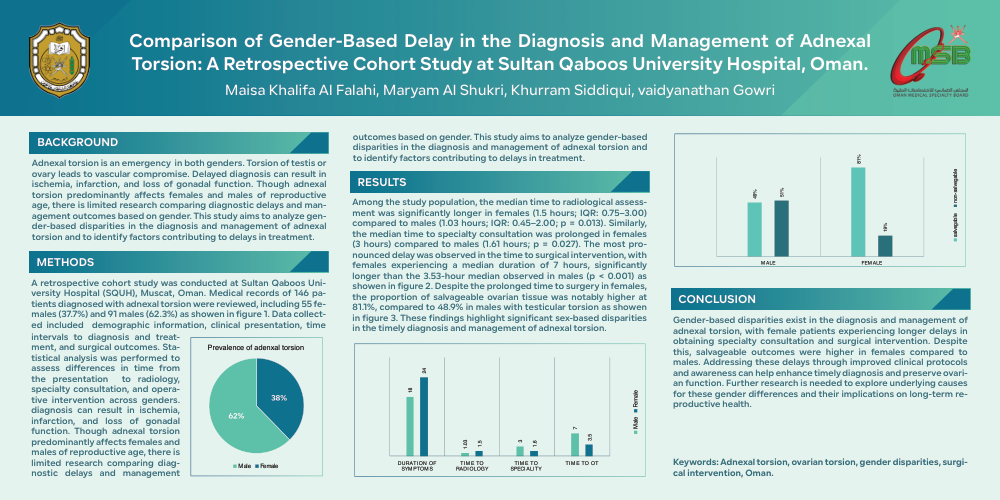
A retrospective cohort study was conducted at Sultan Qaboos University Hospital (SQUH), Muscat, Oman. Medical records of 146 patients diagnosed with adnexal torsion were reviewed, including 55 females (37.7%) and 91 males (62.3%) as showen in figure 1. Data collected included demographic information, clinical presentation, time intervals to diagnosis and treatment, and surgical outcomes. Statistical analysis was performed to assess differences in time from the presentation to radiology, specialty consultation, and operative intervention across genders.
Results:
Among the study population, the median time to radiological assessment was significantly longer in females (1.5 hours; IQR: 0.75–3.00) compared to males (1.03 hours; IQR: 0.45–2.00; p = 0.013). Similarly, the median time to specialty consultation was prolonged in females (3 hours) compared to males (1.61 hours; p = 0.027). The most pronounced delay was observed in the time to surgical intervention, with females experiencing a median duration of 7 hours, significantly longer than the 3.53-hour median observed in males (p < 0.001) as showen in figure 2. Despite the prolonged time to surgery in females, the proportion of salvageable ovarian tissue was notably higher at 81.1%, compared to 48.9% in males with testicular torsion as showen in figure 3. These findings highlight significant sex-based disparities in the timely diagnosis and management of adnexal torsion.
Conclusion:
Gender-based disparities exist in the diagnosis and management of adnexal torsion, with female patients experiencing longer delays in obtaining specialty consultation and surgical intervention. Despite this, salvageable outcomes were higher in females compared to males. Addressing these delays through improved clinical protocols and awareness can help enhance timely diagnosis and preserve ovarian function. Further research is needed to explore underlying causes for these gender differences and their implications on long-term reproductive health.
Keywords: Adnexal torsion, ovarian torsion, gender disparities, surgical intervention, Oman.