2,281 posters, 63 videos, 56 audios, 43 topics, 18 sessions, 6,174 authors, 2,323 institutions
ePostersLive by SciGen Technologies S.A. All rights reserved.
RCOG World Congress 2025
June 23 - 25, 2025 | ExCeL London, UK
EP.2000
Comparison of Transvaginal and Transabdominal Ultrasound-Guided Approaches for Embryo Transfer
Poster Presenter
Authors
Affiliations
Part of Topic
Reproductive medicine/assisted reproduction
Comparison of Transvaginal and Transabdominal Ultrasound-Guided Approaches for Embryo Transfer
Aisha Anwar1,2, Lewis Nancarrow2, Nicola Tempest1,2
1. Department of Women’s and Children’s Health, University of Liverpool 2. Hewitt Fertility Centre, Liverpool Women’s Hospital
BACKGROUND
- Infertility is defined as failure to conceive after 1 year of unprotected intercourse.
- VF involves fertilising eggs in a lab and placing embryos into the uterus via embryo transfer (ET) using a catheter through the cervix.
- UK live birth rate (LBR) per ET remains low (~27%; HFEA 2023).
- The clinical touch technique (CTT) has largely been replaced by ultrasound-guided ET (USGET). NICE (2004) recommended USGET due to improved outcomes (OR 1.47; 95% CI 1.30–1.65) (Brown 2016, Tyler 2022), though a large RCT found no LBR benefit (Drakeley 2008).
ET techniques vary across the UK including catheter type and ultrasound approach —transvaginal (TVUSG) versus transabdominal (TAUSG).
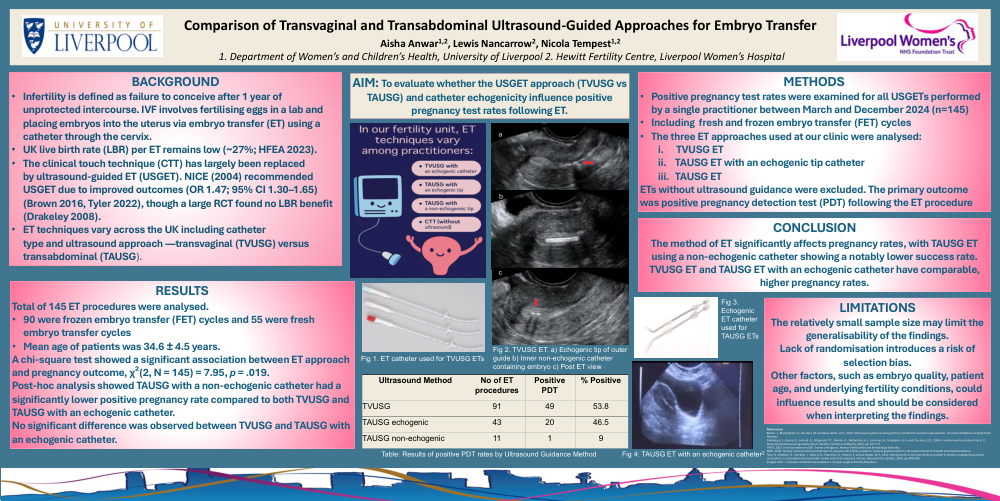
ET approaches Used in our fertility unit:
- TVUSG ET
- TAUSG ET with an echogenic tip catheter
- TAUSG ET with a non-echogenic tip catheter
- CTT (without ultrasound)
AIM
To evaluate whether the USGET approach (TVUSG vs TAUSG) and catheter echogenicity influence positive pregnancy test rates following ET.
METHODS
•Positive pregnancy test rates were examined for all USGETs performed by a single practitioner between March and December 2024 (n=145)
•Including fresh and frozen embryo transfer (FET) cycles
•The three ET approaches used at our clinic were analysed:
i. TVUSG ET
ii. TAUSG ET with an echogenic tip catheter
iii. TAUSG ET
ETs without ultrasound guidance were excluded. The primary outcome was positive pregnancy detection test (PDT) following the ET procedure
RESULTS
Total of 145 ET procedures were analysed.
•90 were frozen embryo transfer (FET) cycles and 55 were fresh embryo transfer cycles
•Mean age of patients was 34.6 ± 4.5 years.
A chi-square test showed a significant association between ET method and pregnancy outcome, χ²(2, N = 145) = 7.95, p = .019. Post-hoc analysis showed TAUSG with a non-echogenic catheter had a significantly lower positive pregnancy rate compared to both TVUSG and TAUSG with an echogenic catheter.
No significant difference was observed between TVUSG and TAUSG with an echogenic catheter.
CONCLUSION
The method of ET significantly affects pregnancy rates, with TAUSG ET using a non-echogenic catheter showing a notably lower success rate.
TVUSG ET and TAUSG ET with an echogenic catheter have comparable, higher pregnancy rates.
LIMITATIONS
The relatively small sample size may limit the generalisability of the findings.
Lack of randomisation introduces a risk of selection bias.
Other factors, such as embryo quality, patient age, and underlying fertility conditions, could influence results and should be considered when interpreting the findings.